
Written by:

Last Published:
22 January 2026
•
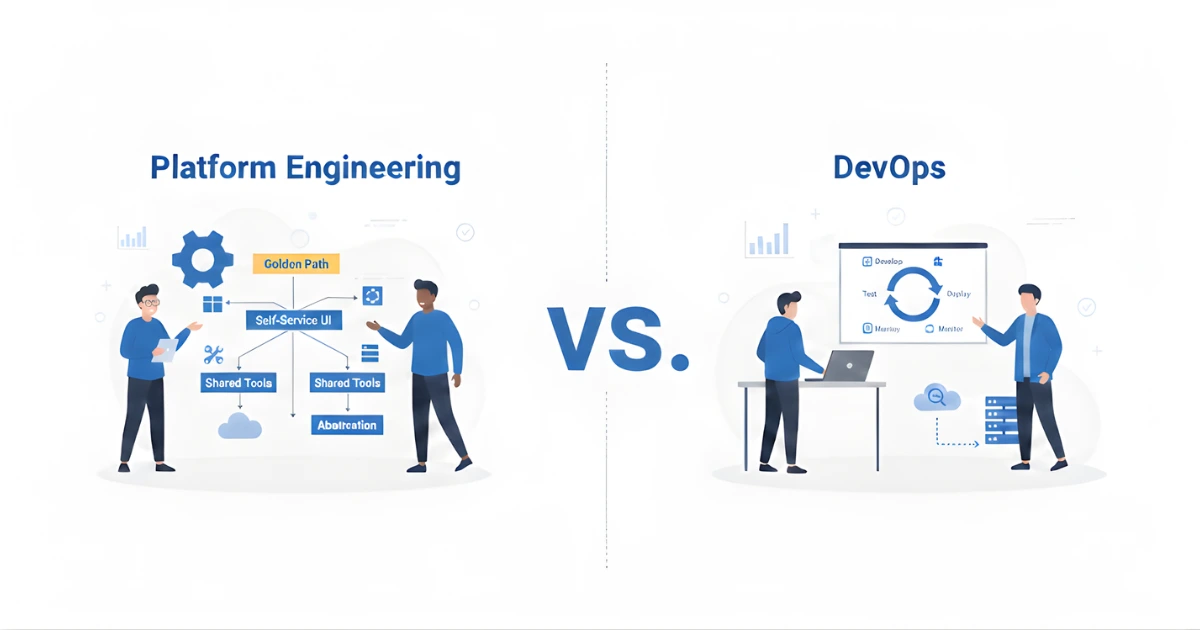
Platform Engineering vs DevOps is a common comparison for teams scaling modern software delivery.
DevOps aims to improve collaboration and automation, while Platform Engineering builds internal platforms to standardise and simplify how developers build, deploy, and run software.
Knowing the differences between Platform Engineering and DevOps helps engineering leaders pick the best approach for their team’s size, complexity, and stage of delivery.
Platform Engineering and DevOps focus on different parts of software delivery, even though both aim for automation, faster releases, and higher quality.
DevOps is a cultural and methodological approach that unites software development (Dev) and IT operations (Ops). It emerged to break down organisational silos, promote collaboration, and automate the software delivery lifecycle so teams can ship software more frequently and reliably.
DevOps focuses on practices such as continuous integration, continuous deployment (CI/CD), infrastructure automation and shared responsibility.
Platform Engineering is a specialised field that builds on DevOps by creating internal platforms and self-service tools. Platform engineers treat these platforms like products, they design, build, and maintain toolchains, APIs, environments, and workflows, often called Internal Developer Platforms (IDPs).
These platforms hide complexity and let developers focus on writing code instead of managing infrastructure.
In essence:
Forbes highlights that Platform Engineering is emerging as organisations scale and require internal platforms to simplify operations and maintain developer velocity.
Many organisations start with DevOps and later adopt Platform Engineering to scale automation and developer productivity.
You might need to make this shift if your team is growing, managing many development environments is getting harder, or you need more standardisation across services.
Leaders watch for these signs to know when a more structured approach like Platform Engineering could help their organisation scale and work more efficiently.
DevOps is a set of practices and cultural values that help development and operations teams work together. This leads to faster, more reliable, and scalable software delivery. DevOps is about how teams work together throughout the software delivery process.
DevOps is all about automation, shared ownership, and always improving. Teams that use DevOps try to cut down on manual steps, remove bottlenecks, and make feedback between code changes and production faster.
According to Amazon Web Services, DevOps enables organisations to “deliver applications and services at high velocity” by evolving and improving products faster than traditional development models.
While responsibilities vary by organisation, DevOps practices typically cover:
- Continuous Integration and Continuous Delivery (CI/CD)
Automating code integration, testing, and deployment to reduce release risk and accelerate delivery.
- Infrastructure Automation
Managing infrastructure using Infrastructure as Code (IaC) to ensure consistency, repeatability, and scalability.
- Monitoring, Logging, and Observability
Ensuring applications are reliable and performant through real-time metrics, logs, and alerts.
- Incident Response and Reliability
Supporting uptime, troubleshooting failures, and improving systems through post-incident reviews.
- Security Integration (DevSecOps)
Embedding security checks into pipelines and workflows rather than treating security as a final gate.
DevOps doesn’t get rid of operational complexity; it spreads the responsibility for it. As teams and systems grow, this shared ownership can be hard to scale, which is why many organisations later look into Platform Engineering.
Platform Engineering is about designing, building, and maintaining internal platforms so development teams can deliver software quickly and safely without handling complex infrastructure themselves. It turns many DevOps capabilities into a dedicated, reusable platform.
The core of Platform Engineering is the Internal Developer Platform (IDP). An IDP gives developers self-service access to infrastructure, deployment workflows, and tools through clear interfaces, APIs, and templates. This helps reduce developer workload and ensures security, reliability, and compliance.
Internal platforms allow developers to focus on coding, while the platform team handles complex operational tasks.
Unlike DevOps, which spreads responsibility across teams, Platform Engineering has a dedicated platform team that works like an internal product group. This team treats developers as customers and focuses on making things easy to use, consistent, and scalable for the long term.
Platform Engineering typically includes:
- Self-Service Infrastructure and Environments
Developers can provision environments, services, and resources on demand without manual approvals or deep infrastructure knowledge.
- Golden Paths and Standardised Workflows
Opinionated, well-supported paths for building, deploying, and operating services that encode best practices by default.
- Abstraction of Complexity
The platform hides underlying cloud, Kubernetes, and tooling complexity behind consistent interfaces, reducing duplication across teams.
- Security and Compliance by Design
Policies, access controls, and guardrails are built into the platform rather than enforced manually or retroactively.
Platform Engineering doesn’t replace DevOps principles; it builds on them. Most organisations start with DevOps and move to Platform Engineering as they add more teams, services, and operational needs.
Example
Spotify’s internal developer platform, Backstage, is one of the most cited real‑world Platform Engineering implementations:

Platform Engineering and DevOps both aim to help teams deliver software faster and more reliably, but they differ in focus, ownership, and results.
According to Google Cloud, Platform Engineering emerged as a response to the challenges organisations face when DevOps practices are applied independently by many teams, leading to tool sprawl and inconsistent standards. A central platform helps standardise these capabilities while preserving team autonomy.
Similarly, the Cloud Native Computing Foundation (CNCF) highlights that Platform Engineering enables teams to “pave golden paths” that encode best practices, allowing developers to move faster without sacrificing reliability or security.
In short:
DevOps isn’t just one role or team. It’s a set of responsibilities shared by development and operations teams. The goal is to build a culture of collaboration, automation, and ongoing improvement throughout software delivery.
1. DevOps Engineer / Automation Engineer
2. Release Manager / Deployment Specialist
3. Site Reliability Engineer (SRE) (sometimes overlaps with DevOps)
4. Security and Compliance (DevSecOps)
Platform Engineering brings in a dedicated team to build and maintain an Internal Developer Platform (IDP). This helps standardise infrastructure, tools, and workflows across many development teams.
Unlike DevOps, which spreads out responsibilities, Platform Engineering centralises them to boost productivity, scalability, and consistency.
1. Platform Engineer / Infrastructure Product Engineer
2. Developer Experience (DX) Specialist
3. Platform Security & Compliance Lead
4. Platform Operations / Reliability Engineer
DevOps is a good fit for organisations that want better collaboration, automation, and faster delivery, but don’t need a dedicated platform team. It works best for small to medium teams and simple delivery pipelines.
1. Small to Mid-Sized Team
2. Early-Stage or Growing Organisations
3. Standardisation Through Practices, Not Platforms
4. Cloud Migration or Modernisation Projects
Platform Engineering is essential when an organisation outgrows what standard DevOps can handle. It centralises tooling, infrastructure, and workflows, helping large engineering teams keep up their speed, reliability, and consistency.
1. Large or Scaling Teams
2. High Operational Complexity
3. Developer Productivity Challenges
4. Need for Standardisation and Compliance
5. Scaling Automation Across Teams
Yes, Platform Engineering and DevOps work well together. DevOps sets up the culture, automation, and collaboration for software delivery, while Platform Engineering formalises and scales these abilities across the organisation.
1. DevOps as the Foundation
2. Platform Engineering as an Extension
3. Improved Developer Experience
4. Scaling Across Teams
No, Platform Engineering isn’t replacing DevOps. Instead, it builds on and scales DevOps practices for larger, more complex organisations. DevOps is about culture, collaboration, and automation, while Platform Engineering adds the tools, workflows, and self-service options to make these practices repeatable and scalable.
1. DevOps Principles Remain Essential
2. Platform Engineering is an Evolution, Not a Replacement
3. Collaboration Continues Across Teams
Choosing between Platform Engineering and DevOps isn’t about picking just one. It’s about knowing your organisation’s size, complexity, and delivery needs, and deciding how to scale effectively.
1. Team Size and Structure
2. Operational Complexity
3. Developer Productivity and Cognitive Load
4. Delivery Frequency and Scalability
5. Compliance and Security Requirements
DevOps builds the foundation with collaboration and automation. Platform Engineering then scales these practices using internal platforms and self-service workflows.
Looking to streamline delivery and boost developer productivity? Contact our team to learn how DevOps and Platform Engineering can work together for your organisation.

DevOps focuses on collaboration, automation, and continuous delivery practices, while Platform Engineering creates internal platforms to standardise workflows and scale developer productivity.
No. Platform Engineering builds on DevOps practices, scaling them across teams through self-service platforms and golden paths, without replacing DevOps' cultural principles.
Yes. DevOps provides the foundational practices, tools, and automation that Platform Engineering formalises and scales for larger teams or more complex systems.
It reduces developer cognitive load, enforces consistent standards, automates repetitive tasks, and improves scalability across multiple teams.
Absolutely. DevOps sets the culture and automation, while Platform Engineering provides self-service platforms, standardised workflows, and internal tools to extend those practices.
Organisations typically adopt Platform Engineering when teams grow, delivery complexity increases, or a consistent developer experience and scalability become critical.
Key roles include platform engineers, developer experience specialists, platform security and compliance leads, and platform reliability engineers who maintain the internal platform as a product.
Alexandra Mendes is a Senior Growth Specialist at Imaginary Cloud with 3+ years of experience writing about software development, AI, and digital transformation. After completing a frontend development course, Alexandra picked up some hands-on coding skills and now works closely with technical teams. Passionate about how new technologies shape business and society, Alexandra enjoys turning complex topics into clear, helpful content for decision-makers.
People who read this post, also found these interesting:

















.webp)
.webp)


