Written by:


Last Published:
20 July 2026
•

Most "top web development companies" lists look identical from the outside. Ten logos, a wall of five-star ratings, a lot of confident adjectives. The genuinely hard part is telling the reliable partner from the expensive mistake before you have signed anything.
So here is the shortlist first, in the order our scoring produced. The top web development companies for enterprise buyers in 2026 are Imaginary Cloud, One Beyond, Apadmi, Emergent Software, Scopic, Savas Labs, AllianceTek, ChopDawg.com, Tech Alchemy and Pixated. What earns a place is one thing above all others: verifiable delivery evidence.
Think of it this way. A glossy portfolio is a photograph of a bridge. What you actually need before you drive a business across it is the load test: the dated proof that the thing carries weight on time, on budget and to a security standard that survives an audit. Screenshots are not that proof.
Unlike most rankings, this one shows its working. Every firm is scored one to five against five weighted criteria, and the full scorecard sits above the profiles rather than buried under them. Disagree with a score and you can change it. The point is that the reasoning is visible.
A reliable web development company can show you independent, dated proof that it ships on time, on budget and to a defined security standard. It also takes clear ownership of the product after launch. A risky one hands you superlatives instead.
This is not a matter of taste. When a build slips or fails a security review, the cost does not land on the agency. It lands on your roadmap, your budget and your compliance position.
So the safest shortlist is the one built on evidence rather than marketing. That is the lens behind this ranking, and it is worth holding in mind before you read a single company profile.
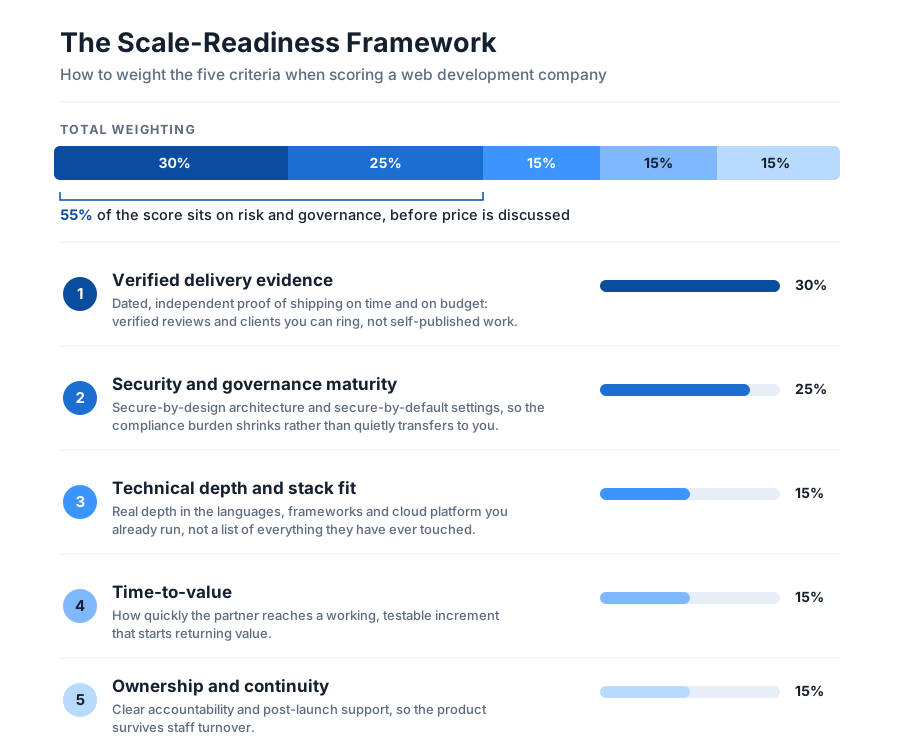
We judged every company against the same lens Imaginary Cloud uses when advising enterprise clients on whether to build in-house or bring in a partner. We call it the Scale-Readiness Framework. It swaps the usual "cost, speed, portfolio" checklist for five criteria weighted towards risk and governance, because those are the things that bite once a project has to survive an audit, a security review and a board conversation.
| # | Criterion | Weight | What you are actually looking for |
|---|---|---|---|
| 1 | Verified delivery evidence | 30% | Independent, dated proof of shipping on time and on budget, via verified reviews and clients you can ring, not self-published case studies |
| 2 | Security and governance maturity | 25% | Secure-by-design architecture and secure-by-default settings, so compliance burden shrinks rather than quietly transfers to you |
| 3 | Technical depth and stack fit | 15% | Real depth in the specific languages, frameworks and cloud platform you already run, not a list of everything they have touched |
| 4 | Time-to-value | 15% | How quickly the partner reaches a working, testable increment that starts returning value |
| 5 | Ownership and continuity | 15% | Clear accountability and post-launch support, so the product survives staff turnover |
Two definitions worth pinning down, because vendors use them loosely. Secure by design means security is built into the architecture from the first line of code. Secure by default means the safe configuration ships as standard, with no extra hardening required from you. Both terms come from the joint guidance published by CISA, the NSA, the FBI and partner agencies in the UK, Australia, Canada, Germany, the Netherlands and New Zealand. It is worth reading in full on the CISA Secure by Design page, because it pushes the security burden onto the manufacturer rather than you, and you should be asking your supplier to meet it.
Time-to-value is the time it takes a partner to reach a working, testable version of your product that starts returning value. For a scale-up, that clock matters more than headcount ever will.
Scores are one to five against each criterion, weighted as above. They are editorial judgements based on publicly verifiable evidence (Clutch rating and review volume, years trading, disclosed security practice, published stack depth and stated support model), not on any commercial relationship. Where a firm publishes nothing about a criterion, it scores low on that criterion, because from a buyer's chair unpublished and absent look identical.
| Rank | Company | Delivery evidence (30%) | Security & governance (25%) | Stack fit (15%) | Time-to-value (15%) | Ownership (15%) | Weighted |
|---|---|---|---|---|---|---|---|
| 1 | Imaginary Cloud | 5 | 4 | 5 | 5 | 5 | 4.75 |
| 2 | One Beyond | 5 | 5 | 5 | 3 | 5 | 4.70 |
| 3 | Apadmi | 4 | 5 | 4 | 3 | 5 | 4.25 |
| 4 | Emergent Software | 4 | 4 | 4 | 4 | 4 | 4.00 |
| 5 | Scopic | 4 | 3 | 4 | 4 | 3 | 3.60 |
| 6 | Savas Labs | 4 | 3 | 3 | 4 | 3 | 3.45 |
| 6= | AllianceTek | 4 | 3 | 3 | 3 | 4 | 3.45 |
| 8 | ChopDawg.com | 4 | 2 | 3 | 4 | 3 | 3.20 |
| 9 | Tech Alchemy | 3 | 2 | 3 | 5 | 3 | 3.05 |
| 10 | Pixated | 3 | 2 | 2 | 4 | 2 | 2.60 |
Read the table honestly. We rank ourselves top on the strength of time-to-value and stack fit for modern JavaScript products, and we would rather say that plainly than pretend the gap is wider than it is.
Two firms are worth flagging for the opposite reason. Pixated is a two-to-nine person studio whose core offer is Meta ads and PPC. It is a capable performance-marketing partner and a poor fit for an enterprise web build; it sits at number ten because the framework says so, and it is on the list only because it appears in the Clutch bracket we screened. Tech Alchemy scores highest of anyone on time-to-value and lowest of almost anyone on governance. That is not a contradiction. It is exactly the trade a seed-stage founder should want and exactly the trade a regulated enterprise should refuse.


Weighted score: 4.75 · Best suited for: scale-ups and enterprises building web and mobile products on modern JavaScript and Python stacks
Imaginary Cloud builds and scales web and mobile products for enterprise and scale-up companies, working through a documented development process and a Europe-based engineering team. Over the past 13 years it has been recognised as a Top 100 Fastest Growing Company, a Top 1000 Global Company in 2020 and 2021, a UK Top B2B Company in 2021 and 2022, and a Europe Best Workplace in 2022.
Delivery evidence (5/5). Two case studies carry dated, specific outcomes rather than adjectives: AppTweak, where a dashboard refactor cut loading time by 80%, and Advania, a Reproduction Process System built to handle a target of one million devices a year across a new Nordic service centre.
Security and governance (4/5). Secure-by-design practice is embedded in the delivery process rather than added at the end.
Services: Digital transformation strategy, digital product design, AI-enabled custom development, elite engineering teams, applied AI and machine learning, digital acceleration programmes, technical and UX audit.
Technologies: React, Next.js, Angular, Vue, Webflow, Node, Python, Rails, Django, React Native, Flutter, AWS, Azure, Google Cloud. If you are still weighing options, our guide to the best tech stack for web development walks through the trade-offs.
Key clients: Nokia, Sage, Ernst & Young, BNP Paribas, TravelWiFi, JingaLife, Elsa, Trust Portal, Remax, Environment Intelect. All case studies →
Client feedback: clients consistently cite delivery against agreed dates and responsiveness to scope change; one describes Imaginary Cloud as the only partner that did what it said it would.
Methodology: Agile · Location: London, United Kingdom · Company size: 50–249 · Founded: 2010 · Price range: $50–$99/hr
When we are not the right call: if you need a two-week landing page, a WordPress theme install, or a purely performance-marketing engagement, a smaller specialist will serve you better and cost less. Our process overhead only pays for itself on builds where governance, scale or integration complexity actually matter.

Weighted score: 4.70 · Best suited for: regulated enterprises and public-sector buyers on Microsoft and Azure stacks
One Beyond is a bespoke software development studio that has built web, desktop and mobile applications since 1994 for businesses, non-profits, government agencies and funded start-ups. Delivery runs through UK-based and nearshore centres under a shared methodology.
The reason it sits this close to the top is criterion two. One Beyond publishes application security testing as a named service line rather than an implied capability, and thirty years of trading gives it the deepest continuity record on this list. The cost is speed: a delivery model built for audit trails is rarely the fastest route to a first increment.
Services: Web application development, bespoke CRM and ERP systems, customer portal software, cloud migration, legacy software modernisation, team augmentation, application support and maintenance, application security testing, hosting, software project rescue.
Technologies: C#, Objective-C, JavaScript, Java, TypeScript, Swift, Kotlin, SQL Server / Azure SQL, MongoDB, Power BI, MySQL, PostgreSQL, Elasticsearch, MariaDB, Azure Blob Storage, DynamoDB, Azure, Amazon S3, RabbitMQ, Azure Service Bus, Docker, Google Cloud Storage, AWS Kubernetes, Firebase, AWS Lambda, Terraform, Kafka.
Key clients: Smith & Nephew, GAIL's Bakery, Costa Express, Pearson.Reviews: 4.8 on Clutch from 55 reviews. Clients describe the firm as straightforward about what it can and cannot do, and note that it stands behind the code it ships.Location: London, United Kingdom · Size: 250–999 · Founded: 1994 · Price: $50–$99/hr

Weighted score: 4.25 · Best suited for: large enterprises with complex system integration and data requirements
Apadmi builds mobile, web and other digital products for large enterprises, focusing on complex system integrations and data-driven experiences. It covers strategy, delivery and ongoing support.
The client list (BBC, NHS, Argos, Co-op) is the governance credential. Organisations of that size do not award repeat work to suppliers who fail security review. The trade-off is at the other end: $300+/hr and an enterprise engagement model mean a slower, more deliberate start.
Services: Technology and product strategy, digital transformation, app audit, user research, mobile app development, complex system integrations, website development, UX and UI design, data science and analytics, monitoring, support and maintenance, conversion optimisation.
Key clients: BBC, Argos, Lexus, Range Rover, NHS, Chelsea FC, SailGP, Co-op, The Guardian, United Utilities, HSS.Reviews: 4.8 on Clutch from 28 reviews. Feedback centres on engagement and professionalism under tight timelines.Location: Salford, United Kingdom · Size: 50–249 · Founded: 2009 · Price: $300+/hr

Weighted score: 4.00 · Best suited for: organisations standardised on Azure and .NET
Emergent Software provides full-stack technology solutions focused on the Microsoft ecosystem, covering custom software, data engineering and cloud transformation, with ongoing support and managed-service options.
If your estate is Azure and .NET end to end, stack fit stops being a scoring criterion and becomes the whole argument. Emergent is the clearest example on this list of a firm that should be top of your shortlist or nowhere near it, depending entirely on what you already run.
Services: Custom software development, website development, database and analytics, Azure cloud services, SharePoint consulting, staffing.Technologies: JavaScript, HTML5, CSS3, React, Blazor, Bootstrap, Angular, Vue.js, jQuery, Azure, Cloudflare, Sitecore, Umbraco, WordPress, Xamarin, React Native, iOS, Android, Microsoft SQL Server, Power BI, Snowflake.Key clients: The Tile Shop, State of Minnesota, The Raymond Corporation, Legrand, WSB, Toro, City of Minneapolis, Kalahari Resorts, Red Wing Shoes.Reviews: 4.9 on Clutch from 30 reviews. Clients highlight consistency and a refusal to take shortcuts.Location: Saint Paul, Minnesota, USA · Size: 50–249 · Founded: 2015 · Price: $150–$199/hr

Weighted score: 3.60 · Best suited for: specialist technical builds: imaging, 3D, computer vision
Scopic has more than 15 years of software development experience, with its delivery team in Ukraine, and has completed over 1,000 projects across desktop, web and mobile.
The distinguishing capability is not web development at all: it is the advanced-graphics bench, covering 3D and 2D graphics, image processing, AR/VR and computer vision. For a medical imaging or CAD-adjacent product, that depth is rare and worth paying for. For a standard enterprise web application, it is not the differentiator you are buying.
Technologies: React, Angular, Node.js, PHP/Laravel/Yii/Magento, .NET, Java, AWS serverless; C++/Qt, Ruby; microservices and multi-tenant architectures; React Native, Ionic, Xamarin; AWS, Google Cloud, CI/CD, Docker and Kubernetes; SQL, MongoDB, DynamoDB, Firebase.Key clients: Mediphany, OrthoSelect, Endovantage, SketchList, Shadewave, StocksToTrade, LasikPlus, RXWeb.Reviews: 4.9 on Clutch from 55 reviews. Feedback repeatedly names C++ engineering strength specifically.Location: Rutland, MA, USA. Delivery team: Ukraine · Size: 50–249 · Founded: 2006 · Price: $25–$49/hr

Weighted score: 3.45 · Best suited for: universities, non-profits and mission-driven organisations
Savas Labs is a Raleigh-based strategy, design and development firm that supports clients from strategic planning through to implementation of complex web solutions.
MIT, Duke, Harvard Medical School and No Kid Hungry is a coherent client base rather than a scattered one, and that consistency is itself a signal: the firm knows one buyer type well. Governance disclosure is thinner than the enterprise names above it.
Services: API development and integrations, brand identity, mobile application development, website design and development, discovery and planning, product design, e-commerce, web application development.Key clients: MIT, Duke, Hunter Boots, Sazerac, Harvard Medical School, National Public Media, Omega Institute, Share Our Strength/No Kid Hungry.Reviews: 4.9 on Clutch from 46 reviews. Clients single out customer service and collaboration.Location: Raleigh, NC, USA · Size: 10–49 · Founded: 2013 · Price: $150–$199/hr
Weighted score: 3.45 · Best suited for: legacy migration and long-tail application maintenance
AllianceTek, founded in 2004, offers custom software from design through to maintenance, with its development team in India. It works to defined requirements agreed with the client and relies heavily on customer referrals.
Referral-led growth over twenty-plus years is a continuity signal that a marketing budget cannot fake. The Fortune-500 client list is impressive, though it reflects departmental engagements more than enterprise-wide platform ownership.
Services: Application development, application UI and UX design, application integration, legacy system migration, support and maintenance.Key clients: National Football League, Pacific Life Global, Cox Communications, Royal Bank of Canada, Saint-Gobain, GENPACT, Johnson & Johnson, Innosight.Reviews: 4.9 on Clutch from 38 reviews. The recurring word in feedback is stability.Location: Malvern, PA, USA. Development team: India · Size: 50–249 · Founded: 2004 · Price: $25–$49/hr

Weighted score: 3.20 · Best suited for: start-ups and SMEs wanting fixed-price app delivery
ChopDawg has developed more than 400 apps with start-ups and companies worldwide since 2009, with its development team in Pakistan. It offers set-rate pricing and dedicated project management.
Set-rate pricing is the whole proposition, and it is a genuinely good one when scope is well defined, because it pushes delivery risk onto the supplier. It is a poor fit when requirements will move, which on most enterprise builds they will.
Services: Cross-platform apps for iOS, Android and web; mixed reality, IoT, voice, wearables and AI; product strategy and prototyping; UI/UX; app branding; WordPress; mobile back-end engineering; analytics integration; QA.Key clients: Wawa, Mister Softee, SparkCharge, Six Flags Great Adventure, Siemens, LA Gear, Hilton, Petland.Reviews: 4.9 on Clutch from 69 reviews, the largest review volume on this list.Location: Philadelphia, PA, USA. Development team: Pakistan · Size: 10–49 · Founded: 2009 · Price: $25–$49/hr

Weighted score: 3.05 · Best suited for: early-stage founders wanting a technical co-founder dynamic
Tech Alchemy is a development and blockchain firm, based in India, that works with a small number of start-ups and engages closely in their product and business development. Its team has built, sold and exited its own ventures.
That operator background is the reason it scores five on time-to-value and the reason a CTO with a compliance obligation should look elsewhere. Founders get a partner who has run the same gauntlet. Enterprises get a governance gap.
Key clients: Ocean Bottle, TOAD, MyBricks, Moviecoin, Mercore, House of Crops, Holofy.Reviews: 5.0 on Clutch from 24 reviews. Feedback emphasises team synergy and start-up experience.Location: London, United Kingdom. Development team: India · Size: 50–249 · Founded: 2016 · Price: $25–$49/hr

Weighted score: 2.60 · Best suited for: performance marketing with a website attached, not an enterprise web build
Pixated is a London design and performance-marketing studio, with its development team in India, that builds websites and runs campaigns measured against lead generation and customer acquisition.
Judged as a web development company for enterprise buyers, it scores lowest here, and the reason is structural rather than a criticism of the work: a two-to-nine person team whose core services are Meta ads, PPC and email marketing is not built to carry an enterprise application. Judged as a growth-marketing partner, it would rank very differently on a very different list.
Services: Meta ads, PPC, web design, email marketing, branding.Key clients: Tesco, Wicked Gummy Co, Vitamasques, Mothercare, Boden, The Guardian, BBC Good Food, CASCAID.Reviews: 4.9 on Clutch from 27 reviews. Feedback focuses on creativity and attention to detail.Location: London, United Kingdom. Development team: India · Size: 2–9 · Founded: 2018 · Price: $50–$99/hr
Every ranking page assumes the answer is yes. Three situations where it is not.
Your requirements are still moving weekly. An external team converts ambiguity into change requests, and change requests into invoices. If nobody internally can state the first testable increment in a sentence, you are not ready to buy. You are ready for a scoping exercise, which is a much smaller purchase.
The work is permanent and central. If the system you are building will need continuous change for the next five years and sits at the heart of your business model, you are describing a team, not a project. A partner is the right answer for a defined build, a capability gap, or a burst of capacity. It is an expensive answer for something you will still be shipping in 2031.
You need less than about six weeks of work. Below that threshold, the onboarding, context transfer and governance overhead of any competent agency eats the value. Hire a contractor.
The honest version: the firms in this ranking are worth their fees on builds where the cost of getting it wrong exceeds the cost of doing it properly. Below that line, they are overkill, and any of them who tell you otherwise is selling.
Forget the abstract benefits for a moment. The value of a specialist web development company shows up in four concrete gains.
A specialist partner brings people who have shipped systems like yours before, on the exact stack you run. For a scale-up, that means adding React, cloud and AI capability in weeks rather than the months an in-house hire would swallow.
Because a mature partner works in defined increments, you get something real users can poke at early, instead of waiting for a big-bang launch that may or may not land. That first increment is where budget is protected and roadmap risk is bled off.
The commercial case for building it properly is well evidenced. Google and Deloitte's Milliseconds Make Millions study analysed 30 million mobile sessions across 37 brands and found that a 0.1-second improvement in load speed lifted retail conversion rates by 8.4% and average order value by 9.2%; travel conversions rose 10.1%. Two caveats worth stating, because most articles quoting this figure do not. The study is from 2020, and it measures correlation across observed speed improvements rather than a controlled experiment. Treat it as direction, not as a forecast for your site. The direction, though, has been replicated repeatedly since.
A serious web development company treats encryption, authentication and monitoring as the locks that come fitted with the house, not an alarm you bolt on afterwards.
The numbers moved in 2025, and moved in a way that most agency blogs have not caught up with. IBM's Cost of a Data Breach Report 2025 put the global average breach cost at $4.44 million, down 9% from $4.88 million, the first decline in five years, driven by faster containment. But the global figure hides the number that should matter to a US-headquartered buyer: the American average rose 9% to $10.22 million, an all-time high, pushed up by regulatory penalties and escalation costs. UK organisations sat at roughly £3.29 million.
The report also found that 13% of organisations had suffered a breach of an AI model or application, and 97% of those lacked proper AI access controls. If your build involves AI features, and in 2026 most enterprise builds do, that is the question to put to a prospective partner, and very few have a good answer ready.
For regulated clients in healthtech and fintech, this discipline is exactly what lets a build pass security review and audit. Skip it, and you pay for it twice.
A good partner engineers for the traffic and features you will have in two years, so the codebase absorbs growth and new integrations without a costly rebuild. Then ongoing support keeps the product secure, current and maintainable. That is the ownership-and-continuity criterion earning its keep. If you have inherited a codebase that did not get this treatment, our guide to managing technical debt covers the recovery path.
These are the factors a CTO or COO should actually weigh, framed around risk, governance and time-to-value rather than the day rate on the front page.
The day rate is the tip of the iceberg. Below the waterline sits the total cost of risk: what a cheap, corner-cutting build costs you in remediation, downtime or a breach.
Cost varies with scope, complexity and where the delivery team sits. The cheapest option is rarely the best value, and a high rate guarantees nothing on its own. Weigh price against verified experience and a portfolio you can check.
The question is not "how fast can they build" but "how quickly do we reach a working increment we can test and learn from." Speed bought at the expense of quality just moves the cost downstream.
Read the answer in past projects and client references, not in the pitch.
Longevity can signal reliability, a broader track record and a deeper bench. It should not be the only thing you look at. Weigh it alongside the quality of the work and let verified delivery evidence break the tie.
The tech stack is the set of languages, frameworks and tools a firm uses to build the front end and back end. It shapes performance, scalability and maintainability.
What matters more than the list is depth of experience with it, and fit with the stack you already run. A firm fluent in your specific technologies builds more reliably than one learning them on your budget. Our breakdown of the top 10 tech stacks for software development covers where each one earns its place, and there are dedicated guides for SaaS products and mobile apps.
A larger team can parallelise work and run several workstreams at once. A smaller one gives you more direct communication and a tighter working dynamic. Match the size to the complexity of your project and the governance overhead you can carry. Bigger is not automatically better.
Security is a governance requirement that shapes the whole engagement, not a feature you check at the end.
When you assess a web development company's security posture, look for evidence across six areas: secure infrastructure (firewalls, intrusion detection, encryption); data protection (secure storage, backup, regular audits); TLS encryption in transit; access control including two-factor authentication for admin areas; ongoing monitoring and patching; and, new since 2025 and the one most firms fumble, access controls and governance for any AI components in the build.
Ask how they stay current. Treat a vague answer as a red flag.
How a firm contracts shapes your risk. A fixed-price contract quotes a set price for a defined scope and pushes delivery risk onto the supplier, but it stiffens the moment requirements change. A time-and-materials contract bills for hours and resources actually used, which keeps you flexible but demands real governance to keep costs in check.
Plenty of enterprise engagements do both: a fixed-price discovery phase, then time-and-materials delivery under agreed guardrails. Match the model to how well you have pinned down scope, and settle where accountability sits before you sign.
Most ranking pages sign off with a generic eight-step checklist. Here is how we would actually coach a CTO or COO through the call, because the difference is all in where you put the weight.
Start by writing down the one outcome that would make the engagement a success, then treat everything else as negotiable. Screen firms against the Scale-Readiness Framework before you glance at price, because a cheap partner that fails the first two criteria is the most expensive choice on the table.
When you take references, do not ask whether the firm is good. Ask about the moment a project went sideways and what the firm did next. That answer tells you more than any case study will.
Then, before you sign, agree the first testable increment and its acceptance criteria in writing, so time-to-value is contractual rather than aspirational.
The usual steps still apply: define requirements, research, request proposals, check references, interview, evaluate, confirm support, decide. The difference is that you sequence risk first and let delivery evidence, not rapport or rate, make the final call.
This leaderboard includes web development companies that meet all of the following:
Those screens are the Scale-Readiness Framework in practice. The review threshold and rating floor stand in for verified delivery evidence, while longevity and portfolio depth map to track record and continuity.
Each firm was then scored one to five against the five criteria and weighted as shown in the scorecard. Scores are editorial judgements made from publicly available evidence at the date of data collection stated at the top of this article, by the named author and technical reviewer. We lean on Clutch because it publishes verified client reviews and independent analysis. There is no sponsorship in this ranking, and no firm paid to appear. Imaginary Cloud publishes this list and ranks itself first; the scorecard exists so you can check the reasoning rather than take our word for it.
A web development company designs, builds and maintains websites and web applications, usually spanning strategy, UX/UI design, front-end and back-end engineering, integrations, security and post-launch support. Some go further into product strategy and data or AI work. Scope varies a lot between firms, so read the fine print.
Score it against verified delivery evidence, security maturity, stack fit, time-to-value and post-launch ownership. In practice that means checking dated reviews on a platform like Clutch, speaking to two or three clients whose projects look like yours, and getting security and accountability terms in writing before you sign.
Start-ups usually do better with smaller, product-minded firms that move fast and behave a bit like a co-founder, such as Tech Alchemy or ChopDawg. Enterprises and scale-ups tend to need documented process, security maturity and continuity, which is where Imaginary Cloud, One Beyond and Apadmi sit. Match the firm to your governance needs, not just your budget.
Put verifiable delivery, security and governance maturity, and depth in your existing stack ahead of the headline price. The strongest single signal is an independent, dated record of shipping on time and on budget, backed by references you can actually ring.
Rates in this ranking run from roughly $25 to $300 and up per hour, depending on location, seniority and model. A custom web application commonly lands anywhere from around $50,000 into the low hundreds of thousands. The bigger number is the cost of a failed or insecure build. IBM put the 2025 global average breach cost at $4.44 million, and the US average at $10.22 million. Judge price against total cost of risk, not in isolation.
Ask for specifics: secure-by-design architecture, encryption in transit and at rest, access controls including two-factor authentication, and a documented patching and monitoring routine. Since 2025, add one more: what access controls govern any AI components in the build. Ask for recent audits, relevant certifications and references from regulated clients. Then confirm who owns security during and after the build.
Spell out IP assignment in the contract. In most enterprise engagements you should own all custom code, designs and assets on final payment, with the supplier keeping only its pre-existing tools and clearly licensed third-party components. Confirm you get full source-code access and repository ownership, and watch for clauses that quietly keep IP with the vendor or licence it back to you.
Vague scope and acceptance criteria, IP that does not transfer to you, no security or data-handling terms, no defined support period, and a payment schedule front-loaded ahead of delivered milestones. If a firm will not give you referenceable clients or pin down the first testable increment, take the hint.
Agree a rhythm of demos tied to increments, a single accountable contact on each side, and clear change-management and reporting so scope changes stay visible and costed. Treat the first increment as a real test of the partnership. Keep decisions and sign-offs documented the whole way through.
It depends less on geography than on overlap and accountability. What actually matters is the number of overlapping working hours with your team, who holds the contract, where the data sits for regulatory purposes, and whether the delivery team is fixed or rotating. Several firms in this ranking are headquartered in one country and deliver from another. That is normal and often sensible, but you should know it before you sign rather than discover it at kick-off.
Here is the whole thing in one line. The web development companies worth your shortlist in 2026 are the ones that can prove how they deliver, not just describe it.
Across all ten firms, the pattern holds. Rate, team size and tech stack matter, but they sit behind the five criteria of the Scale-Readiness Framework: verifiable delivery evidence, security and governance maturity, stack fit, time-to-value and long-term ownership. Score any partner against those five, weight risk and security hardest, and a nerve-wracking bet turns into a governance decision you can defend to a board.
If you are weighing a build decision right now and want a second opinion on your shortlist or your requirements, talk to Imaginary Cloud. We are glad to pressure-test the plan before you commit to it.

Alexandra Mendes is a Senior Growth Specialist at Imaginary Cloud with 3+ years of experience writing about software development, AI, and digital transformation. After completing a frontend development course, Alexandra picked up some hands-on coding skills and now works closely with technical teams. Passionate about how new technologies shape business and society, Alexandra enjoys turning complex topics into clear, helpful content for decision-makers.
Inês Silva is a Project Manager with over four years of experience writing about software delivery, agile methodologies, and tech leadership. Because she started her career as a developer, Inês brings a real, deeply technical understanding to the management side of things. She loves bridging the gap between big-picture business strategy and day-to-day engineering execution, and she's passionate about sharing practical tips that help teams collaborate better and ship great products.
People who read this post, also found these interesting: