Written by:

Last Published:
18 March 2026
•
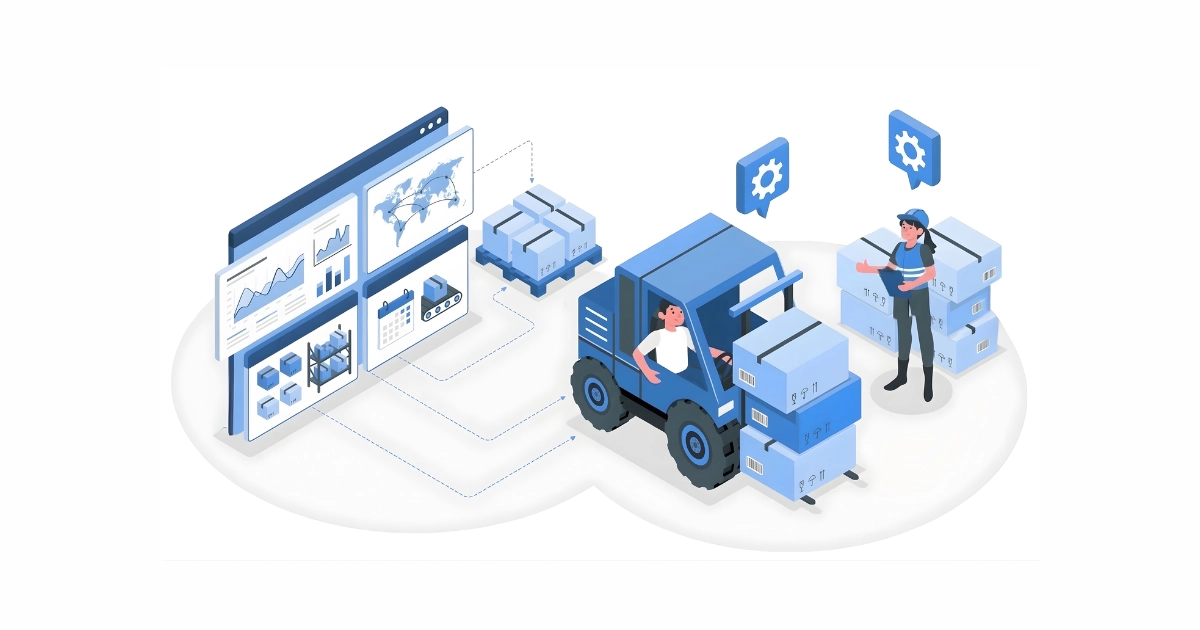
Supply chain management (SCM) software is a digital platform that coordinates procurement, inventory, production, logistics, and delivery across complex supply networks. It enables organisations to plan demand, optimise inventory, automate workflows, and gain real-time visibility into operations using data, integrations, and increasingly AI-driven systems.
In modern enterprises, supply chain management software acts as a central orchestration layer that connects ERP systems, warehouse operations, transportation networks, and analytics platforms into a unified system.
In this guide, you will learn how supply chain management software works from an architectural perspective, including its core components, integration patterns, and the design principles architects use to build scalable, resilient supply chain systems.
In summary:
Supply chain management software is a system that orchestrates data, workflows, and decisions across distributed supply chain operations. It works through integrated modules, real time data pipelines, and automation layers that synchronise planning and execution across suppliers, warehouses, and logistics networks.
Supply chain management software addresses challenges such as fragmented data, limited visibility, inefficient inventory management, and poor demand forecasting. It enables organisations to coordinate suppliers, warehouses, and logistics partners, reduce delays and stockouts, and respond faster to disruptions in global supply chains.
A supply chain management platform typically includes demand planning, inventory management, order management, procurement, warehouse management, and transportation management. Advanced platforms also incorporate supply chain analytics, real time tracking, and AI-driven optimisation to improve forecasting accuracy and operational efficiency.
Supply chain management software focuses on planning, execution, and optimisation of supply chain operations, while ERP systems manage broader business processes such as finance, HR, and accounting. SCM platforms often integrate with ERP systems to provide specialised capabilities such as logistics orchestration, demand forecasting, and real-time supply chain visibility.
To better understand how supply chain management software compares with other enterprise systems, the table below outlines the key differences between SCM, ERP, and WMS platforms.
In short:
A modern supply chain management software architecture is built as a modular, distributed system that separates planning, execution, integration, and data layers. It combines cloud-native infrastructure, APIs, and real time data processing to enable scalable, resilient, and interconnected supply chain operations.
Supply chain management software plays a critical role in broader digital transformation initiatives, particularly in industrial environments adopting Industry 4.0.
A typical supply chain management software architecture includes five core layers: user applications, API and integration layer, supply chain services, data platform, and infrastructure. Each layer is designed to decouple responsibilities, enabling flexibility, scalability, and easier system evolution across complex supply chain environments.
Microservices architecture allows supply chain management software to scale individual components independently, such as demand planning or order management. This improves system resilience, supports continuous deployment, and enables teams to evolve specific capabilities without impacting the entire supply chain platform.
Event-driven architecture enables supply chain management software to react instantly to changes such as inventory updates, shipment delays, or demand fluctuations. By processing events in real time, systems can trigger automated actions, improve responsiveness, and maintain synchronisation across distributed supply chain operations.
Data in supply chain management software flows through ingestion, processing, and consumption layers. Information from ERP systems, IoT devices, and logistics platforms is collected via APIs, processed in real time pipelines, and delivered to applications and analytics tools to support operational decisions and supply chain optimisation.
In short:
Supply chain management software integrates with a wide range of enterprise and operational systems to enable end-to-end coordination across the supply chain. These integrations allow data to flow between platforms, improving visibility, synchronisation, and decision-making across procurement, inventory, and logistics operations.
Supply chain management software integrates with ERP systems to exchange data on orders, inventory, procurement, and financials. While ERP systems manage core business processes, supply chain software extends these capabilities with advanced planning, real time visibility, and supply chain optimisation across distributed operations.
Platforms such as SAP and Oracle emphasise tight integration between supply chain management software and ERP systems to ensure data consistency and operational alignment.
Warehouse management systems integrate with supply chain management software to provide real time inventory data, warehouse operations tracking, and order fulfilment status. This integration enables better inventory accuracy, faster picking and packing processes, and improved coordination between storage and distribution.
Transportation management systems integrate with supply chain management software to optimise shipping routes, carrier selection, and delivery scheduling. By combining logistics data with broader supply chain insights, organisations can reduce transportation costs, improve delivery performance, and increase supply chain efficiency.
IoT devices and telemetry systems feed real time data into supply chain management software, enabling continuous tracking of goods, environmental conditions, and shipment status. This enhances supply chain visibility, supports predictive logistics, and allows organisations to respond quickly to disruptions across global supply chain networks.
In short:
Cloud computing enables supply chain management software to operate as a scalable, distributed platform that supports global supply chain operations. By moving infrastructure, data processing, and integrations to the cloud, organisations can achieve greater flexibility, faster deployment, and improved resilience across supply chain systems.
McKinsey highlights that cloud-based digital supply chains enable greater agility, resilience, and end to end visibility across global operations.
Modern supply chain management software is built on cloud-native infrastructure to support elasticity, high availability, and continuous delivery. Cloud environments allow platforms to scale dynamically based on demand, integrate easily with other enterprise systems, and support real time supply chain visibility across regions and partners.
A well-defined cloud migration strategy is essential for organisations transitioning legacy supply chain systems to scalable, cloud-native platforms.
Distributed supply chain systems allow organisations to operate across multiple locations, suppliers, and logistics networks without relying on centralised infrastructure. This improves fault tolerance, reduces latency, and ensures that supply chain management software can maintain performance and reliability even during disruptions.
Real-time data pipelines collect, process, and distribute data across supply chain management software systems in real time as events occur. By enabling continuous data flow from ERP systems, IoT devices, and logistics platforms, organisations gain accurate, up to date insights that support faster decision-making and supply chain optimisation.
IBM research shows that organisations with end to end supply chain visibility can reduce the impact of disruptions by up to 50 percent.
In short:
Artificial intelligence enhances supply chain management software by enabling predictive, adaptive, and automated decision-making across complex supply chain operations. AI models analyse historical and real time data to improve forecasting, optimise inventory, and automate logistics planning within modern supply chain systems.
Artificial intelligence moves supply chain management software from reactive operations to predictive and adaptive decision-making. The visual below highlights the main areas where AI creates value across forecasting, inventory, logistics, and simulation.
Analyses market trends and historical demand patterns to reduce stockouts and align inventory with expected demand.
Machine learning models estimate optimal stock levels and safety stock to reduce holding costs without harming availability.
AI-driven route and delivery planning helps reduce delays, improve service levels, and support more efficient transport operations.
Virtual models of supply chain systems allow teams to test disruption scenarios and evaluate operational changes before deployment.
AI improves demand forecasting in supply chain management software by analysing historical sales data, seasonality, and external signals such as market trends. Machine learning models generate more accurate forecasts, helping organisations align supply with demand and reduce stockouts or excess inventory.
Machine learning algorithms optimise inventory management by predicting optimal stock levels, reorder points, and safety stock requirements. Within supply chain management software, this reduces holding costs, improves inventory turnover, and ensures product availability across distributed supply chain networks.
Predictive models in supply chain management software analyse routes, delivery times, and operational constraints to optimise logistics planning. This enables better route selection, improved delivery accuracy, and reduced transportation costs across complex logistics networks.
Digital twins within supply chain management software create virtual representations of supply chain systems, allowing organisations to simulate disruptions, test scenarios, and evaluate outcomes. This helps architects and decision-makers design more resilient supply chain strategies and improve operational planning.
In short:

Designing supply chain management software presents challenges related to data fragmentation, system complexity, scalability, and resilience. Architects must balance performance, integration, and flexibility while ensuring that supply chain systems can adapt to disruptions, global operations, and evolving business requirements.
Supply chain management software must integrate data from multiple sources such as ERP systems, warehouse platforms, logistics providers, and IoT devices. Architects address fragmentation by implementing unified data models, API-first integration layers, and real time data pipelines to ensure consistency and visibility across the supply chain.
To improve resilience, supply chain management software uses redundancy, distributed architectures, and real time monitoring. Architects design systems that can reroute logistics, adjust inventory allocation, and respond dynamically to disruptions such as supplier delays or demand spikes.
Scaling supply chain management software requires cloud-native infrastructure, modular architectures, and regional data distribution. Architects must ensure low latency, high availability, and compliance across different geographies while supporting increasing transaction volumes and operational complexity.
Security in supply chain management software involves protecting data across multiple integrations and partners. Architects implement secure APIs, identity and access management, encryption, and monitoring to safeguard sensitive operational and transactional data across the supply chain ecosystem.
In short:
Selecting supply chain management software requires evaluating architectural fit, scalability, integration capabilities, and long term adaptability. Architects must ensure the platform can support complex supply chain operations, integrate with existing enterprise systems, and evolve with changing business and technological requirements.
Enterprise supply chain management software should support modular architectures, API-first design, event-driven processing, and real time data handling. These capabilities enable flexibility, scalability, and seamless integration with ERP systems, logistics platforms, and external partners.
API-first design is critical in supply chain management software because it enables seamless integration between systems, partners, and services. It allows organisations to connect ERP platforms, warehouse systems, and logistics providers while ensuring data flows efficiently across the supply chain.
Global supply chains require supply chain management software that can scale across regions, handle high transaction volumes, and support distributed operations. Architects must consider cloud infrastructure, load balancing, and data replication to ensure consistent performance and availability.
Observability enables architects to monitor system performance, data flows, and operational events within supply chain management software. By implementing logging, metrics, and tracing, organisations can detect issues early, optimise performance, and maintain reliability across complex supply chain systems.
Many organisations explore software development outsourcing or nearshore software development models to accelerate the implementation of complex supply chain systems.
In short:
Supply chain management software is evolving towards more autonomous, data-driven, and interconnected systems. Emerging technologies such as artificial intelligence, real time analytics, and distributed architectures are transforming how organisations design, optimise, and operate digital supply chains at scale.
AI-driven supply chain management software will move from predictive to autonomous decision-making. Systems will not only forecast demand and optimise inventory, but also automatically adjust procurement, production, and logistics in response to real time conditions across the supply chain.
Digital twins are becoming a core capability in advanced supply chain management software. By creating virtual models of supply chain systems, organisations can simulate scenarios, test strategies, and optimise operations before implementing changes in real environments.
Autonomous logistics systems, including automated warehouses and self-optimising delivery networks, will require supply chain management software to support real time coordination and decision-making. This will increase the importance of event-driven architectures and continuous data processing.
Real time orchestration will become central to supply chain management software, enabling systems to coordinate activities dynamically across suppliers, warehouses, and logistics providers. This allows organisations to respond instantly to disruptions, continuously optimise operations, and maintain end-to-end supply chain visibility.
In short:
Supply chain management software is now a core strategic system that drives resilience, scalability, and competitive advantage. For CTOs, the priority is designing an architecture that is modular, data-driven, and ready to evolve with AI and real-time operations.
If you are looking to modernise your supply chain management software or build a scalable, future-ready platform, our team can help you define the right architecture and deliver it with confidence.
Supply chain management software is a digital platform that manages and optimises procurement, inventory, production, and logistics across a supply network. It connects systems, automates workflows, and uses real time data to improve visibility, forecasting, and decision-making.
Supply chain management software synchronises planning and execution across systems. It collects operational data, processes it through workflows and rules, and coordinates actions such as inventory allocation, order fulfilment, and logistics planning in real time.
Supply chain management software improves visibility, reduces operational costs, enhances demand forecasting, and optimises inventory and logistics. It helps organisations respond faster to disruptions and operate more efficient and resilient supply chains.
Supply chain management software focuses on planning, execution, and optimisation of supply chain operations, while ERP systems manage broader business processes such as finance and accounting. SCM platforms typically integrate with ERP systems to provide more advanced supply chain capabilities.
AI in supply chain management software is used for demand forecasting, inventory optimisation, predictive logistics, and anomaly detection. Machine learning models analyse historical and real-time data to improve accuracy and automate decision-making.
.webp)
Alexandra Mendes is a Senior Growth Specialist at Imaginary Cloud with 3+ years of experience writing about software development, AI, and digital transformation. After completing a frontend development course, Alexandra picked up some hands-on coding skills and now works closely with technical teams. Passionate about how new technologies shape business and society, Alexandra enjoys turning complex topics into clear, helpful content for decision-makers.
People who read this post, also found these interesting: