Written by:

Last Published:
8 January 2026
•

An AI Engineer designs, deploys and maintains AI-powered systems in production, combining software engineering, machine learning and infrastructure skills.
In 2026, AI engineering is no longer experimental. Organisations are integrating AI models into real products, workflows and scalable platforms, where reliability, performance and observability matter as much as accuracy.
For full-stack developers, this evolution represents a natural progression. Core skills such as backend development, APIs, cloud infrastructure and DevOps already provide a strong foundation. What changes is how intelligence is built, deployed and operated at scale.
This article presents a practical AI Engineer roadmap for 2026, focused on the skills, tools and MLOps practices required to transition from full-stack development to production-ready AI engineering.
An AI Engineer builds, deploys and operates AI-powered systems in production, ensuring models are reliable, scalable and integrated into real software products.
In 2026, the role focuses less on algorithm experimentation and more on engineering complete AI systems. AI Engineers work at the intersection of software development, machine learning and infrastructure, turning trained models into dependable services that run in live environments.
A data scientist focuses on analysis, experimentation and model development, while an AI Engineer focuses on deploying and operating models in production.
Data scientists explore data, build prototypes and evaluate model performance. AI Engineers take these models and integrate them into applications, handling APIs, scalability, monitoring, security and lifecycle management.
AI engineering extends full-stack development by adding responsibility for data pipelines, models and inference systems.
While full-stack developers build user interfaces, APIs and backend services, AI Engineers also manage model serving, performance optimisation and failure modes unique to machine learning systems.
AI Engineers solve the challenge of making AI models reliable, scalable and maintainable in production environments.
This includes handling data drift, model degradation, latency constraints, cost optimisation, and observability, ensuring AI behaves predictably within larger software systems.
| Role | Primary Focus | Core Responsibilities | Key Skills | Production Ownership |
|---|---|---|---|---|
| AI Engineer | Production AI systems | Deploy, scale and operate AI models in real-world applications; integrate models into software systems; ensure reliability and observability | Software engineering, applied machine learning, MLOps, cloud infrastructure, system design | High – owns model serving, monitoring and lifecycle |
| Full-Stack Developer | End-to-end software development | Build user interfaces, APIs and backend services; manage application logic and integrations | Frontend and backend development, APIs, databases, DevOps | Medium – owns application behaviour, not models |
| Data Scientist | Data analysis and modelling | Explore data, train models, evaluate performance and generate insights | Statistics, machine learning, data analysis, experimentation | Low – focuses on experimentation, not production |
Full-stack developers are well positioned because AI engineering builds on the core principles of software development. Their experience with debugging and monitoring translates directly into building robust AI pipelines.
One reason the transition is so natural is the shared technology stack. For instance, understanding why to use Python for web development gives backend developers a head start, as Python is the primary bridge between traditional backends and AI. Furthermore, comparing Python vs JavaScript helps developers determine when to use each tool, leveraging Python for CPU-intensive ML tasks while keeping JavaScript for real-time user interactions.
Most AI systems in 2026 are deployed as part of larger applications, where reliability, scalability, and integration with existing products are critical. Engineers who already understand APIs, backend services, databases, and deployment pipelines have a strong foundation for designing, deploying, and maintaining AI systems in production. Their experience with debugging, testing, and monitoring complex applications translates directly into building robust AI pipelines and inference services.
Backend development, API design, cloud infrastructure, and DevOps skills transfer directly to AI engineering.
These skills are crucial for deploying AI models as services. For example, an engineer who can set up a REST API can expose a trained model to applications; someone familiar with cloud platforms such as AWS, Azure, or GCP can deploy models at scale; and experience with CI/CD pipelines enables efficient management of versioned model deployments. These competencies reduce the learning curve when moving into AI engineering.
Full-stack developers often lack hands-on experience with machine learning workflows, data pipelines, and model lifecycle management.
Key gaps include understanding the distinction between training and inference, handling large-scale datasets, monitoring model performance over time, and addressing model drift or bias. While they may be comfortable building scalable software, they usually need targeted upskilling in applied machine learning, feature engineering, and MLOps practices to manage AI systems end-to-end.
Backend experience is generally more valuable than frontend experience for AI engineering.
AI Engineers spend most of their time on services, data pipelines, infrastructure, and performance optimisation. Frontend skills are helpful when integrating AI into user-facing applications. Still, the bulk of AI engineering work involves designing reliable pipelines, monitoring models, and ensuring that inference systems perform efficiently at scale. Strong backend skills reduce friction in these tasks and accelerate the transition.
An AI Engineer needs a combination of software engineering, applied machine learning, data management, and MLOps skills to design, deploy, and maintain AI systems in production.
The role builds on core programming and backend knowledge while adding AI-specific skills in model training, deployment, monitoring, and optimisation. Mastery of these areas ensures that AI systems are reliable, scalable, and integrated with real-world applications.
Python remains the primary language for AI engineering, complemented by SQL and, optionally, Java, C++, or Go for high-performance systems.
Python is essential for ML frameworks like TensorFlow, PyTorch, and scikit-learn. SQL is needed for data querying and feature engineering, while other languages may be required for latency-critical inference systems.
Applied machine learning knowledge is more important than deep theoretical expertise.
AI Engineers should understand supervised and unsupervised learning, model evaluation metrics, feature engineering, and training/inference workflows. The focus is on applying models effectively in production rather than publishing research.
AI Engineers need system design skills for scalable, maintainable, and fault-tolerant AI pipelines.
This includes designing APIs for model serving, orchestrating microservices, integrating with cloud platforms, and planning for monitoring, logging, and observability in production environments.
Data engineering is critical, as AI models depend on clean, structured, and accessible data.
AI Engineers should understand data pipelines, ETL processes, feature stores, and the handling of streaming and batch data at scale. Collaborating with data engineers ensures reliable input for training and inference.
| Skill Category | Full-Stack Developer | AI Engineer |
|---|---|---|
| Programming Languages | JavaScript, Python, HTML/CSS, SQL | Python (ML frameworks), SQL, optionally Java/C++/Go |
| Machine Learning | Basic familiarity possible (optional) | Applied ML, model evaluation, feature engineering, training/inference workflows |
| System Design | APIs, microservices, backend architecture | Scalable AI pipelines, model serving APIs, observability, cloud deployment |
| Data Engineering | Database management, basic ETL | Data pipelines, feature stores, batch & streaming processing, collaboration with data engineers |
| DevOps / MLOps | CI/CD, monitoring, deployment pipelines | MLOps pipelines, model versioning, monitoring model drift, automated retraining |
| Cloud Platforms | AWS, Azure, GCP (general services) | Cloud ML services (SageMaker, Azure ML, Vertex AI), scalable model deployment, GPU/TPU utilisation |
The recommended AI Engineer roadmap for full-stack developers is a structured sequence of skills, tools, and applied projects that build on existing software expertise while adding AI-specific capabilities.
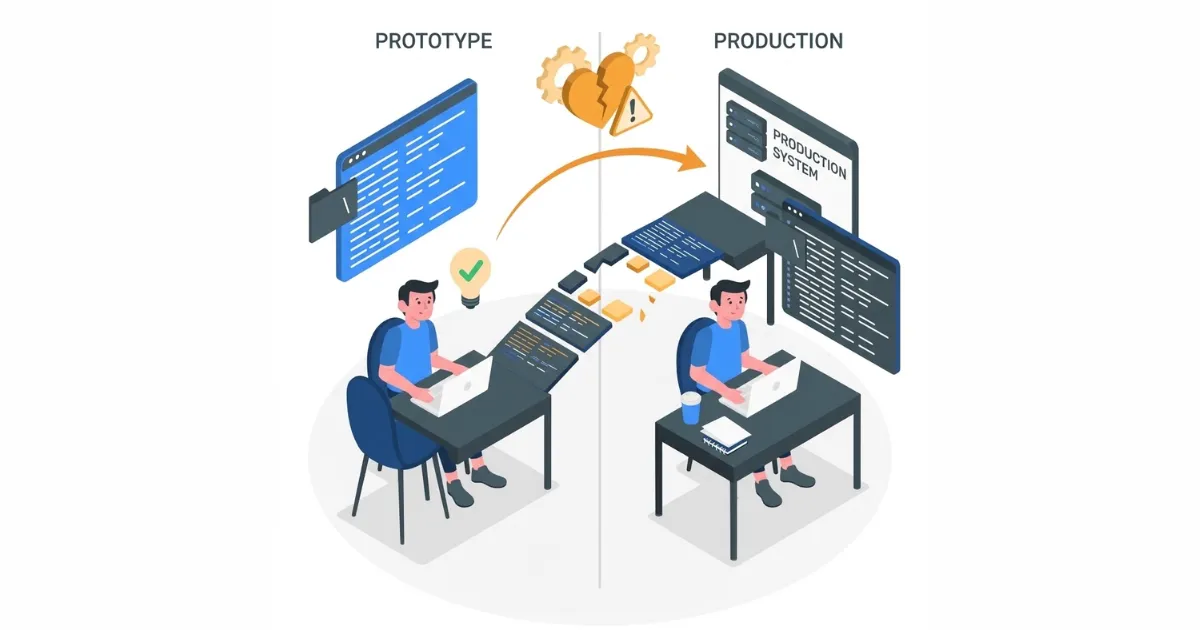
A key stage in this roadmap is moving a project from prototype to production, which requires architectural foresight and resilient data pipelines.
The roadmap is designed to transition developers from building traditional applications to delivering production-ready AI systems, covering programming, machine learning, data pipelines, MLOps, cloud deployment, and system monitoring.
Before applying AI in production, full-stack developers should master Python and key machine learning libraries.
Focus areas:
Develop practical experience with real ML models and datasets.
Focus areas:
Understand data engineering workflows that feed production AI systems.
Focus areas:
Learn MLOps principles to deploy models reliably in production.
Focus areas:
Apply cloud infrastructure to support production AI workloads.
Focus areas:
AI Engineers need to evolve continuously with new tools and methods.
Focus areas:
| Stage | Focus Areas | Practical Actions / Projects |
|---|---|---|
| Stage 1 – Core AI & Python | Python, NumPy, pandas, scikit-learn, data manipulation, basic ML | Build small ML projects: regression, classification; use version control; experiment reproducibly |
| Stage 2 – Applied ML | Supervised/unsupervised learning, model evaluation, bias handling | Projects with real datasets, e.g., recommendation engines, user behaviour prediction |
| Stage 3 – Data Pipelines | ETL workflows, feature stores, batch/stream processing | Build a data pipeline feeding features into a ML model; integrate with database or cloud storage |
| Stage 4 – MLOps | Model serving, Docker/Kubernetes, CI/CD, monitoring | Deploy model APIs, setup monitoring dashboards, implement CI/CD for model updates |
| Stage 5 – Cloud AI Systems | AWS SageMaker, Azure ML, Vertex AI, GPU/TPU utilisation, security, observability | Deploy models at scale, implement logging/alerting, optimise cost/performance |
| Stage 6 – Continuous Learning | Advanced ML (NLP, CV, RL), new frameworks, team collaboration | Explore new AI libraries, run experimental projects, contribute to cross-functional initiatives |
The 2025 Stanford AI Index Report highlights that as training compute and model complexity double every few months, the ability to iterate quickly is now more valuable than building models from scratch.
AI Engineers rely on a combination of programming libraries, ML frameworks, MLOps platforms, and cloud services to build, deploy, and maintain AI systems in production.
Using the right tools accelerates development, ensures reliability, and simplifies scaling of AI workloads.
Python libraries such as NumPy, pandas, scikit-learn, TensorFlow, and PyTorch are essential for AI engineering.
These frameworks enable data manipulation, model training, evaluation, and deployment. AI Engineers often combine them to prototype models quickly and implement production-ready solutions.
MLOps tools such as MLflow, Kubeflow, and TFX help manage the model lifecycle, versioning, and deployment pipelines.
Containerisation tools such as Docker and orchestration platforms like Kubernetes allow AI systems to scale reliably. CI/CD integration ensures that models can be updated safely and continuously.
Cloud platforms like AWS SageMaker, Azure ML, and Google Vertex AI provide scalable infrastructure, prebuilt ML services, and GPU/TPU support.
They simplify model deployment, monitoring, and retraining. AI Engineers can focus on model quality while leveraging cloud services for performance, cost optimisation, and observability.
| Category | Tools / Platforms | Purpose |
|---|---|---|
| Programming / ML Frameworks | Python, NumPy, pandas, scikit-learn, TensorFlow, PyTorch | Data manipulation, model training, evaluation, and deployment |
| MLOps & Orchestration | MLflow, Kubeflow, TFX, Docker, Kubernetes | Model lifecycle management, versioning, containerisation, and scalable deployment |
| Cloud Platforms | AWS SageMaker, Azure ML, Google Vertex AI | Scalable model hosting, GPU/TPU acceleration, monitoring, retraining, and cost optimisation |
| Experimentation & Collaboration | Jupyter Notebook, Colab, GitHub, DVC | Rapid prototyping, version control, dataset management, team collaboration |
Transitioning from full-stack developer to AI Engineer in 2026 builds on your existing software skills while adding applied ML, MLOps, and cloud deployment. Focusing on the model lifecycle, system design, and scalable AI pipelines helps ensure reliable production systems.
Ready to accelerate your AI journey? Contact us today to see how our team can help you implement this roadmap and succeed as an AI Engineer.
An AI Engineer designs, deploys, and maintains AI-powered systems in production.
They combine software engineering, applied machine learning, and infrastructure skills to ensure models are reliable, scalable, and integrated into real-world applications.
A full-stack developer can become an AI Engineer by learning applied ML, MLOps, data pipelines, and cloud deployment.
Core software skills transfer directly, while new AI-specific competencies are gained through structured learning and hands-on projects.
Critical skills include Python programming, applied machine learning, data engineering, MLOps, system design, and cloud platforms.
These skills enable AI Engineers to build production-ready AI systems that are reliable, maintainable, and scalable.
AI Engineers use Python libraries (NumPy, pandas, scikit-learn, TensorFlow, PyTorch), MLOps tools (MLflow, Kubeflow, Docker, Kubernetes), and cloud platforms (AWS SageMaker, Azure ML, Vertex AI).
These tools support model training, deployment, monitoring, and scaling in production environments.
The transition typically takes 6–12 months, depending on prior experience and learning pace.
Following a structured roadmap, covering Python, applied ML, data pipelines, MLOps, and cloud deployment—accelerates the process.
Backend experience is generally more valuable, as AI Engineers focus on services, data pipelines, and infrastructure.
Frontend skills support the integration of AI into user-facing applications but are secondary to system scalability and reliability.
No, applied ML skills are more important than deep theoretical knowledge.
AI Engineers should understand model workflows, evaluation metrics, and feature engineering to deploy and maintain reliable AI systems in production.
Alexandra Mendes is a Senior Growth Specialist at Imaginary Cloud with 3+ years of experience writing about software development, AI, and digital transformation. After completing a frontend development course, Alexandra picked up some hands-on coding skills and now works closely with technical teams. Passionate about how new technologies shape business and society, Alexandra enjoys turning complex topics into clear, helpful content for decision-makers.
People who read this post, also found these interesting: