Choosing a back-end language looks like a technical decision. It isn't. It sets how fast your first version reaches customers, what the codebase costs to change three years from now, and how hard your next five hires will be to find. Python for web development earns its place in that decision because it is fast to build in, cheap to staff, and mature enough to run production systems at scale. Its weaknesses are real, but they are known and manageable rather than hidden, which is more than you can say for most of the alternatives.
This article covers what Python is, why it works well for web development, what it costs you in performance and hosting, and how the two dominant frameworks, Django and Flask, differ once you actually have to live with them. It also sets out the Four-Question Stack Test we use with clients to choose between them. Let's get into it.
Python was created in 1991 by Guido van Rossum. Its philosophy puts code readability first, which you can see in its simple syntax, its namespaces and its near-religious strictness about indentation. That readability is why it is so often the first language people learn, and why a team inheriting a Python codebase can usually get to work without a long ramp-up.
Python runs on Windows, Linux and macOS. It also bends to the programmer's preferred style, whether functional, imperative or object-oriented, so your team picks the approach that suits the task rather than the one the language insists on.
Tim Peters captured its design principles in nineteen aphorisms known as the Zen of Python, published as PEP 20. The one that matters most for a commercial codebase is the plainest of them: readability counts. That isn't decoration. It is the reason code written by one team stays legible to the next one, and legibility is what keeps a long-lived product maintainable.
Google, Intel, Microsoft, Dropbox, Instagram and Spotify all run Python in production. That is not a reason on its own (plenty of bad decisions have famous logos attached), but it does tell you the tooling, the hosting and the security practice around Python have been tested at a scale your product will probably never reach.
Python is a general-purpose language, and web development is only one of the places it dominates. It is also the default for data science and AI, for automation and scripting, for scientific computing, and increasingly for machine learning systems that have to run alongside a product rather than sit in a notebook. That AI gravity is the single biggest reason Python's usage keeps climbing; more on the numbers below.
For a web product, that breadth has a very practical consequence. Say your roadmap includes a recommendation engine, a forecasting feature or a document-processing pipeline. With Python you build it in the same language, often in the same codebase, instead of standing up a second stack and a second team to keep it alive.
It also turns up across travel, healthcare, transport and finance, which matters more than it sounds when compliance and audit requirements start shaping what you are allowed to deploy.
Web development is the work of creating, building and maintaining websites and web applications. It splits into a front end, which is everything your user touches, and a back end, which holds the business logic and talks to the database. Python lives in the back end, usually paired with JavaScript on the front end to make a complete product.
So why choose it for that role? The commercial case comes down to three things.
Time to first release. Python's readability and its mature frameworks mean a working, deployable version of a standard web application takes weeks rather than months. For a product that needs market feedback before the next funding round, that gap is the whole argument. To put a real number on it: when Eurofound, an EU agency, needed a public interface spanning more than 280 policy initiatives, we built it on Django and shipped in six weeks. That timeline only holds because the framework hands you routing, an ORM and an admin on day one, rather than making you build them (case study).
Cost of maintenance. Readable code is cheaper to change. And the cost of a web application is not dominated by writing it, but by modifying it for three to five years afterwards, usually by people who never saw the original. Python's bias towards explicit, legible code lowers that bill.
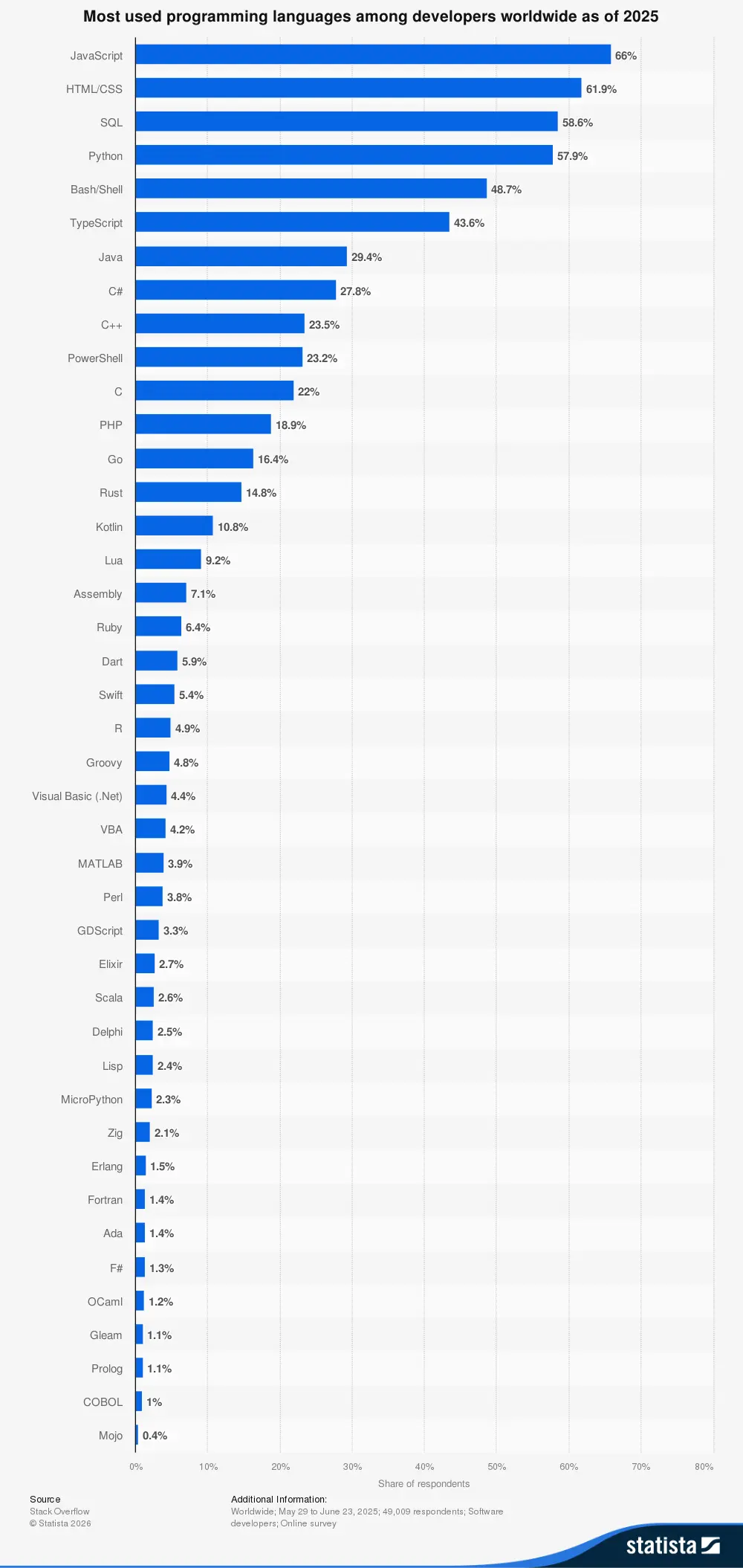
Hiring pool. In the 2025 Stack Overflow Developer Survey, Python's usage rose seven percentage points year on year to roughly 58%, the largest jump of any language, putting it among the four most-used languages overall, alongside JavaScript, HTML/CSS and SQL. More telling for a hiring manager: it is now the language developers most want to learn next. A top-tier position today, the fastest growth of the pack, and the largest cohort of people entering the profession with it tomorrow. That means candidates at every seniority level, in most markets, at rates below those of scarcer languages.
Python is open source and free to use, embed and distribute without licence restrictions. For a commercial product, that quietly removes an entire category of legal and procurement work.
Several concrete factors sit underneath those three commercial arguments:
Easy to learn. Simple syntax lets developers handle intricate systems and talk about them clearly. In practice, a new developer becomes productive in days rather than weeks, and you can bring people onto the team who have never written Python before.
Good readability. Python reads close to everyday language. Code review moves faster, handovers are less risky, and the knowledge of how the system works is less likely to live in one person's head.
Complex work on the back end. Python handles AI, data science and heavy data processing natively, alongside everything a conventional back end does. You are not choosing between a good web language and a good data language. You get both.
A large community. Popularity is a debugging advantage as much as a status one. Stuck on a bug, or unsure how to implement something unfamiliar? More often than not, someone hit it first and wrote up the answer.
A wide range of libraries. Python libraries are packages of pre-written, maintained code that take work off your team. NumPy and scikit-learn cover data analysis and mathematical algorithms, SQLAlchemy covers composable SQL queries, and Requests, Celery and Pillow handle HTTP, background jobs and images. Every one of them is code you never have to write, test or maintain.
Strong frameworks. The most used Python web frameworks are Django, Flask, FastAPI, Pyramid and Web2Py. A framework is a toolbox: standardised, tested code for URL routing, database access, HTTP handling and authentication, so your team spends its hours on what makes the product different rather than on plumbing.
Python is not the fastest option per request. Let's be precise about where that actually bites.
The interpreter executes more slowly than compiled languages such as Go or Rust. Historically it also carried the Global Interpreter Lock (the GIL), which allowed only one thread to run Python code at a time and capped how much a single process gained from extra CPU cores. That last point now comes with an asterisk. As of Python 3.14, released in October 2025, a free-threaded build that switches the GIL off is officially supported (via PEP 703). It is opt-in rather than the default, the single-threaded penalty sits at roughly 5–10%, and any C extension that isn't yet free-threading-aware will quietly switch the GIL back on, so it is not a free lunch, but the decades-old "Python can't use your cores" line is no longer simply true. Python 3.14 also shipped an experimental JIT compiler (PEP 744), the other lever on single-threaded speed.
For the great majority of web applications, none of this decides anything, because response time is dominated by database queries and network calls, not by Python execution. For a small minority (high-frequency trading, real-time bidding, or systems holding tens of thousands of concurrent connections on one node), raw throughput is a genuine constraint and a different language may be the right answer.
Between those two poles, the remedies are ordinary engineering rather than a rewrite. Caching with Redis. Pushing slow work into background queues with Celery. Putting the CPU-bound parts behind a service written in something faster.
Hosting cost follows from all that. In our own client work, a Python application needs more compute than an equivalent compiled-language service to serve the same traffic, and that shows up on the monthly cloud bill. [INSERT ORIGINAL BENCHMARK, e.g. p95 latency, build time, or the measured hosting-cost delta from an IC project, expressed as a concrete figure. This is the one "only someone who ran the code has it" number the article still needs.] Model it for your own traffic rather than assuming ours.
Security is well covered on the Django side, which ships protections against cross-site scripting, cross-site request forgery and SQL injection by default. On Flask, those protections are your team's job. That is a real risk to weigh when the application handles regulated data.
Django is a back-end Python web development framework for building complex, scalable websites, and it is a large part of why Python became a default for web work in the first place. It uses the model-view-template (MVT) architecture, a pattern for organising code that keeps data, presentation and structure apart:
Django follows a "batteries included" philosophy: the standard functionality a web application needs arrives with the framework. Install it and you have a user authentication system, URL routing, a template engine, an Object-Relational Mapper (ORM) and database schema migrations on day one. Setup is fast, and if you need more, the Django Packages directory lists over 4,000 additional reusable packages.
That maturity is exactly why Django is the low-risk choice for regulated, database-heavy work: the problems you are going to hit have already been hit, and written down. On Eurofound we integrated a database that already existed rather than standing a new one up, and Django's ORM and built-in admin were most of the reason a hard six-week deadline was realistic at all. In practice the core of that kind of build is unglamorous: a view that filters an existing dataset and paginates it:
# Illustrative of the pattern behind Eurofound's initiative listings:
# one Django view filtering an existing dataset, no bespoke plumbing.
# [Swap for a real snippet from the IC codebase to fully satisfy the "own code" gate.]
from django.core.paginator import Paginator
from django.shortcuts import render
from .models import Initiative

def initiative_list(request):
    qs = Initiative.objects.all()

    if country := request.GET.get("country"):
        qs = qs.filter(country__iso_code=country)
    if topic := request.GET.get("topic"):
        qs = qs.filter(topics__slug=topic)

    page = Paginator(qs.order_by("-updated_at"), 20).get_page(request.GET.get("page"))
    return render(request, "initiatives/list.html", {"page": page})
The ORM, the query filtering, and pagination are all framework-supplied. That is the "batteries included" bargain in a dozen lines.
Django has been in the open since 2005, and its documentation is unusually thorough, with a deep body of practical tutorials to match. Instagram runs on it, and Spotify uses it for parts of its stack. YouTube is often credited to Django and shouldn't be. It is a Python application, but it predates the framework.

Armin Ronacher released Flask in 2010, as the Python back-end framework positioned against Django. Being the newer arrival, its creator could build on what the Python web development community had already learned from everything that came before.
After Flask's initial success, its author created the Pallets Projects, a collection of libraries covering common web development needs. Django and Flask serve the same purpose, but they hold very different beliefs about how much a framework should decide on your behalf.
Flask ships with two main components: the Jinja2 template engine, which builds HTML templates, and Werkzeug, which provides HTTP routing support. Everything else (the database layer, authentication, forms, admin) is yours to choose. That is why Flask is called a microframework: it comes with the bare minimum and leaves the rest open, which is also why many people consider it the more Pythonic of the two.
Here is the difference in physical terms. Django is a fitted kitchen delivered in one van, appliances installed, everything already plumbed in and roughly where a kitchen expects things to be. Flask is a well-built empty room with sound wiring and a water supply. You can put the sink anywhere you like, and you will also be the one deciding where the sink goes, ordering it, fitting it, and explaining the choice to whoever inherits the room.
That minimalism means applications get built with very little boilerplate, and in experienced hands Flask produces remarkably direct code. Its flexibility lets an application change shape as requirements evolve, without fighting conventions that assumed something else. The cost is that every decision Django would have made for you is now a decision your team makes, documents and maintains. When we built Eurofound's socio-economic MPI analytics tool, Flask was the right call precisely because the service was narrow and data-shaped rather than a full batteries-included product (case study).
| Django | Flask | |
|---|---|---|
| Philosophy | Batteries included | Minimal core, you choose the rest |
| Released | 2005 | 2010 |
| Database layer | Built-in ORM and migrations | Choose your own, usually SQLAlchemy |
| Admin interface | Built in | Build or add it yourself |
| Authentication | Built in | Extension or custom |
| Security defaults | XSS, CSRF and SQL injection protections included | Your team's responsibility |
| Setup speed | Fast for a standard application | Fast for a small service |
| Best for | Database-heavy products, regulated domains, stable scope | Narrow services, APIs, volatile scope |
| Team fit | Mixed-seniority teams | Experienced teams who want control |
| Main risk | Fighting the conventions when your case is unusual | Accumulating bespoke decisions nobody documented |
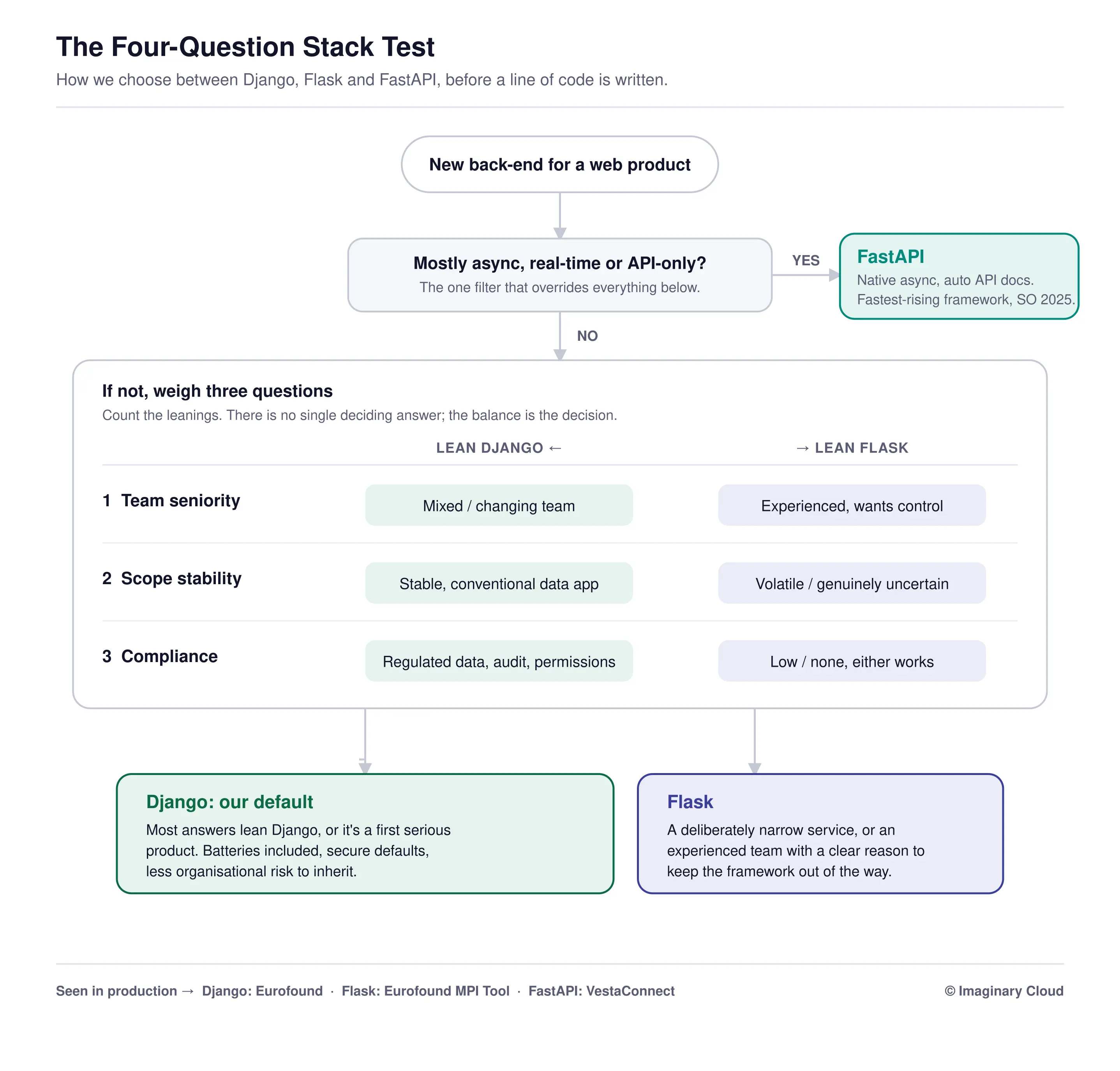
Most comparisons stop at the feature table. In practice, the choice is settled by the team and the product, not by the frameworks, so we run every client project through the same four questions. We call it the Four-Question Stack Test.
1. How senior is the team that will maintain this? Django's conventions are guard rails. On a mixed-seniority team, or one that will change composition over the next two years, those guard rails prevent a great deal of expensive drift. Flask assumes the team can make good architectural decisions over and over, and write them down.
2. How stable is the scope? If you know what you are building and it resembles a conventional data-backed application, Django's assumptions will nearly all be right and the speed is free. If the scope is genuinely uncertain, those same conventions turn into friction, and Flask's blank slate is worth the extra decisions.
3. What are the compliance requirements? Regulated data raises the value of secure defaults, a built-in permissions model and an audit-ready admin interface. Django's territory, squarely. It's what we reached for on Eurofound, a regulated EU-agency build with fixed scope and no room in a six-week deadline to hand-roll auth or an admin. Choosing Flask in a regulated domain is fine, as long as you budget openly for the security work Django would have handed you.
4. What does the traffic profile look like? For conventional request-and-response traffic, either framework is fine. For workloads that are largely asynchronous, real-time or API-only, FastAPI now beats both, with native async support and automatic API documentation, and it was the fastest-rising web framework in the 2025 Stack Overflow survey, so the hiring pool for it is deepening quickly. It is what we used to take VestaConnect from MVP to paid adoption (case study).
Our default recommendation for a client building their first serious web product is Django. Most of the risk in these projects is organisational rather than technical, and Django removes more of that risk than it adds. We reach for Flask when the service is deliberately narrow, or when an experienced team has a clear architectural reason to keep the framework out of the way.
Stack choices are hiring choices. Python's talent pool is among the largest of any back-end language, at every seniority level and in most markets, which shortens time-to-hire and cuts the premium you pay per developer against scarcer languages. If you would rather borrow senior Python capacity than recruit it, that is the shape of our nearshore engineering teams.
Django and Flask experience are both common, Django especially. The more useful point is that they transfer. A developer with solid Python and one of the two can be productive in the other inside a single project, which is simply not true across language boundaries. On a three-year roadmap, that flexibility is worth more than it looks.
Weighing Python against another back-end language? Our comparison of Ruby vs Python for web development covers that decision properly. For the front-end half of the stack, our guide to the best front-end frameworks for 2026 sets out the equivalent trade-offs.
Python is a strong default for web development because it shortens the path to a first release, keeps maintenance costs down through readable code, and draws on one of the deepest hiring pools in the industry, a pool that grew faster than any other language's in the 2025 Stack Overflow survey. It is a back-end language, paired with JavaScript on the front end. It carries a real but well-understood performance ceiling, one that matters to a minority of applications and gets engineered around in all the rest, and even that ceiling is lifting, now that the GIL is optional from Python 3.14.
Choosing between the two dominant frameworks? Run the Four-Question Stack Test: team seniority, scope stability, compliance requirements, traffic profile. Django suits database-heavy products, regulated domains and teams of mixed seniority. Flask suits narrow services and experienced teams who want to make their own calls. FastAPI is the better answer when the workload is asynchronous or API-first. The Python community has a saying that captures the temperament difference perfectly, and we borrowed it for the title of our fuller Flask vs Django comparison: pirates use Flask, the Navy uses Django.
Is Python fast enough for production web apps?Yes, for the large majority of applications. Response time in a typical web application is dominated by database queries and network calls rather than by Python execution, so the interpreter's speed rarely decides what a user experiences. Where throughput genuinely becomes the constraint, caching, background job queues and asynchronous frameworks such as FastAPI resolve most of it, and from Python 3.14 the free-threaded build removes the GIL for CPU-bound work, though library support is still catching up. Applications holding tens of thousands of concurrent connections per node are the real exception, and those may be better served by Go or Rust.
Should I choose Django or Flask?Choose Django if your product is database-heavy, your scope is reasonably stable, you have compliance requirements, or your team is of mixed seniority. Choose Flask if you are building a narrow service or API, your requirements are still moving, and you have experienced developers who want to make their own architectural decisions. If most of your workload is asynchronous or API-only, look at FastAPI before you pick either.
How much does a Python web app cost to maintain?The dominant cost is developer time for changes and support, not hosting. Python keeps that cost comparatively low, because readable code is cheaper to modify and the hiring pool is deep enough to replace people without a long search. Hosting runs higher than an equivalent compiled-language service for the same traffic, but that difference rarely decides anything on a mid-sized application.
Is Python still a good choice for web development in 2026?Yes. Its usage rose seven percentage points year on year in the 2025 Stack Overflow Developer Survey, the biggest jump of any language; it is the language developers most want to learn next, its frameworks are actively maintained, and its position in AI and data work has strengthened the case rather than weakened it, since machine learning features can be built in the same stack as the application. The real choice is not Python against some newer alternative. It is Python's breadth against a faster language's throughput.
What is Python used for besides web development?Data science and machine learning, automation and scripting, scientific computing, financial modelling, and increasingly infrastructure tooling. For a web product that matters, because a data or AI feature on the roadmap can be built in the same language and often the same codebase, rather than requiring a second stack and a second team.
Can Python handle high-traffic websites?Yes, with the right architecture. Instagram runs on Django at very large scale and has documented how, and the pattern is well established: horizontal scaling behind a load balancer, aggressive caching, asynchronous processing of anything slow, and moving genuinely CPU-bound work into a separate service or the free-threaded build. What Python does not give you is high throughput per node without doing that architectural work.
Choosing a back-end stack is easier with someone who has made the choice before, and lived with the consequences. If you are weighing Python against the alternatives for a new product, or deciding between Django and Flask for one already under way, book a call and we will talk it through with you.


Computer science student and ImaginaryCloud part-timer. Eager to learn new technologies and techniques. Tennis and piano player.

CEO @ Imaginary Cloud and co-author of the Product Design Process book. I enjoy food, wine, and Krav Maga (not necessarily in this order).
People who read this post, also found these interesting: