Written by:

Last Published:
26 February 2016
•
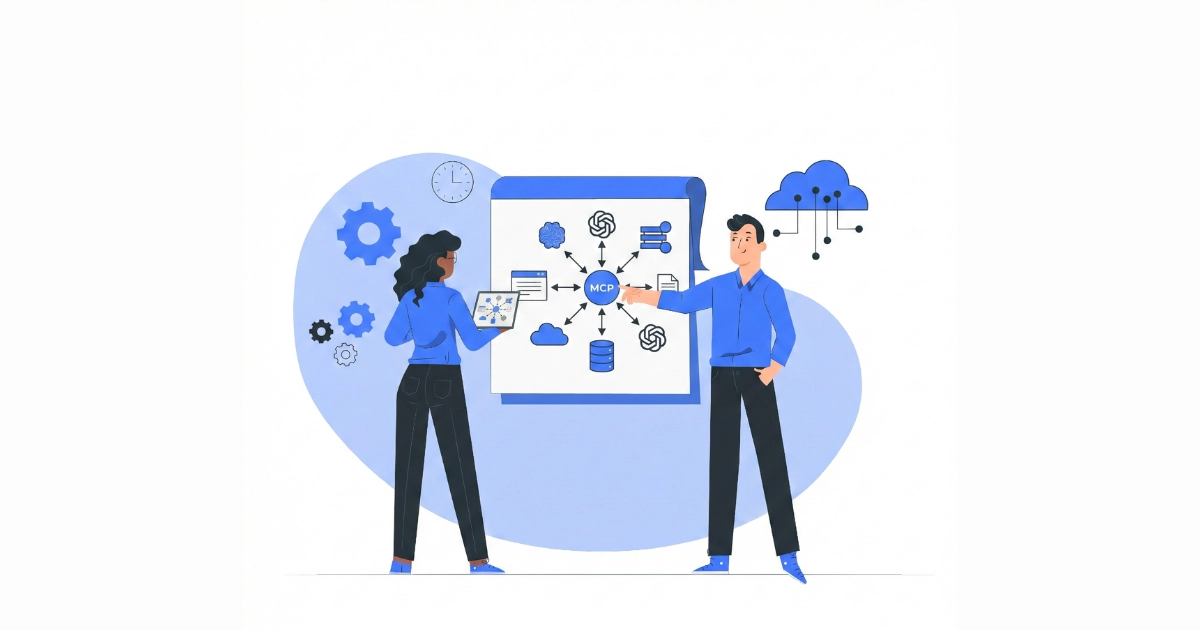
Model Context Protocol, or MCP, is an open standard that defines how large language models communicate with external tools, data sources, and systems in a structured and secure way. Instead of hardcoding integrations or relying on fragile prompt instructions, MCP enables models to discover capabilities, exchange context, and invoke tools through a consistent protocol layer.
For engineering leaders building AI assistants, copilots, or multi-agent systems, this creates a scalable way to manage tool access, permissions, and context across environments. In this guide, you will learn how Model Context Protocol works, how it compares to APIs and RAG, and how to implement it effectively in enterprise AI architecture.
Summary:
Model Context Protocol, or MCP, is an open standard that defines how large language models communicate with external tools, data sources, and applications in a structured and secure way. It standardises how context, capabilities, and permissions are exchanged, enabling AI systems to reliably invoke tools without hard-coded integrations or fragile prompt logic.
In practical terms, MCP acts as a coordination layer between an LLM and the tools it can use. Instead of embedding instructions directly in prompts, the model queries a structured interface that describes available capabilities and how to access them.
At a high level, the architecture looks like this:
The MCP server exposes tools and their capabilities. The LLM, via an MCP client, discovers those tools, receives structured context, and invokes them under defined permissions.
MCP was created to solve a growing problem in AI engineering: large language models need access to tools, data, and systems, but traditional integrations are brittle and difficult to scale.
Before MCP, teams often relied on:
As AI systems evolved into multi-tool assistants and autonomous agents, these approaches became difficult to maintain. Context handling was inconsistent, permissions were loosely enforced, and integrations were tightly coupled to specific models.
MCP introduces a model-agnostic, structured protocol that separates tool integration from prompt engineering. This improves scalability, security, and architectural clarity.
Model Context Protocol was introduced by Anthropic as an open standard to enable structured tool use in AI systems. It was designed to be model-agnostic, meaning it can work with different large language models rather than being tied to a single provider.
By publishing MCP as an open specification, the goal was to encourage interoperability across AI tools, agents, and enterprise systems. This positions MCP as infrastructure rather than a proprietary feature.
Traditional APIs define how software systems communicate with each other. MCP defines how language models communicate with tools.
The key differences are:
In short, APIs expose functionality. MCP structures how an LLM understands, selects, and safely invokes that functionality within an AI-driven workflow.
Model Context Protocol works by introducing a structured interface between a large language model and the tools it can access. Instead of embedding tool instructions directly in prompts, MCP defines how tools describe their capabilities, how context is shared, and how the model invokes actions under controlled permissions.
In practice, MCP follows a predictable lifecycle:
This separation between reasoning and execution makes AI systems more modular, observable, and secure.
MCP uses a client-server architecture.
At a simplified level:
Key components include:
This structure ensures the model does not directly access tools without defined boundaries.
Context exchange is central to MCP.
Instead of passing raw text instructions, MCP allows tools to describe:
When the model needs to perform an action, it sends a structured request through the protocol. The response is returned in a predictable format, reducing ambiguity and prompt fragility.
This structured exchange reduces hallucination risk and improves reliability in multi-step workflows.
MCP is primarily client-server.
The LLM interacts with an MCP server that exposes tools. The server enforces capability boundaries and permission rules. This architecture allows centralised governance, logging, and observability, which is critical in enterprise environments.
Peer-to-peer interaction is not the primary design goal. MCP is designed to act as a controlled mediation layer between models and external systems.
Tools register with an MCP server by publishing structured metadata. This typically includes:
Once registered, the tool becomes discoverable by the LLM through the protocol. The model does not need to be retrained to use new tools. It simply queries the server for available capabilities and selects the appropriate one.
For engineering leaders, this means new integrations can be added without rewriting prompt logic or tightly coupling systems to a specific model provider.
Model Context Protocol addresses a core scaling challenge in AI systems: large language models are powerful reasoners, but they are not natively designed to manage tool access, permissions, and structured context across complex environments. As organisations move from prototypes to production-grade AI, integration complexity grows rapidly.
MCP introduces a standardised coordination layer that reduces fragility, improves governance, and enables scalable orchestration of AI tools.
In most early-stage AI applications, context is injected directly into prompts. This works for simple use cases, but breaks down when:
Prompt-based context injection is:
Without a structured protocol, teams often rely on brittle chains of function calls or ad hoc middleware. MCP formalises how context is passed, validated, and returned, reducing ambiguity and improving determinism in execution.
Traditional integrations require developers to manually wire LLM outputs to API calls. This often results in:
MCP standardises tool discovery and invocation. Tools expose structured metadata, and the model selects them dynamically based on task requirements.
Benefits include:
For engineering teams, this means integrations become modular rather than bespoke.
Yes. One of MCP’s most practical benefits is reducing reliance on complex prompt engineering.
Instead of embedding detailed tool instructions in prompts, the model queries a structured capability layer. This shifts complexity away from prompt design and into a formal protocol.
As a result:
For organisations building enterprise AI assistants, internal copilots, or multi-agent systems, this reduces operational risk and accelerates iteration without sacrificing governance.
Model Context Protocol is often compared to APIs, Retrieval-Augmented Generation, and function calling. However, MCP operates at a different architectural layer. It does not replace these technologies. Instead, it standardises how a language model discovers, selects, and securely invokes tools across them.
In simple terms:
Understanding these differences is critical for engineering leaders designing scalable AI systems.
No. MCP does not replace APIs.
APIs define how two software systems communicate. MCP defines how a language model communicates with systems that expose APIs.
In a typical workflow:
The API remains the execution layer. MCP acts as the mediation and coordination layer between the model and the API.
Yes, in many cases you need both.
Retrieval-Augmented Generation is designed to fetch relevant documents or data and inject them into the model’s context window. It improves factual grounding.
MCP, by contrast, manages structured tool interaction.
RAG answers questions by retrieving knowledge.
MCP enables the model to take actions.
For example:
They address different problems and are complementary in producing AI architectures.
Function calling enables a model to return structured arguments that conform to a predefined schema. It is typically tightly coupled to a specific provider’s API format.
MCP generalises this idea.
Key differences:
For example, OpenAI’s structured function calling guide outlines its implementation approach
In short, function calling defines how a model can call a function. MCP defines a standardised ecosystem for discovering and managing many tools across systems.
Yes. MCP is designed to be model-agnostic.
It does not assume a specific LLM provider or proprietary interface. Instead, it defines a structured protocol that any compliant model and server can implement.
For engineering leaders, this reduces the risk of vendor lock-in. It enables:
| Dimension | MCP | APIs | RAG | Function Calling |
|---|---|---|---|---|
| Primary Purpose | Tool orchestration layer for LLMs | Software to software communication | Knowledge retrieval for grounding | Structured action invocation |
| Context Handling | Structured and permission aware | Not context aware for LLM reasoning | Injects retrieved documents | Schema based output only |
| Tool Discovery | Dynamic capability discovery | Static endpoint definition | Not applicable | Predefined schema |
| Model Agnostic | Yes | Yes | Yes | Often provider specific |
| Best Use Case | Enterprise AI agents and copilots | Backend integrations | Question answering systems | Simple structured tasks |
This layered understanding helps engineering teams position MCP correctly within a broader AI architecture rather than viewing it as a competing technology.

The Model Context Protocol (MCP) is already being adopted beyond the theoretical stage. As an open standard for LLM-to-tool interaction, MCP enables AI assistants to have reliable, secure access to real systems. MCP helps connect AI to tools like databases, developer platforms, CRM systems, and even enterprise workflows.
Below are real examples you can explore:
One documented MCP integration pattern involves MCP servers enabling AI agents to assist help desks by making tool calls into ticketing systems. This lets intelligent assistants retrieve relevant IT service management data, fetch request histories, and suggest resolutions dynamically.
MCP is widely used in developer tooling. For example, reference MCP implementations hosted on GitHub demonstrate how MCP servers connect large language models to developer environments, enabling code-aware assistants that can query project structure and repositories.
Another real MCP application example is extending recruiting platforms to power AI agents that automatically access applicant tracking systems (ATS) and internal candidate databases. This enables contextualising recruiter queries with real data and suggesting personalised candidate lists.
This example shows how agentic AI is transforming source-to-pay workflows by enabling intelligent agents to operate across procurement, supplier management, and finance systems. In this use case, AI agents interact with enterprise platforms to analyse supplier data, review contracts, and support sourcing and negotiation decisions across the procurement lifecycle
Security is one of the primary reasons engineering leaders evaluate Model Context Protocol. As AI systems gain the ability to trigger workflows, update records, and access sensitive enterprise data, governance becomes a core architectural requirement. MCP introduces a structured mediation layer that helps enforce boundaries between the model’s reasoning and real system execution.
Instead of allowing an LLM to call APIs directly, MCP routes all tool interactions through a controlled server layer where permissions, logging, and validation rules can be applied consistently.
MCP itself is a protocol, not an identity provider. Authentication and authorisation are enforced at the MCP server layer.
In a production setup:
This ensures the model cannot exceed the privileges of the requesting user.
For example, a finance assistant may be able to read supplier data but not approve payments. The MCP layer enforces that boundary before the action reaches the ERP system.
Yes. MCP supports role-aware access control through structured tool metadata and server-side enforcement.
Each tool can define:
The MCP server checks these conditions before allowing the tool call to proceed.
This is especially important in regulated environments where access to financial, healthcare, or personal data must be tightly controlled. Rather than relying on prompt instructions such as “do not access sensitive data,” MCP enforces restrictions programmatically.
From a governance perspective, MCP improves:
Every tool invocation can be logged centrally, including parameters, user context, and execution results.
Engineering teams gain visibility into which tools are being used, how often, and for what purpose.
New tools can be registered without modifying model prompts, reducing risk during iteration.
Model reasoning is decoupled from execution logic, making systems easier to review and certify.
These governance controls align with broader AI risk frameworks such as the NIST AI Risk Management Framework.
For engineering leaders designing enterprise AI architecture, this structured control layer reduces operational risk compared to loosely coupled prompt-based integrations. It supports long-term scalability, compliance readiness, and clearer accountability in AI-driven workflows
Implementing Model Context Protocol in production requires more than enabling tool calling. It involves designing a structured integration layer that manages tool discovery, permissions, and context exchange independently from prompt logic.
The goal is to separate reasoning from execution, making your AI system modular, observable, and secure.
A typical production setup includes:
The MCP server acts as the coordination layer. It exposes tools in a structured format and validates every invocation before execution.
This architecture ensures the model never directly connects to production systems without mediation.
Yes, in most enterprise environments, a dedicated MCP server is recommended.
A dedicated server allows you to:
In smaller projects, MCP can run within the same infrastructure as your backend services. However, as the number of tools grows, separating the MCP layer improves maintainability and governance.
In multi-agent architectures, different agents may handle distinct responsibilities such as retrieval, planning, execution, or validation.
MCP supports this by:
Instead of each agent embedding its own integration logic, all agents rely on the same structured protocol layer. This reduces duplication and simplifies system evolution.
Frameworks such as LangChain document MCP integration patterns within agent workflows.
Engineering teams adopting MCP typically face:
Tools must define clear input and output schemas. Poor schema design reduces reliability.
Role-based access must align with existing identity systems.
Without proper logging, debugging agent behaviour becomes difficult.
AI architecture must align with security and compliance teams early in the process.
To mitigate these risks, engineering leaders should treat MCP as infrastructure rather than a feature. Establish governance standards, define naming conventions for tools, document permission scopes, and integrate monitoring from day one.
Implementing MCP successfully also requires alignment with established MLOps best practices to ensure monitoring, versioning, and production stability.
In production AI systems, disciplined protocol design is what enables scale without losing control.
Not every AI project requires Model Context Protocol. However, as systems evolve from experimental chatbots to enterprise-grade assistants and agents, the limitations of ad hoc integrations become visible.
Engineering leaders should evaluate MCP when AI systems must interact with multiple tools, enforce permissions reliably, and scale across teams or business units. At that point, structured orchestration becomes a necessity rather than an optimisation.
In many cases, organisations bring in specialised AI engineering teams to accelerate adoption while maintaining internal governance standards.
In early-stage prototypes, MCP may not be essential.
If your AI system:
Then, direct function calling or simple middleware may be sufficient.
However, as soon as additional tools, user roles, or audit requirements are introduced, retrofitting governance becomes expensive. MCP is often easier to implement early than to retrofit later.
Clear architectural signals include:
If your team is repeatedly rewriting prompt logic to manage tool access, that is a structural signal that orchestration should move to a protocol layer.
For engineering leaders thinking beyond short-term delivery, MCP supports:
New tools can be added without rewriting model prompts.
Because MCP is model-agnostic, you can switch or combine LLM providers.
Security and compliance teams gain clearer control points.
Tool logic lives in a structured layer instead of scattered prompt instructions.
In enterprise AI architecture, the transition from experimental automation to governed, multi-system orchestration is inevitable. Model Context Protocol provides a standardised foundation for making that transition sustainable.
Model Context Protocol marks a structural shift in enterprise AI architecture. As large language models move into production, the challenge is no longer generation quality but control, security, and scalability. For CTOs, MCP provides a standardised orchestration layer that reduces integration fragility, limits vendor lock-in, and enables governed, multi-agent AI systems across core business platforms.
If you are planning or scaling enterprise AI initiatives, now is the time to design the infrastructure layer correctly. Contact our team to explore how Model Context Protocol can support your AI roadmap and help you build secure, production-ready systems that scale with confidence.
Yes. Model Context Protocol is published as an open standard specification. While different organisations may provide their own implementations, the protocol itself is designed to be open and model-agnostic, encouraging interoperability across AI systems and tooling ecosystems.
No. MCP does not replace APIs. APIs remain the execution layer that exposes system functionality. MCP acts as a structured coordination layer that allows large language models to discover and safely invoke APIs in a consistent, permission-aware way.
In principle, yes. MCP is designed to be model-agnostic, meaning it can work with different large language models as long as they support structured tool interaction. This reduces vendor lock-in and supports multi-model strategies in enterprise environments.
No. Retrieval-Augmented Generation focuses on retrieving documents or knowledge to improve answer accuracy. MCP focuses on the structured orchestration and execution of tools. Many production AI systems use both RAG for grounding and MCP for action.
MCP is still evolving, but adoption is growing within AI tooling and agent frameworks. Its value lies in architectural standardisation rather than vendor-specific features. Engineering leaders should evaluate ecosystem maturity alongside internal governance requirements and long-term AI strategy.
Alexandra Mendes is a Senior Growth Specialist at Imaginary Cloud with 3+ years of experience writing about software development, AI, and digital transformation. After completing a frontend development course, Alexandra picked up some hands-on coding skills and now works closely with technical teams. Passionate about how new technologies shape business and society, Alexandra enjoys turning complex topics into clear, helpful content for decision-makers.
People who read this post, also found these interesting: