Beyond simple prompts, our Agentic Engineers use AI systems to execute workflows under a human failsafe





Where your project sits on the AI adoption ladder, and what that buys you.
Every developer on your project is a certified Agentic Engineer. They don't just prompt for code. They build and use systems where the AI can take actions on their behalf, then review and validate the result, so the "human-in-the-loop" failsafe always holds.
Set against a non-AI-enabled developer, Agentic Engineers deliver 30 to 50% faster with 50 to 60% higher code stability.
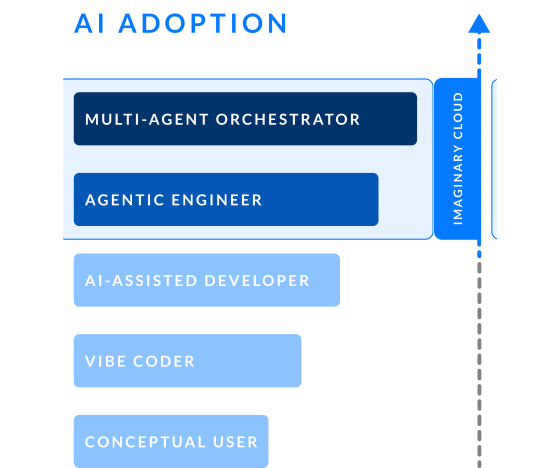
Every Imaginary Cloud developer is a trained Agentic Engineer or Multi-Agent Orchestrator. Which level of AI adoption gets deployed on your project depends on your needs and the shape of the work.
AI shifts from reactive prompting to proactive agency. Sitting directly inside the dev environment, it navigates complex architectures, executes terminal commands, and runs autonomous test suites.
Full-cycle automation. Starting from a Jira ticket, the agents propose multi-file solutions and verify local builds, flagging errors before a human even opens the code.
High operational velocity. The "grunt work" of the development cycle gets automated, the system thinks ahead, and your engineers spend their hours on strategy and scale instead.
Full-scale coordination between specialised AI agents. A "Coder", a "Reviewer", and a "DevOps" agent talk to each other autonomously, identifying, fixing, and auditing code before any of it reaches a human.
A self-driven lifecycle. From production bug detection through to ticket creation and deployment, the AI ecosystem runs the end-to-end process. You get constant iteration and self-healing systems.
The engineer evolves from "Builder" to "Orchestrator." Your team shifts to high-level strategy and final validation, while the AI ecosystem handles the continuous evolution of your product.
Traditional delivery moves in sequential human handoffs. Yours won't. The framework here is built for controlled acceleration: a high-autonomy system that stays strictly human-governed. More than simple automation, it is coordinated intelligence.
The model runs on specialised AI Agent Swarms, integrated into AI IDEs such as Cursor or Copilot, and automates over 50% of routine development, design, and testing. A mandatory "Human-in-the-Loop" (HITL) protocol sits at the centre of it. Human expertise stays the final authority at the critical deployment stage.
Multiple MCPs give the model a deep, contextual understanding of your project. That lets agents do four things:
Extract design tokens and UI specifications autonomously.
Translate structured user stories into functional code.
Monitor application health and diagnose regressions to generate prioritised patches.
Facilitate real-time, asynchronous updates and deployment notifications.
Together, these integrations streamline the entire SDLC, so when a human does step in, they step in faster and with better data.
Agents work inside a "sandbox", turning requirements into production-ready code. Before any human review takes place, they self-correct by analysing automated test failures and error reports. Once the work is refined, the agents raise the Pull Requests (PRs) themselves and stage every change for formal oversight.
No code enters your production environment without a successful PR merge. That merge needs explicit approval from a Technical Lead, who evaluates every agent-generated PR for security compliance, architectural alignment, and the validation of complex business logic. Total integrity, held at the gate.
Velocity: Cycle times drop sharply, from initial concept to live deployment.
Reliability: Escaped defects are minimised through rigorous, MCP-integrated automated testing.
Accountability: You get enterprise-grade audit trails, and absolute human responsibility for every production change.
We don’t just build faster, we have built a system that maintains high operational velocity with significantly greater code stability.
We stay platform-agnostic, because your existing architecture comes first. Within that, the delivery teams hold deep, certified expertise across the industry's most advanced AI ecosystems.

cursor IDE
Our primary environment for Agentic Coding. Cursor allows our engineers to act as architects, using AI to manage entire directory structures and execute complex, multi-file refactors autonomously.

Claude (Anthropic)
Leveraged for its industry-leading reasoning and coding performance. We use Claude’s massive context window to digest entire project ecosystems, ensuring every line of code respects your unique architectural patterns.

GitHub Copilot
Integrated for real-time logic assistance and documentation. It serves as our first-line "reviewer," catching syntax and security vulnerabilities before they leave the editor.

Google Gemini
Used for its multimodal strengths and deep integration with the Google Cloud ecosystem. It excels at complex data synthesis and cross-referencing massive technical documentation.

Google AI Studio
The laboratory for rapid prototyping. Custom "system instructions" and specialised agentic behaviours get built and tested here, before anything touches your codebase.

NotebookLM
The hub for project-specific knowledge. Your AI is grounded in your business documentation, so the agents understand your compliance, logic, and domain rules as well as a senior human partner.

figma ai
The bridge between vision and code. Figma's AI-powered "First Draft" and "Dev Mode" generate production-ready UI components, reducing design-to-dev friction by up to 40%.