Written by:

Last Published:
21 May, 2025
•
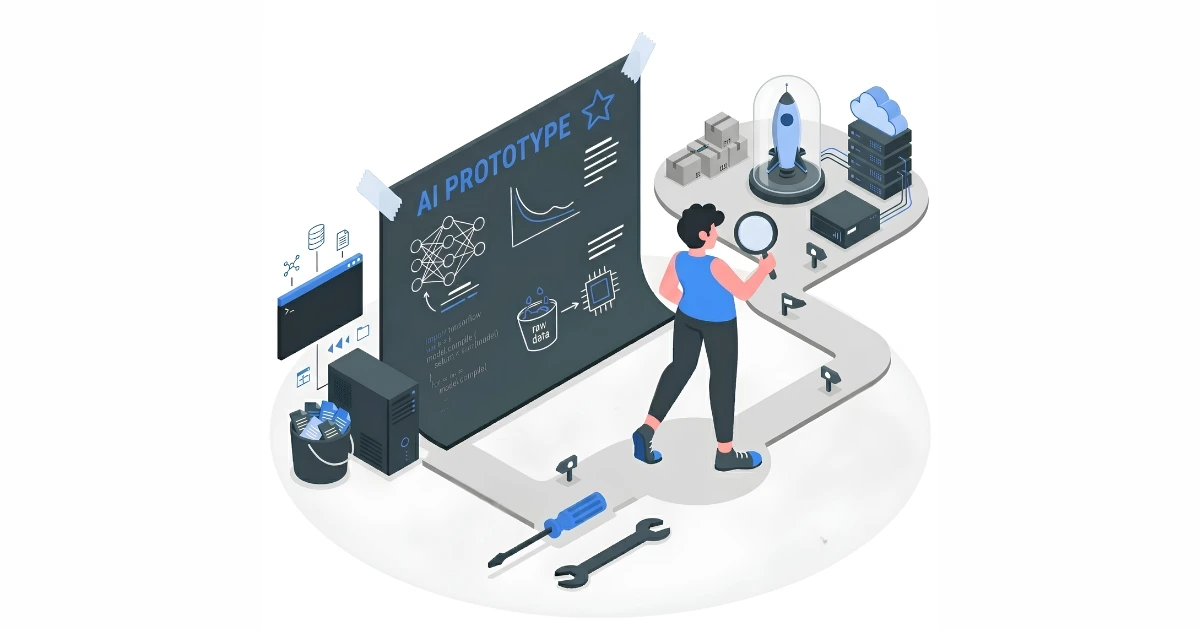
Moving an AI prototype to production means taking a system that works in a controlled environment and making it work reliably in the real world. That means live data, real users, and business processes that depend on it running consistently.
It is a harder transition than most organisations expect. The demo succeeds. The business case is approved. Then, somewhere between the proof of concept and a live, integrated system, things stall or collapse entirely.
This post walks through why that happens and what a well-managed AI prototype to production migration actually involves, using the Imaginary Cloud AI Deployment Framework: a structured five-stage process designed to close the gap between a working prototype and a reliable, production-grade AI system.
TL;DR
Moving an AI prototype to production requires more than deployment. It requires a structured approach to each stage of the journey. The Imaginary Cloud AI Deployment Framework covers five stages: production readiness assessment, architectural hardening, compliance review, MLOps ownership, and staged rollout. Most organisations take an average of eight months. The organisations that close the gap fastest treat production readiness as a design constraint from the start, address governance before infrastructure is locked in, and decide early whether to build in-house or bring in a specialist partner.
Most AI projects fail not because the idea was wrong, but because the prototype was never built to survive contact with the real world.
According to Gartner, only 48% of AI projects reach production, and it takes an average of 8 months to get there. RAND Corporation's Why AI Projects Fail found that AI projects fail at more than twice the rate of non-AI IT projects.
A mid-sized lender built a credit-decisioning AI prototype over three months. Eight weeks into the production build, the legal team identified that the model accessed customer financial data in a cloud region that did not comply with the firm's data residency obligations under FCA guidelines. Eleven weeks of infrastructure work were discarded. The migration was extended by four months. A two-hour scoping conversation with the legal team at the start of the migration would have surfaced the constraint before a single line of production infrastructure was written.
A production-ready AI system is reliable under real-world conditions, integrated with live data and business systems, compliant with security and governance requirements, and supported by a defined monitoring and ownership model. It is not a deployed prototype. It is a hardened system with a named owner, drift tracking, and a documented incident response process in place before go-live.
AI Prototype: A system built to prove a concept works. Runs on clean, curated data in an isolated environment. No monitoring, fallback logic, or live system integration. Failure is acceptable.
AI Production System: A system built to keep working reliably at scale, under real conditions, integrated with live data and business processes. Requires monitoring, governance, a defined ownership model, and an incident response process.
The gap between them is not a finishing step. It is a distinct phase of engineering work that most organisations significantly underestimate.
| Condition | What it requires | Common failure mode |
|---|---|---|
| Reliability under real conditions | Handles unexpected inputs, edge cases, and traffic spikes without failing | System performs well in the demo, but degrades under production load |
| Integration with live systems | Connected to actual data sources, APIs, and business applications | Legacy system integration was discovered late; months of rework were added |
| Security and data governance | Access controls defined, data residency rules met, and regulatory requirements addressed before infrastructure is locked in | Compliance requirement found after build forces architectural undo |
| Defined ownership and monitoring | Named owner, model drift tracking, retraining cycles, and documented incident response | System deployed with no owner; degrades quietly until business-visible failure |
A retailer built an AI demand forecasting model to replace manual planning spreadsheets. Making it production-ready required load testing against peak season traffic, fallback logic if the model returned null, live integration with SAP, POS transaction feeds, and a supplier API that did not exist in the prototype environment, a GDPR review of customer purchase data, and a named business owner with a weekly performance review cadence. The prototype took four weeks to build. The production readiness work took nine weeks. That ratio is normal, not exceptional.
The Imaginary Cloud AI Deployment Framework comprises five sequential stages: a production-readiness assessment, architecture and data-pipeline hardening, a security and compliance review, an MLOps infrastructure build and ownership assignment, and a staged rollout with a defined stabilisation period. Each stage ends with a binary go/no-go gate. The most important sequencing decision is to begin compliance scoping during Stage 1, not after Stage 2.
| Step | Focus | Key output |
|---|---|---|
| 1 | Production readiness assessment | Risk-prioritised gap list; rebuild vs refactor scope |
| 2 | Architecture and data pipeline hardening | Containerised codebase; validated data pipeline; CI/CD live |
| 3 | Security, compliance, and governance | Legal sign-off; access controls; data residency confirmed |
| 4 | MLOps infrastructure and ownership | Named owner; monitoring active; drift thresholds defined |
| 5 | Staged rollout and stabilisation | Canary release passed; model version registry in place |
Sequencing note: Step 3 should begin in parallel with Step 1. Teams that wait until architecture is hardened before engaging compliance routinely discover requirements that force them to undo weeks of infrastructure work.
Before any migration begins, the existing prototype needs an honest appraisal. This means reviewing architecture decisions made under prototype conditions and producing a risk-prioritised list of gaps.
A freight operator estimated a four-week migration to containerise a routing model and connect it to live data. Three weeks in, the engineering team discovered the model had been hardwired to assume a fixed fleet size, a single depot, and consistent address formatting, none of which existed in production. The four-week estimate became a fourteen-week rebuild. The assessment was performed by the migration team, not by an independent reviewer. The prototype team had moved on, and the hidden assumptions were never surfaced.
This step means modularising components, containerising with Docker, and establishing parity between development, staging, and production environments. It also means addressing the data pipeline directly.
| Dimension | Demo data | Production data |
|---|---|---|
| Quality | Clean, manually curated | Messy, inconsistent, incomplete |
| Volume | Limited, static | Large, constantly changing |
| Sources | Single or a few | Multiple, often legacy systems |
| Edge cases | Rare or absent | Frequent and unpredictable |
| Pipeline required | Minimal or none | Robust ingestion, validation, and monitoring |
A manufacturer planned to connect a predictive maintenance model to its sensor management system via a documented REST API. During integration testing, the team discovered the API had not been updated since 2019, returned data in a schema that differed from the documentation, imposed a rate limit that the model would exceed by a factor of six, and required eight weeks of vendor approval for third-party access. A custom middleware build and vendor approval process added fourteen weeks to the migration. The legacy system had been treated as a known quantity because it had documented endpoints. The documentation was four years out of date.
This step is where many migrations lose the most time, because they leave it too late.
| Approach | When legal is involved | Typical outcome |
|---|---|---|
| Compliance as sign-off | After the system is built | Late rework, delayed launch, or shelved project |
| Compliance as design input | During the readiness assessment | Compliant architecture from the start; no late surprises |
An e-commerce business built an AI personalisation engine using inferred demographic signals. The legal team, brought in two weeks before launch for sign-off, identified that processing inferred demographic data lacked a valid lawful basis under GDPR, and that there was no mechanism for users to opt out of model training. The launch was halted. The model required a significant redesign, and the delay was nine weeks. Every finding the legal team made was available at the start of the project.
Deploying without a monitoring and ownership model is not a launch. It is the start of an unmanaged risk.
DevOps manages a static artefact: compiled code. MLOps manages a living system whose outputs can degrade without any change to the code, because the world the model was trained on has changed. This is the key operational difference that catches teams off guard.
| Role | Responsibility | Risk if absent |
|---|---|---|
| ML engineer | Owns the model and pipeline | Drift goes undetected |
| DevOps / platform engineer | Infrastructure, CI/CD, environment management | Deployment fragile; rollback difficult |
| Security/compliance lead | Governance, access controls, and regulatory alignment | Compliance exposure |
| QA engineer | Production testing, regression coverage | Edge cases surface only after go-live |
| Delivery manager | Timeline, stakeholder alignment, risk escalation | Scope creep; milestone slippage |
A retail bank deployed an AI transaction categorisation model with strong initial accuracy. No drift thresholds were defined, no retraining cadence was established, and the ML engineer moved to another project three weeks after launch. Eight weeks later, customer complaints surfaced. An internal review found that accuracy had dropped to 71%, with a visible decline in the monitoring data over four weeks before anyone looked. The fix that would have taken 72 hours under a managed drift process took three weeks under crisis conditions.
A full production launch on day one is rarely the right approach.
| Strategy | Risk level | Best used when |
|---|---|---|
| Full launch | High: any failure affects everyone | Almost never appropriate for AI systems |
| Canary release | Low: failure contained to a small segment | First production deployment of any AI system |
| Phased by segment | Medium: controlled blast radius | Large user bases with distinct usage patterns |
| Shadow mode | None: purely observational | High-stakes systems where live exposure carries significant risk |
A telecoms provider launched an AI customer service routing system for all inbound traffic simultaneously. By 11 am, misrouted queries were escalating. By 3 pm, the system had been rolled back. The investigation found the model had been trained primarily on web chat queries, but Monday morning traffic was dominated by voice transcription: a channel with different vocabulary patterns the model had not seen. The rollback took four hours longer than expected because the procedure had never been rehearsed. The reputational impact reached national news coverage. Pre-agreed acceptance criteria covering all inbound channels, a canary release, and one rehearsed rollback would each have independently changed the outcome.
The industry average is eight months, according to Gartner, and only for the 48% of AI projects that reach production. The single most compressible factor is compliance timing: teams that brief legal during the prototype phase avoid the rework that routinely adds months at the end.
| Organisation profile | Typical timeline | Primary driver |
|---|---|---|
| Start-up or scale-up; greenfield infrastructure; simple compliance environment | 6 to 10 weeks | Codebase quality and data pipeline readiness |
| Mid-market; some legacy systems; moderate compliance requirements | 3 to 5 months | Integration complexity and compliance scoping |
| Large enterprise; significant legacy infrastructure; GDPR or sector-specific compliance | 6 to 9 months | Compliance timing, legacy integration, and team continuity |
| Large enterprise; late compliance discovery; team handover mid-migration | 9 to 14 months | Rework from late compliance discovery; context loss from team change |
McKinsey's State of AI 2025 reinforces why timeline discipline matters: nearly two-thirds of organisations have not begun scaling AI across the enterprise, remaining stuck in pilot or experimentation mode long after the proof of concept has been validated. For organisations at an earlier stage of the journey, our guide to enterprise AI transformation with Azure AI Foundry covers how platform choices affect the migration timeline from the outset.
Build in-house if your engineering team has hands-on MLOps experience, your DevOps infrastructure is mature, and the AI system represents core intellectual property. Bring in a partner if the prototype was built for speed rather than scale, timelines are fixed, or internal teams lack production infrastructure experience.
| Signal | Build in-house | Bring in a partner |
|---|---|---|
| MLOps experience | Team has hands-on production MLOps experience | The team has built models, but not managed production AI systems |
| Prototype quality | Built with modularity and production readiness in mind | Built for speed; significant rework likely |
| Timeline | Flexible; the internal team can absorb the work | Fixed deadline; board commitment or contractual obligation |
| Cost of delay | Low | High: every month undeployed represents unrealised value |
| Compliance complexity | Straightforward regulatory environment | GDPR, sector-specific frameworks, or cross-border data residency are involved |
and
| Skill area | Prototype phase | Production phase |
|---|---|---|
| Data science / ML modelling | Core requirement | Still needed for retraining and drift response |
| DevOps / infrastructure | Often absent | Essential for CI/CD, containerisation, and environment parity |
| MLOps | Often absent | Essential for monitoring, versioning, and retraining pipelines |
| Security/compliance | Typically not involved | Essential before infrastructure decisions are locked in |
| QA engineering | Informal | Essential for regression coverage and production testing |
There are three situations where a specialist partner consistently accelerates the timeline: when the prototype was built for speed, not scale; when timelines are fixed; and when in-house teams lack production infrastructure experience.
A useful frame for a CFO or COO: estimate the monthly revenue or cost impact of the AI system once live, multiply by the number of months a failed migration would add, and compare that against the cost of an external engagement. BCG's research on AI adoption found that 74% of companies struggle to achieve and scale value from AI, and that the organisations generating the most value are those that focus deliberately on people and processes over technology alone.
The projects that successfully move an AI prototype to production share one characteristic: they treat production readiness as a design constraint from the start, not a checklist at the end. Architecture is built to be hardened. Compliance is addressed before the infrastructure is locked in. Ownership is defined before go-live, not after the first incident.
The Imaginary Cloud AI Deployment Framework exists precisely for this reason: to give organisations a repeatable, five-stage path from proof of concept to live system, with go/no-go gates at every step and compliance embedded from day one rather than bolted on at the end.
What separates the organisations that get there from those that do not is rarely the quality of the underlying model. It is the decision, made early enough to matter, to treat an AI prototype to production as an engineering discipline rather than a deployment event. Every month a working prototype sits undeployed is a month of unrealised value: productivity gains not captured, costs not reduced, and, in competitive markets, ground conceded to a faster-moving rival.
If you have an AI prototype that needs to reach production, or an initiative you want to build correctly from the start, we would be glad to understand where you are. Book a no-obligation discovery call and let's talk through what the right path looks like for your specific situation.
The most common reasons are not technical. Architectural shortcuts create unexpected rework. Compliance requirements are discovered too late. Ownership is undefined. The prototype and production teams are often different people with no handover of context. According to Gartner, fewer than half of AI projects ever reach production.
The industry average is around eight months The primary drivers are codebase quality, integration complexity, and the timing of compliance work.
A production-ready system is reliable under real conditions, integrated with live data and business systems, compliant with security and governance requirements, and supported by a defined monitoring and ownership model, not a deployed prototype.
A prototype built with production in mind typically requires four to eight weeks of hardening work. One built purely for demonstration can require a near-complete rebuild, with migration costs that frequently exceed the original development spend. The most reliable way to scope cost is a production-readiness assessment before any hardening work begins.
When the prototype was built for speed rather than scale. When internal teams lack experience with MLOps or production infrastructure. When timelines are fixed. And when the cost of a delayed or failed launch exceeds the cost of bringing in external support.
Alexandra Mendes is a Senior Growth Specialist at Imaginary Cloud with 3+ years of experience writing about software development, AI, and digital transformation. After completing a frontend development course, Alexandra picked up some hands-on coding skills and now works closely with technical teams. Passionate about how new technologies shape business and society, Alexandra enjoys turning complex topics into clear, helpful content for decision-makers.
People who read this post, also found these interesting: