Written by:


Last Published:
02 August 2026
•

Most articles about the advantages of Python will tell you it is readable. True, and almost useless on its own. What you actually want to know is what that readability does to your build time, your hiring, your maintenance bill and your platform risk.
That is what this piece covers. Python is among the most widely used programming languages in the world, and over the years it has held its place across software development, data science and machine learning. Six advantages, six consequences, each one carrying what it means for delivery.
Python is a high-level, interpreted, general-purpose programming language. It was introduced in 1991 by Guido van Rossum, who had started work on it in the late 1980s.
Think of a programming language as a bridge between the way you think and the way a machine executes. Some bridges are narrow, fast and unforgiving. Python built a wide one, put railings on it, and let almost everybody cross. That is why it has become a default across software development, data science, machine learning, artificial intelligence and computer vision — and why it sits at or near the top of every popularity ranking. In data and AI work, it is the language most teams reach for first.
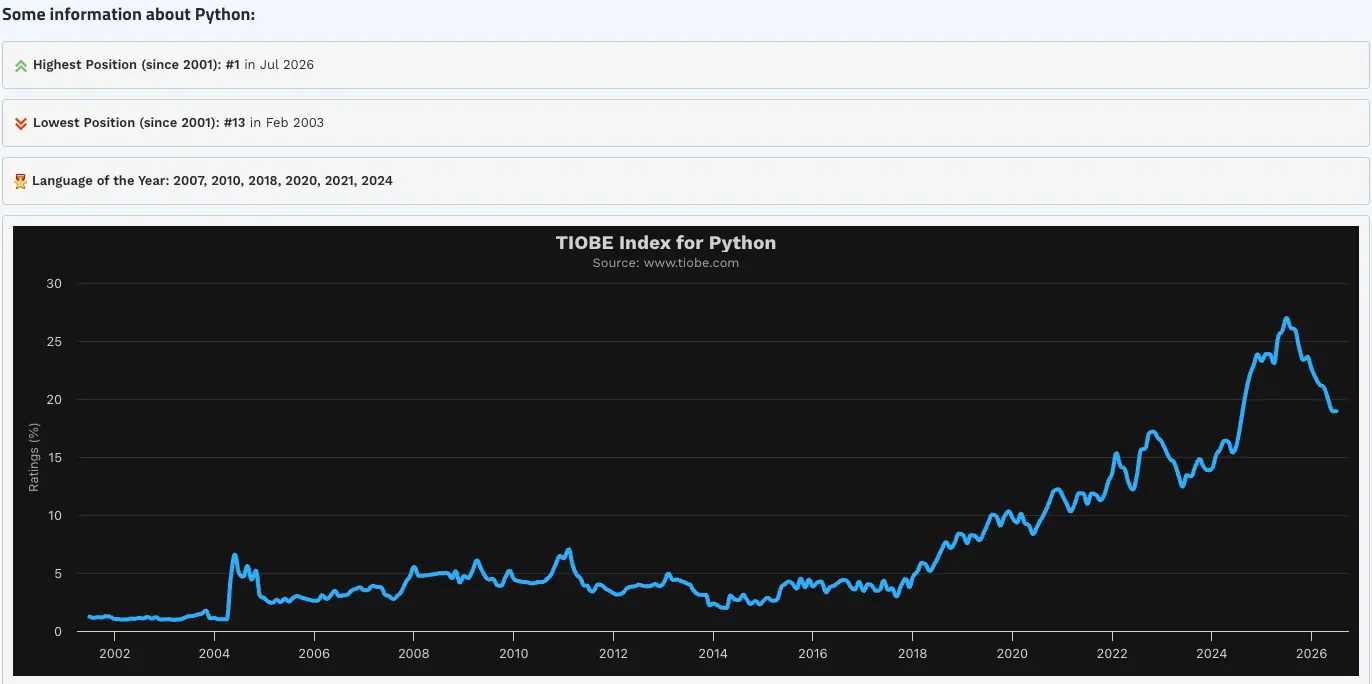
Python has led the TIOBE Index since it overtook C, and as of mid-2026 it still holds first place by a wide margin, though it has come off its peak — it rated around 27% in mid-2025 and sits nearer 19% now, still comfortably clear of C in second. It has been named TIOBE "Language of the Year" more often than any other language: 2007, 2010, 2018, 2020, 2021 and 2024. Worth being straight about the recent picture, though — C++ took the 2022 title, and C# took both 2023 and 2025, so Python is the most-decorated rather than the current holder.
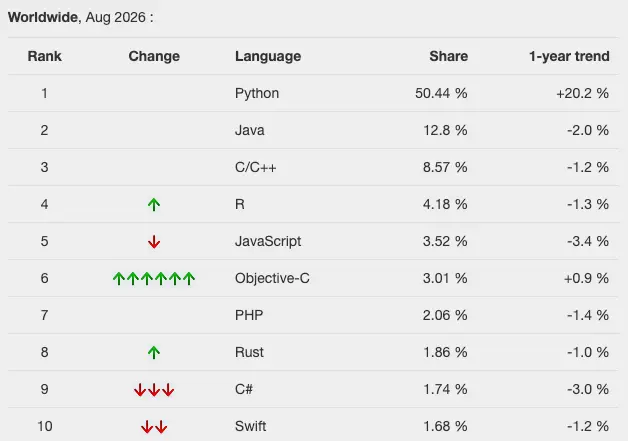
The PYPL Index (Popularity of Programming Language Index), which measures how often a language's tutorials are searched, puts Python first worldwide by a large margin, with Java second and JavaScript third.
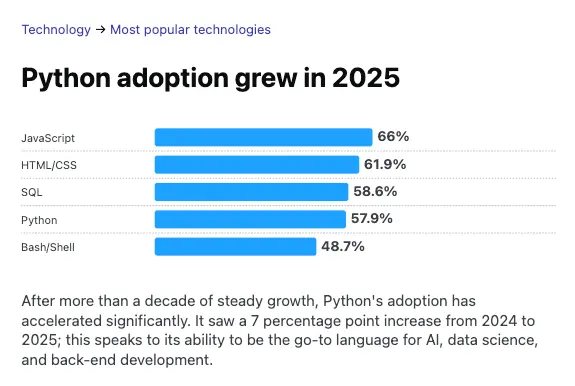
The Stack Overflow Developer Survey tells a more textured story from the practitioner side: Python is among the most used and most admired languages, though by raw usage JavaScript still leads the web-heavy respondent base. Two things are worth noting honestly: Python posted the single biggest usage jump in the 2025 survey, driven by AI and data work, and, separately, TypeScript recently overtook Python as the most-contributed language on GitHub. Popularity is not one number; it depends which decision you're making.
What this means for delivery. Popularity is a hiring signal before it is anything else. A language sitting at the top of these indexes has a deep talent pool, which shortens time to hire, softens the per-engineer premium, and lowers the odds that a system becomes unmaintainable the day one person resigns.
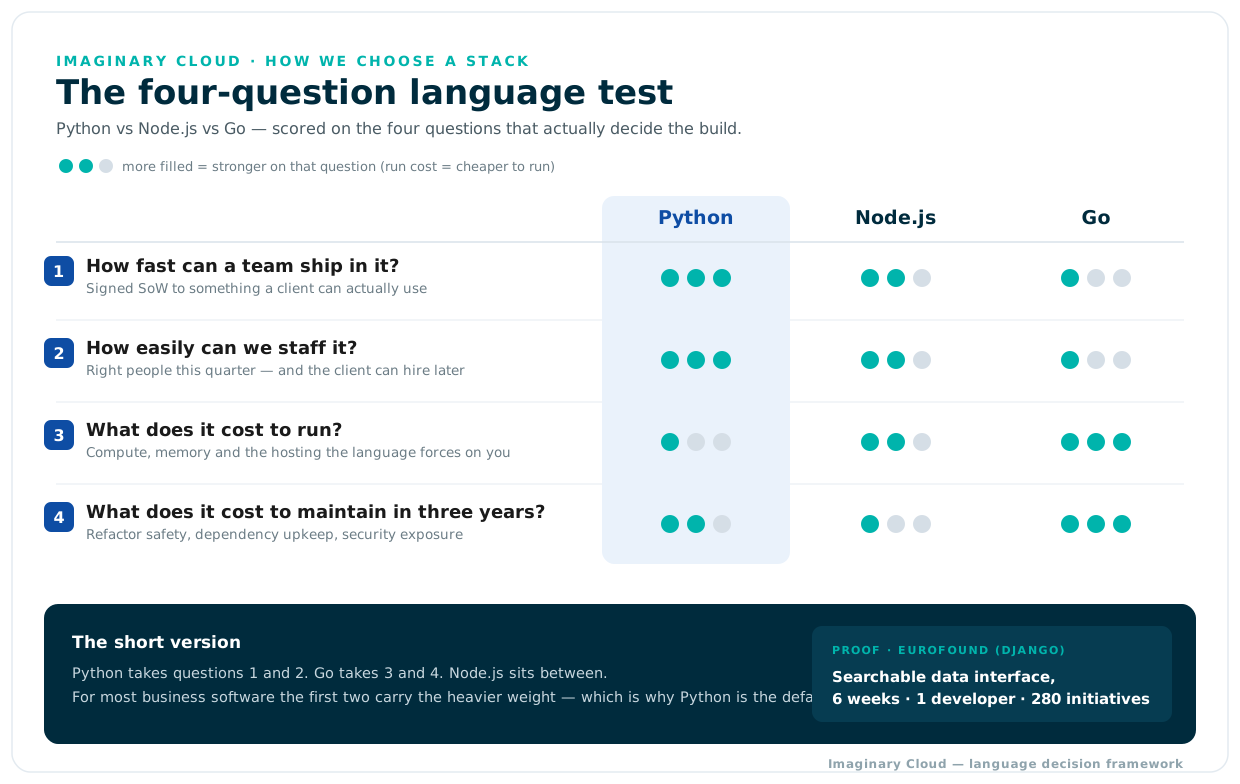
At Imaginary Cloud we do not pick a language on features. We put it through four questions, and the answers decide the stack:
Python's six well-known advantages are worth far more read against those questions than as a flat list. So that is how they are grouped below, each one carrying the question it answers.
How this plays out in practice. We put Eurofound's Economy Database (280+ policy initiatives) behind a searchable, filterable web interface in six weeks, with a single developer. Django did the heavy lifting: the back end fetched and generated listings from Eurofound's existing database, a Python cronjob kept the content current, and the app deployed to Azure at the client's request. The point is not that Python is magic; it is that the standard library, Django's ORM and admin, and PyPI meant one engineer could cover back-end integration, listings, and twelve filter dimensions inside a fixed deadline, then hand it over clean. That is Questions 1 and 3 answered in a single project. (Client: Eurofound, EU agency)
Two of Python's advantages do most of the work here: how it reads, and what comes in the box.
Python sits further from machine code and closer to natural language than a lower-level language such as C. The greater the distance between the language and the machine binary, the higher-level it is, and Python's English-like syntax means you can more or less read it out loud.
What this means for delivery. Readable code is cheaper code. An engineer joining a well-structured Python codebase generally reaches a first merged change faster than on a comparable lower-level codebase; handover between teams carries less risk; and code review catches more, because reviewers can follow the logic instead of decoding it. On projects where the client's own team eventually takes the system over, that is often the deciding factor.
Python's largest advantage is its collection of libraries, frameworks and tools. The Python Standard Library ships with the language and is extensive, with many built-in modules (written in C) ready as standardised solutions for everyday problems. Beyond it, PyPI (Python Package Index) hosts hundreds of thousands more. For data and scientific work there are mature libraries including TensorFlow, PyTorch, NumPy and Pandas.
For full-stack web frameworks there are TurboGears, Dash, Web2Py and Django, the most widely used. For microframeworks there are Flask, Pyramid, Bottle, Falcon and FastAPI. They are "micro" because they focus on one aspect, unlike full-stack frameworks that bundle a database layer, an HTTP application server, a request dispatcher (the layer routing an incoming URL to the code that answers it) and a templating engine (which renders HTML from data).
What this means for delivery. Every mature library is a feature you do not have to build, test or maintain. Authentication, admin interfaces, background jobs, data validation and payment integrations are solved problems with maintained packages, so the first working version arrives materially sooner than if those pieces were written from scratch. The trade-off is dependency management; more on that below.
Two more advantages answer the staffing question: how far one language reaches, and how many people already speak it.
Python is general-purpose: it stretches across software development (with Django and Flask), web scripting, desktop GUI development, game development, security operations and data science, where it is the primary language for most teams. It is also multi-paradigm (object-oriented, functional and structured), which is part of why it has spread so far.
What this means for delivery. A general-purpose language cuts the number of stacks you have to staff and maintain. When the API, the data pipeline and the internal automation are all Python, engineers move between them without retraining. You are not funding three sets of tooling, three build-pipeline configurations and three sets of hiring criteria.
Python is free and open source: developers can read, modify and distribute the source, and thousands of contributors have published packages that keep the ecosystem current. That community is large, steady and known for being welcoming to beginners, senior engineers, data scientists and academics alike. It is big enough that most problems a team hits have already been documented, answered and fixed.
What this means for delivery. A large community is a maintenance guarantee in practice, if not in contract. Popular packages get security patches quickly, breaking changes are widely documented before you meet them, and an unfamiliar error usually has an answer within a search. For a system you intend to run for five years, that is worth more than any single language feature.
Portability and open licensing settle most of the running cost.
Python runs on the major operating systems (macOS, Linux, UNIX and Windows), and in most cases application logic written on one runs on another unchanged. Code that leans on the file system, native extensions or OS-specific paths still needs attention, so "write once, run anywhere" holds for application logic rather than for everything. Python is also frequently used as "glue" between components written in different languages.
What this means for delivery. Portability keeps your hosting decisions reversible. A Python service developed on macOS, containerised on Linux and deployed to any major cloud does not tie you to one vendor's runtime. That matters the week a cloud contract comes up for renewal, or the week a client asks for on-premise deployment.
Python is developed under an OSI-approved open-source licence, so it can be freely used and distributed. No per-seat cost, no runtime licence to renew, no vendor able to rewrite the commercial terms on a system you have already built.
What this means for delivery. The licence line on a Python project is zero, and it stays zero. The real costs sit elsewhere: engineering time, hosting, and the security review of the third-party packages you depend on.
This is the question Python's advantages answer least comfortably. Open licensing and the community help: a widely used open-source language does not get discontinued, and its popular packages keep receiving security patches. Against that sit dynamic typing, which makes large refactors riskier, and a dependency surface that has to be actively managed. Both are set out under What Python costs you below, because they are the terms on which the rest of Python's case should be read.
Most teams weighing Python are really weighing it against Node.js or Go. Here they are on the same four questions.
| Python | Node.js | Go | |
|---|---|---|---|
| Speed to first release | Fastest for data, AI and admin-heavy products; the ecosystem covers most of the plumbing | Comparable for web products; one language across front and back end | Slower to start; less is bundled, more written by hand |
| Hiring depth | Deepest of the three, widest range of backgrounds | Very deep, overlaps the front-end market | Smallest pool, usually a salary premium |
| Run cost | Higher CPU/memory per request; shows up on compute-heavy work | Similar to Python, better on concurrent I/O | Lowest; compiled binaries, low memory, high concurrency |
| 3-year maintenance | Needs type hints and disciplined dependency pinning | Similar exposure, faster-moving ecosystem | Easiest; static typing, small toolchain |
| Where it wins | Data platforms, ML, internal tooling, most web products | Real-time features, JS-strong teams | High-throughput services, infra tooling, tight run-cost budgets |
The short version: Python usually takes questions 1 and 2, Go usually takes 3 and 4, and Node.js sits in between. For most business software the first two questions carry the heavier weight, which is why Python is the default rather than the exception.
Choosing Python is a trade. The case for it is stronger with the costs on the table.
Runtime performance and the GIL. Python is slower than compiled languages for CPU-bound work, and the Global Interpreter Lock means one process does not execute Python bytecode on multiple cores in parallel. For I/O-bound services (most web work), this rarely bites. For heavy numerical work, the usual answer is to push the computation into C-backed libraries such as NumPy, or into a separate service.
Dynamic typing at scale. Dynamic typing accelerates the first six months and complicates the next three years. A large untyped codebase makes refactoring risky, because the compiler will not tell you what you broke. Type hints and a checker such as mypy deal with this, but they have to be adopted early, not retrofitted.
Packaging and dependency management. The size of PyPI is also a liability. Environments drift, and transitive dependencies can end up fighting each other. A project without a lockfile is not reproducible. Pinning dependencies and standardising on one tool across the team is not optional on anything you intend to keep.
Security and maintenance overhead. Every dependency is code you did not write and are still responsible for. Supply-chain risk is real, so automated dependency scanning and a routine for applying updates belong in the plan from the start, not in the post-mortem.
Where Python sits in the AI stack. Nearly every current machine-learning and LLM framework ships a Python interface first, the single strongest practical argument for the language today. If AI features are anywhere on your roadmap, Python keeps that door open at no extra cost.
Yes, for most web services, internal tools, data platforms and AI-backed products. Its libraries shorten the build, its talent pool is deep, and it carries no licence cost. It is weaker for latency-critical systems, native mobile apps and heavy CPU-bound processing.
For I/O-bound applications (most APIs and web services), yes. Performance is usually decided by database queries, network calls and architecture rather than language speed. For CPU-bound work, teams keep Python at the edges and move the hot path into C-backed libraries or a separate service.
Slower runtime than compiled languages, the GIL limiting in-process parallelism, dynamic typing that makes large refactors riskier, dependency management that needs discipline, and weak support for native mobile development.
It is the default. TensorFlow, PyTorch, scikit-learn and effectively every current LLM framework ship Python interfaces first, and the tooling around training, evaluation and deployment assumes Python.
Python for the shortest path to a working product, the widest hiring pool, or anything touching data and ML. Go if run cost per request, high concurrency or long-term refactoring safety matter more than speed to first release.
Not natively. Kivy and BeeWare can produce Android and iOS builds, but for a consumer-facing mobile product the native or cross-platform stacks remain the better choice.
Yes. It leads the TIOBE and PYPL rankings, dominates data and AI work, and has a hiring pool that makes staffing a Python team straightforward in most markets.
Python's advantages hold up. It is readable, general-purpose, exceptionally well supplied with libraries, portable, free to licence and backed by a large community. Put it through the four-question test and it answers the first two better than almost anything else, and the last two adequately, provided the typing and dependency discipline above is actually in place.
Is it the right answer everywhere? No. Performance-critical systems, native mobile applications and workloads that need genuine in-process parallelism are all better served elsewhere, and the packaging and typing costs are real on any long-lived codebase. The best language is the one that fits the project, and the honest version of Python's case includes where it does not fit.
Where it does fit, and where we see it work, is web development, database programming, data science, scripting and automation, and anything with machine learning in it.
If you are weighing Python against another stack for a specific project, we are happy to talk it through, including the cases where we would argue against it. Get in touch and we will give you a straight assessment.
Marketing Intern with a particular interest in technology and research. In my free time, I play volleyball and spoil my dog as much as possible.
Software developer with a big curiosity about technology and how it impacts our life. Love for sports, music, and learning!
People who read this post, also found these interesting: