Written by:

Last Published:
8 September 2026
•

Here's what founders rarely admit: launching an MVP feels like completion. You've shipped something real. Users click. Feedback floods in. You've proven the concept exists. Then silence arrives, not crickets, but something worse. Traction without revenue. Engagement without economics. Your analytics show activity; your bank account shows doubt.
This is the MVP-to-paid gap. And it's where most founders stumble.
The confusion starts early. Founders obsess over speed: ship faster, validate sooner, iterate quicker. All sensible. But somewhere between "build MVP fast" and "scale to revenue," there's a missing step. Testing whether real people will pay for what you've built. Not hypothetically. Not in a landing page poll. Actually pay. With money. Before you've perfected the product.
The stakes? Wrong MVP scope wastes six months. Wrong monetization strategy leaves money on the table. Wrong user targeting means your MVP solves a problem nobody will pay to fix.
Testing if real people will pay for your MVP, not waiting for the "perfect" product, but validating unit economics and customer willingness-to-pay while you still have time to pivot.
Think of your MVP like testing water temperature before diving. MVP validation is the shallow end: you're checking if the water's right for swimming. But paid adoption is different. It's wading in deeper, money in hand, committing to stay.
The distinction matters because it changes how you build your MVP. If you're testing whether to charge, your feature scope narrows. You're not building "everything users asked for." You're building "the smallest thing someone will pay for." That's a different MVP.
According to the Lean Product Playbook, the MVP should validate your riskiest assumptions, and for most SaaS founders, the riskiest assumption isn't "will they like the product," it's "will they pay for it?" Most founders reverse the order: build everything, then figure out who pays. The result? Bloated MVP. No clear monetization. Users liking your product but not valuing it enough to hand over cash. And six months later, you're rebuilding around what actually sold.
Here's where theory meets reality. VestaConnect, a caregiver coordination platform built to simplify daily care responsibilities among families and practitioners, started with a focused MVP. The founders understood their core problem: caregivers manage complex schedules, delegate tasks, and coordinate with multiple practitioners, often through fragmented tools. No single platform. Lots of friction. Time wasted on logistics instead of care.
The team built an MVP in phases: task management and scheduling first, collaboration tools second, social connectivity third. Each phase tested whether caregivers would value that specific job enough to pay for it.
Here's the breakdown.
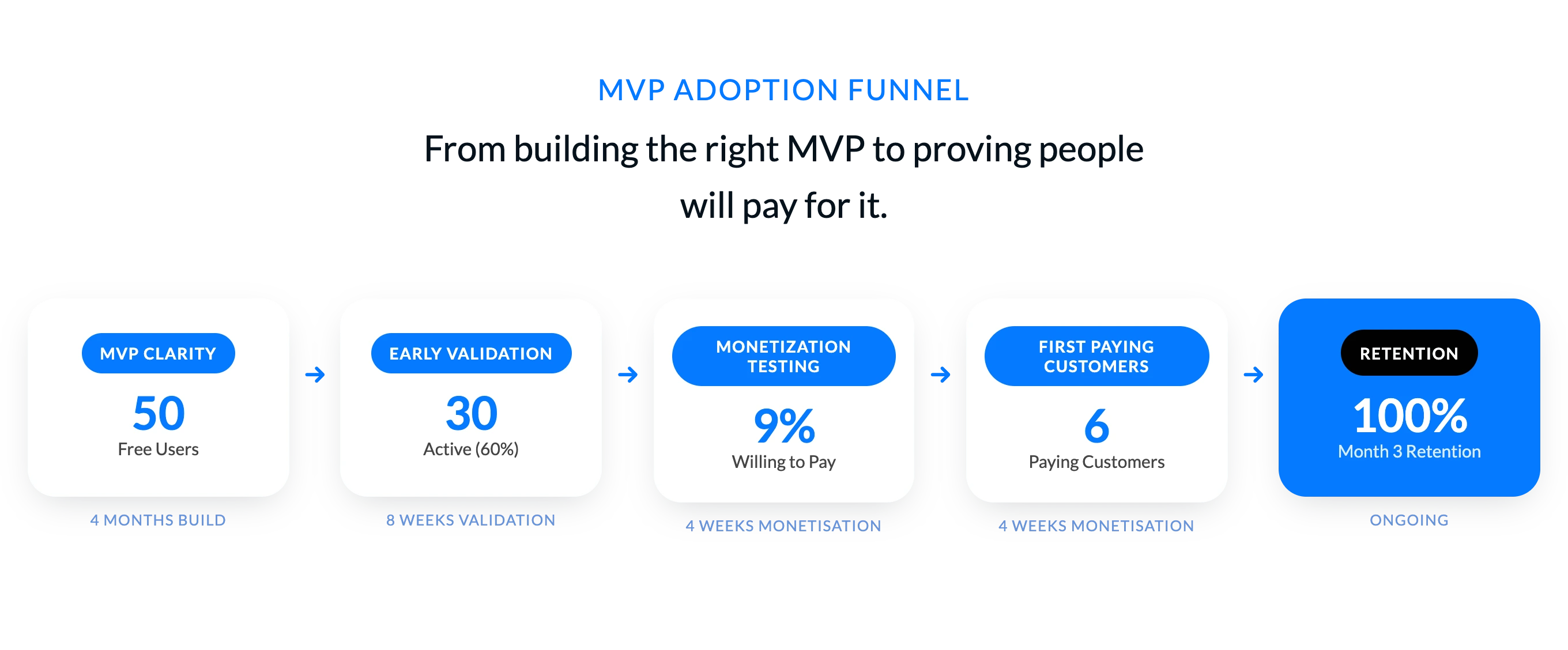
The founders faced a common temptation: build everything caregivers could ever want. Task management, collaboration, analytics, social features, integrations with health platforms, compliance tools—the list was long.
But they started specific. Not "caregiving software." Not "family coordination tools." This: primary caregivers managing multiple seniors' schedules while delegating tasks to family and practitioners.
That specificity changed everything. The MVP narrowed to one core job: shared task management and clear communication between caregivers and practitioners. Not analytics. Not gamification. Not every feature. Just the job caregivers would pay for first.
Why this matters: Clarity on who and what job means your MVP solves a problem worth money. Vagueness means you're guessing.
Beta launch happened. Real caregivers tested the platform. The retention signal was clear: caregivers came back because the MVP solved an urgent problem. Scheduling confusion disappeared. Practitioners got clarity on tasks. Communication improved.
Feature requests came in, but the pattern was telling. Users weren't asking for "more features." They asked for depth: better scheduling visibility, faster task updates, clearer role definitions.
Per Imaginary Cloud definition, an MVP must allow you to test your core hypothesis with real users. VestaConnect's hypothesis: "Caregivers will pay for a platform that simplifies coordination and reduces administrative burden." Beta users proved it. They came back regularly because they needed clarity. Free or paid, they engaged.
Why this matters: Retention tells you pricing power. Users who come back daily are showing you they value the job you're solving.
After beta validation, the decision came: charge for what you have, or build more first?
The team didn't wait. They tested monetization. The key question wasn't "what features should we charge for?" but "what job are caregivers hiring our product to do, and how much is that job worth?"
Caregivers quantified the value: hours saved per week coordinating schedules, reduction in miscommunication, fewer duplicate efforts. The job had clear economics. Time and stress reduction in caregiving are worth real money.
The insights from this phase drove the transition from beta to a sustainable paid model. Not all caregivers converted, but those who did saw the value clearly: simplified daily care coordination meant less overhead, fewer errors, better quality time with seniors.
This aligns with the Jobs-to-be-Done framework: people don't buy products, they hire them to do jobs. And they pay based on the value of the job done, not the features included.
Why this matters: Monetisation testing happens before product-market fit. You're not waiting for perfect product. You're testing if your understanding of value aligns with your customer's. If it doesn't, you've learned it during beta, not after six months of feature building.
The platform transitioned from beta to a paid model. Paying customers came because they'd experienced the problem and seen the solution work.
But here's what the team discovered: paying customers demanded different things than beta users. Beta users explored. Paying customers depended on the tool for their daily caregiving workflows. They needed reliability, seamless task coordination, and responsive support. The support load went up. Feature requests shifted from "nice-to-have" to "essential for daily use."
And churn? Low. Not because the product was perfect, but because paying customers solved a problem worth the fee. Caregiving coordination is urgent. It doesn't stop. If your tool reduces that burden, caregivers stay.
By Phase 3, the team expanded to mobile—native apps for both iOS and Android. Why? Caregivers don't sit at desks. They're managing care on the go. Mobile wasn't a feature; it was essential infrastructure for the job they hired the product to do.
Why this matters: Paying customers aren't just scaled beta users. They're a different customer. They're buying a job to be done, not exploring an idea.
If you're moving an MVP to paid adoption, three decisions dominate. Get them wrong, and you're guessing in the dark.
Specificity wins. Not "families." Not "healthcare workers." Not "seniors."
Who is the specific human who wakes up frustrated by a problem your MVP solves? What's their title? What's their day like? Can you name one?
VestaConnect made this specific: primary caregiver managing multiple seniors' schedules while coordinating with family members and practitioners. Not "anyone involved in caregiving." One persona. One person.
Why? Because specificity changes how you build, price, and sell. A $50 per month platform appeals to a caregiver with $200 monthly budget for care management. The same platform doesn't appeal to a hospital procurement department. Same product. Different users. Different outcomes.
Test specificity early: Can you describe your ideal customer in three sentences? If not, your target is too broad.
Feature creep kills MVP adoption because founders conflate "everything the user could want" with "everything they'll pay for."
VestaConnect could have built: task management, analytics, integrations with health platforms, social connectivity, compliance tracking, reporting dashboards. Let the market guide us, the thinking goes.
Instead, what's the single job paying customers will value first? VestaConnect's answer: Clear task assignment and communication between caregivers and practitioners.
Everything else (social features, advanced integrations, compliance tools) is future phases. Phase 1 MVP is: job clarity. That's the paid adoption moment.
Test with customers: Show them two options. Option A: the full-featured care platform (everything they might want). Option B: the focused MVP (the core job). Which would they pay for first? Which would they trust their daily caregiving to?
The answer is almost always Option B.
This is a founder conversation, not a survey. Not a landing page. Not a pre-order button.
Talk to five potential customers before you launch monetization. Describe the problem. Describe the MVP solution. Then ask: "If this existed at $199 per month, would you buy it?"
Not "could you see a use case." Not "is this interesting." Would you buy it?
Watch for hesitation. Watch for the qualifier ("I'd buy it if..."). Those tell you the MVP scope is wrong. The paying customer should light up. "Yes, and here's how much we'd spend."
The founder above did this with 12 potential customers. Six said "yes, immediate need." The other six said "interesting, but wait." Guess who the first paying customers were?
Beta users say "I wish you had X." Founders hear "build X."
But beta users aren't paying. They can afford to be greedy. The paying customer is different. They have budget constraints. They prioritise what actually solves their problem today.
Example from the field: Caregiving apps often get feature requests: mobile alerts, wearable integrations, AI scheduling suggestions, health analytics. But paying customers' top requests? Reliability and responsive support. The core job done well, not a bloated feature set.
Antidote: Separate beta feedback from paid feedback. Weight them differently. Beta users are exploring. Paying customers are committing.
Founders often pick a number (gut feeling, competitor pricing, cost-plus math) and hope it sticks.
What actually works: Talk to customers about their economics. If your product saves a caregiver five hours per week in scheduling and coordination, what's that worth? If it reduces miscommunication errors by 50%, what's the cost of those errors today? Now, price to capture 10 to 20 percent of that value.
Caregiving coordination has clear economics. Time saved is tangible. Stress reduced is quantifiable. Pricing should reflect that value, not arbitrary guesses.
This aligns with the Jobs-to-be-Done framework, already mentioned: people don't buy products, they hire them to do jobs. And they pay based on the value of the job done, not the features included.
Antidote: Price based on value created, not features included. And talk to customers about their numbers, not your build costs.
You've got beta users. Engagement looks good. Now you flip to paid. But you haven't answered the critical question: what makes them stay?
Retention is different from acquisition. A user who tries your app is making one decision. A paying customer staying for month three is making a different one: "this is worth the fee this month, too."
For caregiving platforms, retention comes from reliability and responsiveness. Caregivers don't switch tools mid-crisis. But they will churn if the tool fails them when they need it most.
Antidote: Retention is a feature. Plan it alongside launch. For VestaConnect, that meant mobile expansion—caregivers need the app everywhere, not just on desktop.
When you've answered these three questions:
If you can answer yes to all three, start charging. Not on day one of beta. But not six months later, either.
Depends on your customer segment. B2B, niche problem, small market? Charge early. You need revenue signals and real value commitment.
B2C, mass-market, you can afford longer. But even then, get to monetisation testing within eight weeks.
Three signals: customer acquisition cost, churn, and willingness-to-pay. If CAC is low (because customers seek you out) and churn is zero, pricing is too low. Raise it. If CAC is high and churn is high, pricing is aligned with value captured, but customer fit is wrong.
The pattern: each pricing test reveals customer fit better than the last. VestaConnect's progression—from beta to initial paid model to expanded mobile offering—reflected this learning.
Then your MVP scope is wrong, your customer targeting is wrong, or your value perception is wrong. Test anyway, at a very low price, and listen closely. Nobody paying? Your MVP solves a problem nobody will pay for. Better to learn that now than six months into feature building.
Most MVP guidance focuses on speed: how quickly you can ship something. This article focuses on validation, how quickly you can test whether anyone will pay. The difference is critical. A fast MVP that nobody pays for is a failure, not a win. Paid adoption is the proof that your MVP isn't solving a problem in the void; it's solving a problem worth money. This approach treats monetization not as a post-launch afterthought but as a validation signal built into your MVP strategy from day one. You're not asking "what should we charge once we've perfected the product?" Instead, you're asking "will anyone pay for this core problem, right now, in its current form?" That reframing transforms MVP from a feature checklist into a business model test.
Here's what founders miss when they talk about MVP: it's not the product. It's the validation. Minimum viable product is the deliverable. Minimum viable adoption is the insight.
You can have a beautiful, feature-rich MVP. If nobody pays for it, it's not viable. Viability is proof: real customers, real money, real retention. Everything else is assumption.
VestaConnect didn't start with the perfect platform. They started with a clear customer segment (primary caregivers), a specific job to solve (task coordination), and a willingness to test monetization early. By the time they expanded to mobile and added social connectivity features, they'd already validated that caregivers would pay for the core job. That's when they could build confidently.
The takeaway? Move fast on validation, not features. Test monetization early. Listen to paying customers. Build based on what they need to stay, not what everyone wants to explore.
Your MVP to paid adoption is the proof your business model exists. Everything after that is scaling.
If you're building your MVP foundation, read "Build MVP with Agile" for the process and methodology. And once you've crossed the paid adoption threshold, "Scaling MVP to Product" walks you through growing your paying customers into product-market fit and sustainable revenue.
The gap between idea and invoice doesn't close on its own. If you're navigating MVP scope, monetization decisions, or the path to first paying customers, the team at Imaginary Cloud can help. We've guided founders through this exact journey—from customer validation to pricing models to retention strategies. Get in touch to explore how we support early-stage product teams in moving from MVP to sustainable revenue.
Alexandra Mendes is a Senior Growth Specialist at Imaginary Cloud with 3+ years of experience writing about software development, AI, and digital transformation. After completing a frontend development course, Alexandra picked up some hands-on coding skills and now works closely with technical teams. Passionate about how new technologies shape business and society, Alexandra enjoys turning complex topics into clear, helpful content for decision-makers.
People who read this post, also found these interesting:
















.webp)