Written by:


Last Published:
23 June 2026
•
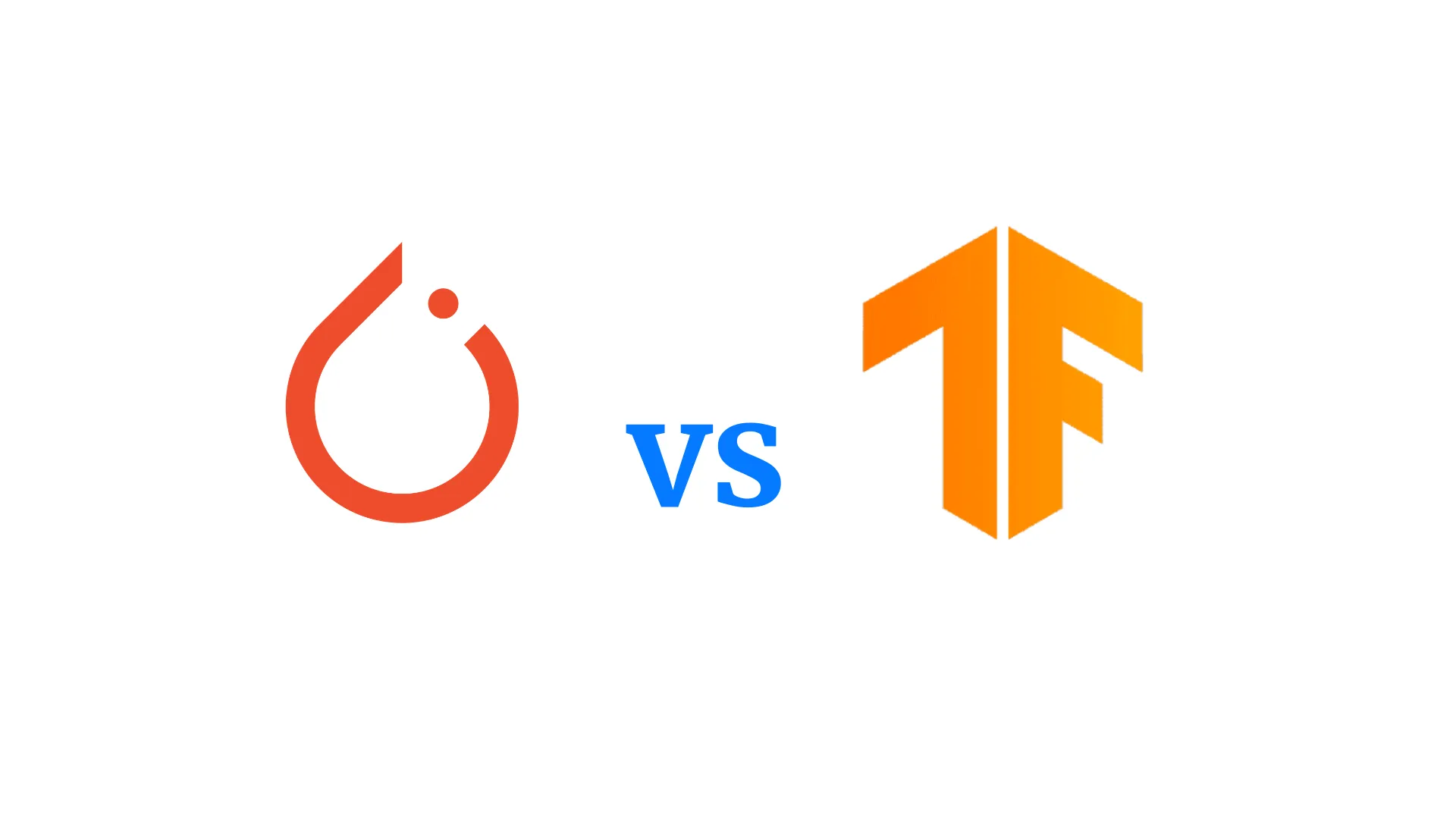
Pick almost any serious deep learning project and the same two names turn up: PyTorch and TensorFlow. They sit at the top of the field, they keep lifting each other's best ideas, and over the years they've grown so alike that telling them apart is harder than it used to be. So which one belongs in your next build? That is the question this PyTorch vs TensorFlow comparison sets out to settle.
First, a little groundwork. Deep learning is a subfield of machine learning that stacks algorithms into layers, building deep artificial neural networks that learn and make decisions on their own, much the way a human brain shunts information from one set of neurons to the next. Both frameworks live squarely in that world. Let's take each one in turn, then put them head to head.
PyTorch is an open-source machine learning library developed by Facebook AI Research Lab, first released in 2016 and distributed free under the BSD licence.
Python's data science ecosystem is unusually rich, and we covered the most useful libraries in our guide to Python for data science [internal link: IC "Python for data science" article]. PyTorch speaks the language natively: its functionalities are built as Python classes, so it slots straight into the Python package ecosystem and extends happily with other Python libraries such as SciPy and NumPy. Need to drop down a level? You can program in C/C++ as well, because PyTorch shares some of its C++ backend with Torch, the original deep learning framework.
Your first torch install is a one-liner. On most setups, this is all it takes:
One catch trips people up: the package you pip install is named torch, not pytorch. And if you plan to train on a GPU, the build has to match your CUDA version (CUDA is NVIDIA's toolkit for running code on graphics cards). Install a CPU-only wheel on a GPU machine, or mismatch the CUDA build, and PyTorch will quietly fall back to the CPU while you wonder why training crawls. Rather than guess, use the official PyTorch installation selector, which builds the exact command for your operating system, package manager and CUDA version.
TensorFlow is an open-source machine learning library created by the Google Brain team, first released in 2015 and written in Python, C++ and CUDA (NVIDIA's toolkit for running code on graphics cards).
Like PyTorch, TensorFlow is built around deep neural networks: it lets you create and combine different types of deep learning model and generate graphs of a model's performance during training. And although it began life as a Python library, in 2017 TensorFlow added an R interface for RStudio, widening its reach beyond the Python crowd.
Here's the honest answer up front. Most of the good features now live in both frameworks, so the differences that remain are about style and emphasis rather than raw capability. Project managers and data scientists reach for both as their go-to libraries when building innovative deep learning applications, or doing pure research. What's left to compare comes down to four things: how each builds its graph, how it deploys models, how it visualises them, and how it lets you debug.
TensorFlow builds its computation graph statically, defining the whole thing before the model runs; PyTorch builds its graph dynamically, creating it on the fly as the model executes. That single distinction shaped the personality of each framework for years.
Step back for the basics. A computation graph describes a calculation: a data structure of nodes and edges that, during training, stores the activations of the neural network on a forward pass (one run of the data through the network from input to output). Back-propagation then walks that graph to adjust each of the network's weights; back-propagation is the process by which the network works backwards through its layers to correct its mistakes, and it is how the network learns. PyTorch and TensorFlow agree on the foundations here. Both view any model as a DAG, a Directed Acyclic Graph, which is just a one-way map of steps that never loops back on itself. Both also operate on tensors, which you can picture as spreadsheets with depth: grids of numbers stacked into extra dimensions beyond plain rows and columns.
Then they part ways. TensorFlow draws the blueprint first, creating a stateful dataflow graph, a fixed map of operations that also remembers values as data passes through it, before the model can run. PyTorch sketches as it goes, executing nodes as the model runs and letting you alter the graph mid-flight. That sketch-as-you-go approach is why PyTorch is so often preferred in research: custom models are easier to assemble, and a dynamic graph makes it simpler to reach in and interact with the model's internals.
Does that make TensorFlow the rigid one forever? No. In 2019, TensorFlow 2.0 introduced dynamic graphs too, letting operations run at execution time without generating a graph to be run later. So what was once the headline difference between the two has mostly dissolved. Today you can work dynamically or statically in either framework.
In 2020, PyTorch introduced TorchServe, a model deployment tool covering the basics: metrics, an API endpoint specification, a model archiver tool, and so on.
TensorFlow's equivalent is TensorFlow Serving, a built-in tool for deploying machine learning models and gRPC servers (gRPC is a protocol for fast communication between services), with remote access to those servers included. It lets you roll out new algorithms while keeping the same server architecture and APIs. TensorFlow Serving was built for production from the start, and truth be told, that heritage is the strongest reason teams still reach for it.
Both frameworks support visualisation tools, which makes debugging easier and gives you a quick, broad view of how training is going.
PyTorch doesn't ship a dedicated visualisation suite, but it has Visdom, a minimalistic tool that works with Numpy or PyTorch. Visdom is flexible, reasonably easy to use and supports PyTorch tensors, though its feature set is fairly basic. TensorFlow, by contrast, has TensorBoard, which reads a deep learning model through five different visualisations: graphs, audio, images, distributions and histograms, and scalars. In our experience, TensorBoard is the more versatile of the two, so much so that PyTorch made it possible to integrate TensorBoard from version 1.2.0 onwards.
PyTorch is the easier framework to debug. Because it defines graphs dynamically at run time, you can lean on Python's standard debuggers, such as the PyCharm debugger and pdb, with very little friction.
TensorFlow asks more of you. Debugging its model code is more involved: you'll need to learn the library's own debugger, tfdbg, along with how to request variables from a session. Not impossible, just a steeper climb.
Switching frameworks mid-project is expensive, and the bill is rarely the part people expect. Both libraries are free and open source, so the licence costs nothing. The real spend is the migration tax: the senior-engineer hours it takes to rewrite training loops, rebuild data pipelines, re-validate that the ported model produces the same numbers, and re-tune everything once it doesn't.
Picture a mid-sized TensorFlow model that a team decides to move to PyTorch a year in. You are not just translating code. You are re-checking numerical parity layer by layer, re-running the test suite, and re-certifying the model for production. Realistically that is weeks of your best people's time, easily tens of thousands of pounds once you count the re-validation, for a model that already worked.
So treat the first choice as a strategic one. Lock-in risk is low on paper, since both export to the shared ONNX format, but "portable in theory" and "cheap to port in practice" are not the same thing. Match the framework to the team you have and the delivery timeline you are committing to, not to whichever one is winning the popularity contest this quarter.
Ecosystem fit is often the quiet tiebreaker, so it belongs in the decision early rather than as an afterthought. PyTorch sits at the centre of the modern open-source AI world: Hugging Face, the de facto hub for pretrained models, defaults to PyTorch, and most new research code lands there first. If your roadmap leans on off-the-shelf transformers or the latest architectures, that gravity matters.
TensorFlow's pull is strongest inside Google Cloud. Its integration with GCP and TPUs is tight and well-trodden, a real advantage if your infrastructure already lives there. AWS, for its part, supports both camps comfortably; it co-built TorchServe with Facebook, so PyTorch is a first-class citizen there too. The practical read for technical leaders: let your existing cloud and model-sourcing habits weigh on the decision, because fighting the ecosystem is a tax you pay every sprint.
Forget the feature wars for a second. In practice, the right choice falls out of five business variables, not a spec sheet. Score your project against each row, then count which way it leans.
Read it like a tally. Three or more rows pointing the same way is your answer, plain and simple. A genuine split is the one case where it pays to pressure-test the decision before you commit, because that's where the cost of choosing wrong shows up later.
Start with the problem, not the tool. Before you weigh TensorFlow vs PyTorch, get a firm grasp of how neural networks will help you build a better deep learning model for your specific purpose. The framework should follow that understanding, not lead it.
From there, a simple rule of thumb helps. If you already think in Python, PyTorch is a natural fit, because it is genuinely Python-friendly. It has won a loyal following among research-oriented developers, supports dynamic training, and gives you that smoother debugging experience. That preference shows up in the numbers: according to Papers With Code, the share of new research papers implementing their models in PyTorch rose from 51% in September 2020 to 59% in September 2024, while TensorFlow's share fell from 10% to 2% over the same period.
TensorFlow earns its keep elsewhere. It offers plenty of options for high-level model development, it is usually regarded as the more mature library, and it supports mobile platforms, which matters the moment your model needs to leave the lab. On community, it's a draw: both frameworks are well organised and come with thorough documentation, plenty of resources and free tutorials.
PyTorch and TensorFlow are both chasing the same prize: excellence at deep neural networks. They keep improving, and they keep copying each other's best features, which is exactly why picking a winner is so hard.
So where does that leave you? Roughly here: TensorFlow is the more mature library and the one most often associated with shipping AI products, while PyTorch, every bit as powerful, is the darling of Python enthusiasts and the research community. Choose the one whose strengths match the job in front of you, and you won't go far wrong.

PyTorch is usually the gentler starting point for beginners. Its code runs line by line like ordinary Python, so you can use familiar tools to inspect and debug as you go. TensorFlow has narrowed the gap by adopting Keras as its high-level interface, which is also very approachable. If you already know Python, PyTorch tends to feel the most natural.
Neither framework is reliably faster; training speed depends far more on your model architecture, hardware and optimisation than on the framework badge. Industry benchmarks like MLPerf, run by MLCommons, collect training results across both frameworks, and the winners shift from task to task and chip to chip. In practice, well-optimised PyTorch and TensorFlow land within a small margin of each other on the same hardware. Spend your effort on data pipelines, batch sizes and mixed-precision settings before you blame the framework.
Yes, though you rarely run them inside the same model. Most teams use a shared format such as ONNX to move a trained model from one framework to the other, for example training in PyTorch and deploying through a TensorFlow-based pipeline. It is more common to standardise on one framework per project and keep the other for specific tasks. Mixing them adds moving parts, so do it deliberately rather than by accident.
TensorFlow has historically been the more common choice in production, thanks to its mature deployment tooling like TensorFlow Serving and its support for mobile and edge devices. PyTorch has closed much of that gap since launching TorchServe in 2020 and now powers plenty of production systems too. In short, TensorFlow built its reputation on production while PyTorch built its on research, and both now do both. The right answer depends on your team and your deployment target more than on any league table.
For most setups, run undefined from your terminal. Note that the package is named torch, not pytorch, and that GPU users must match the build to their CUDA version. The simplest route is the official PyTorch installation selector at pytorch.org/get-started/locally, which generates the exact command for your operating system and hardware.
Yes, TensorFlow remains highly relevant in 2025. It is still a mature, widely deployed framework with strong production tooling, mobile and edge support through TensorFlow Lite, and deep integration with Google Cloud. PyTorch has overtaken it in research popularity, but that is a different contest from production reliability. For teams shipping and maintaining models at scale, TensorFlow is very much a live option.
If you are evaluating which framework to build your next AI product on, our team can help you map that decision to your architecture and delivery timelines. Get in touch.
Marketing Intern with a particular interest in technology and research. In my free time, I play volleyball and spoil my dog as much as possible.
Data Scientist with a deep passion for engineering, physics, and mathematics. I like listening to and making music, travelling, and riding mountain bike trails.
People who read this post, also found these interesting:













.webp)
.webp)