
Written by:

Last Published:
12 March 2026
•
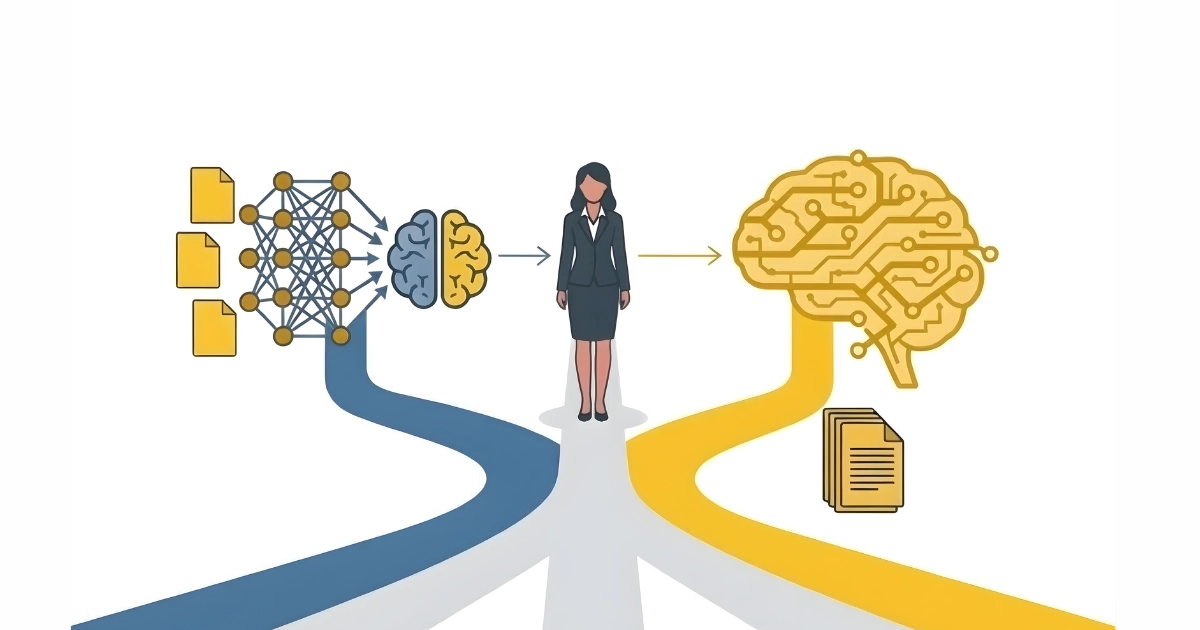
RAG vs Fine-Tuning compares two of the most widely used approaches for improving the accuracy of large language model applications. Retrieval-Augmented Generation retrieves relevant external knowledge at query time, while fine-tuning modifies the model’s internal parameters using specialised training data. The best approach depends on the type of LLM application, the stability of your data, and the level of domain expertise the model needs to demonstrate.
Choosing the right method is critical when building reliable AI systems, particularly for enterprise knowledge assistants, document search tools, and specialised AI copilots. In this guide, you will learn how RAG and fine-tuning work, their key differences, and when to use each approach to design accurate and scalable LLM applications.
Summary:
Retrieval-Augmented Generation (RAG) is an LLM architecture that improves response accuracy by retrieving relevant information from external data sources before generating an answer. It works by converting documents into embeddings, searching them through a vector database, injecting the retrieved context into the prompt, and then generating a grounded response using the language model.
In a typical RAG pipeline, company documents, knowledge bases, or product manuals are transformed into embeddings and stored in a vector database. When a user submits a query, the system performs a semantic vector search to retrieve the most relevant passages. These passages are then added to the model prompt via context injection, allowing the LLM to generate responses based on trusted information rather than relying solely on its pretraining.
Because the model references real data during inference, RAG is widely used to build accurate and controllable LLM applications.
RAG improves LLM accuracy by grounding model responses in relevant external information retrieved at runtime. Instead of relying only on its training data, the model receives additional context from documents, databases, or knowledge bases.
This process reduces hallucinations and enables the model to generate answers that reflect current, domain-specific, or proprietary information. As a result, RAG systems are particularly effective for knowledge-intensive tasks such as document question answering and enterprise knowledge retrieval.
Research from Google on retrieval-augmented models shows that integrating external knowledge retrieval with language models can significantly improve performance on question-answering tasks that require factual accuracy.
RAG is widely adopted in enterprise AI systems because it allows organisations to integrate proprietary data into LLM applications without retraining the model. Companies can connect internal documents, support knowledge bases, product manuals, or policy archives to a retrieval pipeline.
This architecture provides several advantages for enterprise deployments:
These properties make RAG suitable for production AI systems that require reliability, transparency, and frequent knowledge updates.
Many organisations are integrating retrieval pipelines into broader digital transformation initiatives powered by AI and cloud infrastructure.
RAG works best for language model systems that depend on large document collections or constantly evolving knowledge sources.
Common examples include:
AI systems that answer questions based on reports, PDFs, research papers, or technical documentation.
Assistants who help employees access company policies, onboarding guides, and operational procedures.
AI tools that retrieve answers from support documentation, product manuals, and troubleshooting guides.
Enterprise assistants that provide contextual guidance using internal data such as product information, engineering documentation, or organisational knowledge bases.
These applications benefit from RAG because the model can generate answers grounded in real and up-to-date information rather than relying solely on its training data.
LLM fine-tuning is the process of adapting a pre-trained language model by training it on a specialised dataset. This updates the model’s internal parameters, enabling it to learn domain-specific terminology, patterns, and behaviours. Fine-tuning is commonly used to improve task performance in LLM applications, such as classification, structured output prediction, coding assistance, and domain-specific reasoning.
Fine-tuning adapts the model itself by updating its parameters through additional training on specialised datasets. Engineers provide labelled or curated training data that teaches the model how to respond in a specific context. After training, the model can perform specialised tasks more accurately without requiring external document retrieval.
Because the model internalises patterns during training, fine-tuning is particularly effective for language model systems that require consistent behaviour, specialised knowledge, or structured responses.
Fine-tuning allows developers to adapt a pre-trained model using custom datasets so that the model performs specialised tasks more reliably.
Fine-tuning is the process of updating a language model's weights using domain-specific training data. During training, the model learns new patterns, vocabulary, and task structures that improve its performance on targeted use cases.
For example, a model can be fine-tuned on:
After fine-tuning, the model becomes better at recognising the types of prompts and responses that appear in that domain. This process helps build domain-adapted LLM applications that produce more reliable outputs for specialised tasks.
Fine-tuning improves LLM performance when an application requires consistent behaviour, structured outputs, or specialised reasoning rather than relying on large-scale external knowledge retrieval.
Typical scenarios include:
In these cases, the model benefits from learning patterns directly during training rather than retrieving information dynamically from a knowledge base.
Although fine-tuning can significantly improve LLM performance, it introduces operational and technical challenges.
One major cost is compute resources. Training large models requires specialised infrastructure, which increases development costs compared to retrieval-based approaches.
Fine-tuning also requires high-quality datasets, which can be difficult to collect and maintain. Poor training data can lead to inaccurate or biased model behaviour.
Another limitation is knowledge rigidity. Once a model is fine-tuned, updating its knowledge requires retraining or additional training cycles. This makes fine-tuning less flexible than RAG for applications that rely on frequently updated information.
For this reason, many modern LLM applications combine fine-tuning with retrieval pipelines, allowing the model to specialise in behaviour while still accessing up-to-date external knowledge.
The key difference in RAG vs Fine-Tuning lies in how each method improves the behaviour and accuracy of language model systems. Retrieval-Augmented Generation enhances model outputs by retrieving external knowledge at runtime, while fine-tuning improves the model by training it on specialised datasets to learn domain-specific patterns.
In practice, RAG focuses on knowledge retrieval, while fine-tuning focuses on model behaviour and task performance. Both approaches aim to improve the accuracy and reliability of large language model applications, but they solve different technical challenges within the AI system architecture.
RAG is typically implemented as part of an LLM inference pipeline, where embeddings, vector search, and context injection allow the model to reference external information. Fine-tuning, on the other hand, modifies the model’s internal parameters through training to perform specific tasks more effectively.
Because these approaches address different layers of the system, choosing among them depends on the type of LLM application, the nature of the data, and the AI system's performance requirements.
RAG and fine-tuning address two different challenges in LLM system design.
RAG solves the problem of knowledge grounding. Large language models are trained on static datasets and may not contain up-to-date or proprietary information. By retrieving relevant documents from a vector database, RAG enables the model to generate answers that draw on current and domain-specific knowledge.
Fine-tuning solves the problem of task specialisation. Even powerful foundation models may struggle with structured tasks, domain terminology, or specific reasoning patterns. Fine-tuning allows developers to adapt the model so it behaves consistently within a particular application domain.
Because of this distinction, many modern enterprise AI architectures combine retrieval pipelines and model customisation techniques to achieve both reliable knowledge access and specialised behaviour.
Neither approach universally improves accuracy more than the other. The best choice depends on the LLM application's design goals.
RAG generally improves accuracy when the task requires retrieving information from external knowledge sources, such as company documents, product documentation, or research archives.
Fine-tuning improves accuracy when the model must perform specialised tasks or follow strict output structures, such as classification, coding assistance, or domain-specific reasoning.
For many production AI systems, the most effective solution is a hybrid architecture that combines RAG with fine-tuned models. This allows the model to access up-to-date knowledge while reliably performing specialised tasks.
This section summarises the main trade-offs between RAG and fine-tuning across key operational dimensions, helping readers understand where each approach delivers the strongest value.
Key Differences
RAG is strongest when applications need fresh, traceable external knowledge. Fine-tuning is strongest when applications need consistent behaviour, specialised reasoning, or strict output control.
Knowledge Source
Update Frequency
Implementation Focus
Hallucination Risk
Best Strength
Typical Use Cases
“RAG solves the problem of knowledge grounding. Fine-tuning solves the problem of task specialisation.”
You should use Retrieval-Augmented Generation (RAG) when an LLM application needs access to large knowledge sources, frequently updated information, or proprietary enterprise data. Instead of modifying the model through training, the retrieval pipeline searches the indexed documents and provides the model with relevant context before generation, enabling it to generate grounded responses.
This approach is particularly effective for knowledge-intensive AI systems, where output accuracy depends on retrieving the correct information at runtime. Because the knowledge base can be updated without retraining the model, RAG is widely used in production enterprise AI architectures that rely on dynamic data.
Yes. RAG is particularly effective for knowledge-heavy language model systems where answers must reference large document collections.
Large language models are trained on static datasets and cannot easily access new or proprietary information. By integrating a retrieval pipeline with vector databases, RAG allows the system to search internal data sources and retrieve relevant passages before generating an answer.
This architecture is commonly used for:
Because the model receives relevant context before generating an answer, RAG significantly improves knowledge grounding and factual accuracy.
Yes. One of the main advantages of RAG is that it can work with frequently updated information.
Instead of retraining the model whenever new information becomes available, developers can simply update the vector database or document index. The next time a query is processed, the retrieval system will search the updated data and provide the model with the new context.
This makes RAG ideal for LLM applications that rely on dynamic knowledge, such as:
Because knowledge updates do not require model retraining, RAG provides a scalable architecture for maintaining accurate AI systems over time.
Enterprise AI systems frequently use RAG because it allows organisations to connect internal data sources directly to large language models while maintaining control over sensitive information.
Companies can store documents, policies, manuals, and internal knowledge bases in a vector database, then use semantic search to retrieve the most relevant information when a query is submitted.
This approach provides several advantages for enterprise deployments:
Retrieval pipelines are increasingly used to reduce hallucinations and connect models with reliable data sources, which is a key consideration when building modern AI-powered products.
For this reason, RAG has become a core architecture for many enterprise LLM applications, including AI copilots, internal support assistants, and knowledge retrieval platforms.
Fine-tuning is the better choice when an LLM application requires consistent behaviour, specialised reasoning, or structured outputs that cannot be reliably achieved through retrieval alone. By training the model on domain-specific datasets, fine-tuning LLMs updates their parameters so they learn the patterns, terminology, and response structures required for a specific task.
Unlike Retrieval-Augmented Generation (RAG), which retrieves external knowledge at runtime, fine-tuning improves the model's internal behaviour. This makes it particularly effective for task-driven LLM applications where accuracy depends on the model learning specialised workflows rather than retrieving documents.
Fine-tuning is therefore commonly used to build domain-adapted AI systems that must follow precise output formats or reasoning patterns.
Yes. Fine-tuning can significantly improve domain expertise in language model systems by training the model on curated datasets that reflect specialised knowledge.
For example, organisations can fine-tune a model using:
Through this process, the model learns the terminology, reasoning patterns, and response structures common in that domain. This allows the model to generate more accurate responses when handling specialised LLM applications.
However, unlike RAG systems that retrieve external documents during inference, a fine-tuned model relies primarily on the knowledge learned during training.
Fine-tuning is often the better approach for structured tasks that require predictable outputs.
Large language models can struggle to produce consistent formats when relying only on prompt instructions. Fine-tuning allows developers to train the model using examples that demonstrate the exact response structure required.
Examples of structured tasks include:
In these scenarios, fine-tuning improves the model’s ability to produce reliable and repeatable outputs, which is critical for production AI systems.
For production AI systems, improving model performance often requires combining model training with robust deployment infrastructure and scalable cloud environments.
Fine-tuning works best for LLM applications that require specialised task performance rather than knowledge retrieval.
Common examples include:
Fine-tuned models can learn coding conventions, internal libraries, and development workflows used by engineering teams.
Models trained on labelled datasets can categorise documents, emails, or support tickets more accurately.
Fine-tuned models can support industries such as finance, healthcare, or law by learning specialised terminology and reasoning patterns.
Models trained on annotated datasets can reliably extract information from contracts, invoices, or technical reports.
For many production systems, fine-tuning is combined with RAG architectures to create advanced language models that integrate task specialisation with knowledge retrieval.

Yes. Many modern LLM applications combine Retrieval-Augmented Generation (RAG) and fine-tuning to achieve both accurate knowledge retrieval and specialised model behaviour. In this hybrid architecture, fine-tuning improves the model's performance on tasks, while RAG provides access to external knowledge via embeddings, vector search, and context injection.
Because the two methods solve different problems, combining them often produces more reliable enterprise AI systems. Fine-tuning helps the model follow domain-specific instructions or output formats, while the RAG pipeline retrieves relevant information from knowledge bases, documents, or databases at inference time.
Hybrid architectures are increasingly common in modern AI development projects, where teams combine retrieval pipelines with specialised model behaviour.
This hybrid approach is also increasingly common in production LLM systems, where applications must provide accurate answers based on up-to-date data while maintaining consistent behaviour.
Research highlights that retrieval-augmented systems can be combined with model customisation techniques such as fine-tuning to improve both knowledge grounding and task performance in enterprise AI systems.
Advanced AI systems combine RAG and fine-tuning because each method improves a different layer of the LLM application architecture.
Fine-tuning improves:
RAG improves:
When these methods are combined, the system can generate responses that are both task-optimised and grounded in reliable knowledge sources. This significantly improves the performance of AI systems used in enterprise environments.
A hybrid RAG and fine-tuning architecture typically includes several components that work together within the LLM inference pipeline.
First, the model may be fine-tuned on a domain-specific dataset to improve behaviour, terminology, or response structure. This ensures the model performs well for the intended application.
Next, a retrieval pipeline is added to provide external knowledge. Documents are converted into embeddings and stored in a vector database. When a user submits a query, the system performs a semantic vector search to retrieve relevant passages.
Finally, the retrieved context is injected into the prompt so the model can generate a response that is both domain-adapted and grounded in real data.
This architecture is widely used for advanced LLM applications, including:
By combining model customisation and knowledge retrieval, hybrid architectures help organisations build accurate, scalable, and maintainable AI systems.
Although Retrieval-Augmented Generation (RAG) improves knowledge grounding in many language model systems, it also introduces architectural complexity and operational trade-offs. RAG systems rely on embeddings, vector databases, and retrieval pipelines, which means overall performance depends on the quality of the knowledge base and the effectiveness of the semantic search process.
If the retrieval system fails to return relevant documents, the large language model may still generate incorrect answers. In addition, the extra retrieval step can introduce latency in the LLM inference pipeline, particularly when working with large document collections.
For these reasons, RAG works best when the underlying data infrastructure, indexing strategy, and retrieval logic are carefully designed.
Yes. RAG can increase latency because the system must perform additional steps before the model generates a response.
In a typical RAG architecture, the system must:
Each step adds processing time to the LLM application pipeline. While modern vector databases and optimised retrieval systems can reduce this overhead, latency can still become noticeable in applications that require real-time responses.
Designing reliable retrieval pipelines is a core part of building production AI systems. Learn more about the broader AI development lifecycle in our guide to AI engineering tools and infrastructure.
Yes. The accuracy of a RAG system strongly depends on the quality of the vector database and the embeddings used for semantic search.
If documents are poorly indexed or embeddings fail to capture semantic meaning, the retrieval step may return irrelevant passages. This can lead to incorrect responses even if the underlying language model is highly capable.
Effective LLM applications built with RAG, therefore, require careful attention to:
Improving these components can significantly enhance the accuracy of retrieval-based AI systems.
RAG may fail to improve accuracy when the application does not depend on large knowledge bases or external documents.
For example, tasks such as classification, structured output generation, or specialised reasoning often benefit more from LLM fine-tuning than from retrieval pipelines.
RAG can also perform poorly if the knowledge base contains incomplete or outdated information. In these cases, the system may retrieve incorrect context, leading the model to generate misleading responses.
Because of these limitations, many production LLM applications combine RAG with fine-tuned models, ensuring the system benefits from both knowledge retrieval and task-specific model behaviour.
Although LLM fine-tuning can significantly improve model behaviour and domain expertise, it also introduces operational costs and long-term maintenance challenges. Fine-tuning requires specialised training datasets, compute resources, and careful model evaluation. Unlike Retrieval-Augmented Generation (RAG), which retrieves external knowledge at runtime, a fine-tuned model stores learned patterns directly in its parameters.
This means updating the model’s knowledge typically requires additional training cycles, which can make fine-tuning less flexible for LLM applications that rely on frequently changing information. For many AI systems, these limitations influence whether fine-tuning or a retrieval-based architecture is the better approach.
Fine-tuning can be expensive because it requires training infrastructure and curated datasets. Updating the parameters of a large language model often requires GPUs or specialised machine learning hardware, increasing operational costs compared to retrieval-based approaches.
In addition, preparing high-quality training datasets can be time-consuming. Data must often be:
These requirements can make fine-tuning more resource-intensive than RAG, especially for organisations building large-scale LLM applications.
One limitation of fine-tuning is that the model’s knowledge becomes static once training is complete.
If the underlying information changes, developers must either retrain the model or perform additional fine-tuning to incorporate the updated knowledge. This can introduce delays when deploying new information to production systems.
In contrast, RAG architectures allow knowledge updates without retraining, since developers can simply update the document collection or vector database used for retrieval. This difference is one reason why retrieval pipelines are often preferred for knowledge-driven language model systems.
Yes. Fine-tuning can lead to overfitting if the training dataset is too small or not representative of the real-world tasks the model will perform.
When overfitting occurs, the model becomes highly specialised to the training data but performs poorly on new prompts or slightly different inputs. This can reduce the reliability of LLM applications deployed in production environments.
To avoid overfitting, developers must carefully design the training dataset, evaluate model performance across multiple scenarios, and monitor behaviour after deployment.
Because of these risks, many organisations combine fine-tuning with retrieval pipelines such as RAG, allowing the model to benefit from both task specialisation and access to external knowledge.
Choosing between RAG vs Fine-Tuning depends on the type of LLM application, the nature of the data involved, and the behaviour you want the model to exhibit. Retrieval-Augmented Generation is designed to connect large language models with external knowledge sources, while fine-tuning adapts the model itself to perform specialised tasks.
In many cases, the best approach depends on whether the AI system requires dynamic knowledge retrieval or specialised model behaviour. Applications that rely on large document collections or frequently updated information typically benefit from RAG. Applications that require consistent outputs, domain reasoning, or structured responses often benefit from fine-tuning.
Understanding these differences helps teams design accurate, scalable LLM applications that align with their technical and business requirements.
The decision usually comes down to a single question: what does this application absolutely have to get right? Once you can name that primary requirement, the architecture tends to pick itself.
Most production systems, of course, have more than one priority, which is exactly why so many teams end up combining the two.
Many modern LLM applications combine RAG and fine-tuning to achieve both knowledge grounding and specialised model behaviour.
For example, an enterprise AI copilot may use:
This hybrid architecture allows the model to generate responses that are both domain-adapted and grounded in real organisational knowledge.
As organisations build more complex AI systems powered by large language models, hybrid architectures are becoming a common strategy for balancing accuracy, scalability, and maintainability.
Choosing between RAG and fine-tuning is a strategic architecture decision that shapes the accuracy, scalability, and reliability of your LLM applications. RAG connects models to dynamic knowledge sources, while fine-tuning improves specialised task performance. Many production AI systems combine both approaches to balance knowledge retrieval and model behaviour.
If you are building LLM applications with RAG, fine-tuning, or hybrid architectures, our team can help design and deploy scalable AI systems tailored to your data and infrastructure. Contact our team to discuss your AI project.
The difference between RAG vs Fine-Tuning is how they improve LLM applications. Retrieval-Augmented Generation retrieves relevant external information during inference using embeddings and vector search, while fine-tuning updates the model’s parameters through additional training. RAG improves access to knowledge, while fine-tuning improves model behaviour and task performance.
Neither approach is universally better. RAG works best for knowledge-heavy LLM applications that rely on documents or frequently updated information. Fine-tuning is better for structured tasks such as classification, coding assistance, or domain-specific reasoning. Many production AI systems combine both approaches to maximise accuracy and reliability.
You should use RAG when your LLM application needs access to large knowledge bases, enterprise documents, or frequently updated information. RAG retrieves relevant data from vector databases at query time, enabling the model to generate grounded answers without retraining.
Fine-tuning is useful when an LLM application requires specialised behaviour, domain-specific terminology, or structured outputs. By training the model on curated datasets, fine-tuning improves its ability to perform tasks such as classification, entity extraction, coding assistance, and domain reasoning.
Yes. Many modern LLM applications combine RAG and fine-tuning. Fine-tuning improves the model’s behaviour and task performance, while RAG retrieves relevant external knowledge through embeddings and vector search. This hybrid architecture helps AI systems produce accurate responses grounded in both specialised training and up-to-date information.

Alexandra Mendes is a Senior Growth Specialist at Imaginary Cloud with 3+ years of experience writing about software development, AI, and digital transformation. After completing a frontend development course, Alexandra picked up some hands-on coding skills and now works closely with technical teams. Passionate about how new technologies shape business and society, Alexandra enjoys turning complex topics into clear, helpful content for decision-makers.
People who read this post, also found these interesting:
















.webp)
.webp)


