Written by:


Last Published:
06 July 2026
•

Every "top software development companies" list, including this one, ranks capability: technologies, ratings, portfolios. But capability is rarely why engagements fail. In sixteen years of delivery work at Imaginary Cloud, the pattern we have seen most often is a mismatch between the partner's delivery model and the client's internal governance. Think of it as a transplant: capability is the healthy organ, governance fit is the blood type. A vendor shipping two-week sprints gets rejected by a client whose budget approvals run quarterly, no matter how strong the code. The organ was fine. The body said no.
And in 2026, with AI-assisted development compressing build timelines everywhere, process fit, not coding speed, is what separates vendors. So this article does two things for the CEOs, CTOs and engineering leaders who own this decision: it lists ten software development companies that clear a defined evaluation bar, and it hands you our Delivery-Governance Fit Test, four questions to run against any of them before you sign. Let's get into it.
Choose a software development company in two stages. First, screen for capability: at least 20 verified client reviews, a rating of 4.8 or higher, five or more years in business, and named projects in your domain. The ten companies listed below clear that bar. Second, test for fit using the Delivery-Governance Fit Test:
(1) does the vendor's delivery cadence match your internal approval cycles,
(2) can they name a project that failed and what changed afterwards,
(3) is intellectual property assignment to you complete, including reused components, and
(4) does the contract structure align incentives, ideally a fixed-price scoping phase followed by capped time-and-materials delivery?
Capability gets a vendor onto your shortlist. Fit is what determines whether the engagement succeeds.
Company descriptions below are based on each firm's published services, portfolio and verified reviews. Client feedback is quoted verbatim from Clutch reviews and retains its original spelling.


Best suited for: Scale-ups, Enterprises
Brief description: Imaginary Cloud builds front-end software and integrations for enterprises and scale-ups, designed around the people using it and connected to the systems already in place. Over sixteen years the company has codified its delivery practice into more than fifteen documented methodologies, including its scoping session and Product Development Process, and it holds ISO 9001 certification. Recognitions include Top 100 Fastest Growing Companies, Top 1000 Global Companies (2020 and 2021), UK Top B2B Company (2021 and 2022), and Europe Best Workplace 2022.
Services: Product ideation: Digital Transformation, Digital Acceleration, Scoping sessions, Product Development Process, MVP. Product development: Web and Mobile development, Artificial Intelligence, UX/UI Design, Nearshore Teams. Product improvement: Code Audit, UX Audit.
Technologies: React, Next.js, Angular, Vue, Webflow, Ruby on Rails, Node, Python, Django, React Native, Flutter, AWS, Azure, Google Cloud
Key clients: Nokia, Sage, Ernst & Young, BNP Paribas, TravelWiFi, JingaLife, Elsa, Trust Portal, Remax, Environment Intelect
Reviews: 5.0 stars on Clutch from 31 reviews
Feedback: "They always deliver on time and are very responsive to changes in scope"; "The team delivered on time and within budget, ultimately helping accelerate the overall process. Moreover, their team members were outstanding"; "We've worked with several developers, but Imaginary Cloud is the only partner that does what they say they'll do."
Methodology: Agile
Location: London, United Kingdom
Company size: 50 - 249
Founded in: 2010
Price range: $50 - $99 / hr
Culture and values: Process-oriented, with sixteen years of documented delivery methodologies rather than ad hoc practice. The engineering team is Europe-based and senior-heavy, with 90% employee retention against an industry average of roughly 43%. In plain terms: the people who start your project are usually the people who finish it. Communication, project management and budgeting are transparent by default, and the company takes ownership of outcomes, not just tickets.

Brief description: Inventive Works is an Austin-based studio that takes on three kinds of engagement: new builds (prototypes, apps and systems), modernisation of existing systems, and rescue of half-finished software abandoned by a previous vendor. That third category is a useful signal. Firms willing to inherit another vendor's codebase tend to have disciplined code-audit practices.
Services: Software design and architecture, Product design and development, Software engineering, Cloud migration services, Legacy modernisation services, Mobile and web app development.
Key clients: Texas A&M, Service Group, iAS, Prograde Digital, PetroLegacy Energy, Spitzer Industries, HC Info, The Australian Shepherd Club of America, American Campus Communities
Reviews: 4.9 stars on Clutch from 22 reviews
Feedback: "They respected my time and allowed me to have more focus on the more important aspects of my business"; "Inventive Works' team is composed of self-starting problem solvers"; "We were most impressed with Inventive Work's utmost understanding of our needs."
Location: Austin, TX, USA
Company size: 10 - 49
Founded in: 2016
Price range: $100 - $149 / hr

Brief description: Emergent Software works almost entirely within the Microsoft ecosystem: custom software, data engineering and Azure cloud work. That concentration is the trade-off to weigh. If your estate runs on Microsoft technologies, their depth in that stack is an advantage; if it does not, they are the wrong shortlist. The company positions itself as a long-term partner and offers ongoing support and managed service options.
Services: Custom software development, Website development services, Database and Analytics services, Azure Cloud services, SharePoint consulting services, Staffing services.
Technologies: JavaScript, HTML 5, CSS 3, React, Blazor, Bootstrap, Angular, Vue.js, jQuery, Azure, Cloudflare, Sitecore, Umbraco, WordPress, Xamarin, React Native, iOS, Android, Microsoft SQL Server, Power BI, Snowflake.
Key clients: The Tile Shop, State of Minnesota, The Raymond Corporation, Legrand, WSB, Toro, City of Minneapolis, Kalahari Resorts, Rice Lake Weighing Systems, Absolute Resolutions Corp, Red Wing Shoes
Reviews: 4.9 stars on Clutch from 30 reviews
Feedback: "Everything they've provided has been customized to fit our needs, so everything's exactly where we want to be"; "The team is very consistent in quality and responsiveness"; "They set up for success and don't take shortcuts to achieve their goals."
Location: Saint Paul, Minnesota, USA
Company size: 50 - 249
Founded in: 2015
Price range: $150 - $199 / hr

Brief description: Origami Studios is a US-registered firm with its development team in Pakistan, which is how it offers enterprise-brand experience (Nestle, Shell, Johnson & Johnson) at a $25 to $49 hourly rate. The portfolio is strongest in mobile: native iOS and Android, cross-platform builds, and back-end development for SaaS products. The distributed model makes time-zone overlap and communication cadence the main things to test in a first call.
Services: Custom Software Development: Web applications and back-end development, SaaS application development, and custom application development for various business models. App Development Services: Android app development, iOS app development, Cross-platform and hybrid app development. IT Staff Augmentation.
Technologies: Swift, Objective-C, Appcelerator, Xamarin, React Native, Android NDK, Java, AngularJS, Ionic, Google VR, Unity, Oculus, Vive, Azure, Amazon Web Services, Google Cloud Platform, IBM Bluemix, DigitalOcean, Firebase, Parse, Node, Python, Adobe After Effects, Axure, Adobe Illustrator, InVision, Adobe Photoshop, Sketch, Zeplin, DynamoDB, MariaDB, MySQL, MongoDB
Key clients: Nestle, Johnson & Johnson, Experian Hitwise, Shell, Asian Development Bank, Dubai Smart Government, TUV Austria
Reviews: 5.0 stars on Clutch from 43 reviews
Feedback: "The team at Origami Studios was highly professional and always delivered on time"; "Everyone's input was extremely valuable and helped keep me on task"; "The team completed everything on time and communicated effectively."
Location: Parsippany-Troy Hills, New Jersey, USA. Development team: Pakistan
Company size: 10 - 49
Founded in: 2013
Price range: $25 - $49 / hr

Brief description: One Beyond has built bespoke web, desktop and mobile applications since 1994, one of the longest track records on this list, for businesses, non-profits, government agencies and funded startups. Delivery runs through a blend of UK-based and nearshore centres under a shared methodology. The service list extends beyond builds into hosting, security testing and project rescue.
Services: Web application development, Bespoke CRM and ERP systems, Customer portal software, Application migration to Cloud, Legacy software modernisation, Team augmentation, Application support and software maintenance, Application security testing services, Hosting, Software project rescue.
Technologies: C#, Objective-C, JavaScript, Java, TypeScript, Swift, Kotlin, SQL Server / Azure SQL, MongoDB, Power BI, MySQL, PostgreSQL, Elasticsearch, SSRS, MariaDB, Azure Blob Storage, DynamoDB, Azure, Amazon S3, Google Big Data, RabbitMQ, Azure Bus, Docker, Google Cloud Storage, mParticle, AWS Kubernetes, Firebase, Nomad, AWS Lambda, Terraform, Kafka.
Key clients: Smith & Nephew, GAIL's Bakery, Costa Express, Pearson
Reviews: 4.8 stars on Clutch from 55 reviews
Feedback: "There has been no fluff to it. One Beyond is open and straightforward about what we need and what they can do for us"; "They were transparent and available to answer any questions when needed"; "They make sure that they stand behind every piece of code they ship out."
Location: London, United Kingdom
Company size: 250 - 999
Founded in: 1994
Price range: $50 - $99 / hr
Brief description: Accelerance is not a development shop. It is an outsourcing advisory that evaluates and certifies partner companies against a published vetting process, giving clients access to vetted teams in more than 40 countries. The distinction matters for how you use this list: you would engage Accelerance to find and manage a development partner, not to write code directly. Their consultants assist with outsourcing planning, selection and ongoing management.
Services: Web Development, IoT, Mobile Applications, Data Science and Architecture, UI/UX Design, MVP Development, Software QA and Testing, Database Development, Maintenance and Support, Code Quality, AI and ML, Application Performance.
Technologies: AWS, Salesforce, Microsoft, Alfresco, Android, Angular, Apex, Azure, Blockchain, Bootstrap, C++, C#, CSS 3, HTML 5, Docker, Drupal, Go, Hadoop, Ionic, iOS, Java, JavaScript, Joomla, jQuery, Kotlin, Kubernetes, Laravel, Magento, MongoDB, MySQL, Node.js, Oracle, PHP, PostgreSQL, Python, React, Ruby on Rails, SQL, Swift, Visual Studio, WordPress.
Key clients: Acrowire, Find.com, MediaPro, AdRoll, RateMyAgent, Sharpslide, MuleSoft, Kyani, GSL Solutions, Bullhorn, Epiq
Reviews: 5.0 stars on Clutch from 27 reviews
Feedback: "Accelerance helped us find the right team, and they knew how to navigate those waters successfully"; "All communication has been quick and earnest on their side, and any potential issues were tackled promptly"; "All communication has been timely with Accelerance."
Location: Redwood City, CA, USA. Development team: Latin America, South and Southeast Asia, Central and Eastern Europe
Company size: 10 - 49
Founded in: 2001
Price range: $50 - $99 / hr

Brief description: GoodCore, founded in 2005 and headquartered in Croydon with its development team in Pakistan, builds bespoke business applications, mobile apps and MVPs. Its most distinctive practice is a fixed-cost, time-bound exploration phase before full development, which produces refined design and technical requirements and gives both sides a low-cost way to test the working relationship. Clients include SWIFT and Winchester University.
Services: MVP development, Bespoke business applications, Mobile app development, Web applications, Dedicated development team, Testing and Quality assurance, UI/UX design.
Technologies: Node.js, PHP, .NET, Java, React, Vue.js, Angular, Microsoft Azure, Google Cloud Platform.
Key clients: Printed Music Licensing, Weight Loss Resources, GC Business Finance, XTracked Deliveries, One Golf Network, Harding Display, SWIFT, Winchester University, OKAY.com, Cardinal Management, Securities Commission, Psychological Services Bureau, Echovision, EZX
Reviews: 5.0 stars on Clutch from 26 reviews
Feedback: "GoodCore Software was great at grasping the concept of what we wanted to achieve"; "We think of them as a part of our team"; "GoodCore's organization, methodology, and transparency distinguish them from other providers."
Location: Croydon, United Kingdom. Development team: Pakistan
Company size: 50 - 249
Founded in: 2005
Price range: $25 - $49 / hr

Brief description: Light IT, based in Kyiv, has delivered more than 500 custom web and mobile solutions since 2006 for clients across Europe, North America and Asia. The service range is broad, from standard web and SaaS builds through to machine learning, business intelligence and blockchain work, at a $25 to $49 hourly rate. As with any single-location team, continuity planning and communication cadence are the practical points to confirm before committing.
Services: Custom Software Development, Business Digital Transformation, IT Consulting, Web, Mobile, SaaS Development, Cloud Solutions, Artificial Intelligence, Machine Learning, Deep Learning, Business Intelligence, Big Data (Data Mining and Processing), QA and DevOps services, Blockchain
Key clients: Gaming Engage, CarLend Deals, Tapway
Reviews: 4.9 stars on Clutch from 37 reviews
Feedback: "They went above and beyond the requirements to deliver the best possible work, which was nice"; "They had excellent developers who really cared about the project"; "Nothing could stop them from delivering their work."
Location: Kyiv, Ukraine
Company size: 50 - 249
Founded in: 2006
Price range: $25 - $49 / hr

Brief description: Rootstrap measures its work against business goals and return on investment rather than interface polish, and its client list, which includes MasterClass, Google, Salesforce and Universal Music Group, suggests the positioning holds up at enterprise scale. Teams sit in the US, Uruguay and Argentina, so US clients get near-complete time-zone overlap. They build products from scratch or supplement internal teams through staff augmentation.
Services: Web development, mobile development, staff augmentation, and emerging tech like AR/VR, artificial intelligence, blockchain and cryptocurrency, chatbots, and ML/deep learning.
Technologies: Ruby on Rails, Django, Node.js, NestJS, Python, Flask, Express.js, Java, Kotlin, Swift, Vue.js, JavaScript, Next.js, TypeScript, Illustrator, Photoshop, Figma, Neo4j, MongoDB, Cassandra, SQL Server, MySQL, PostgreSQL, JMeter, PyTest, Mocha, RSpec, Redis, Kubernetes, Docker, Jenkins, Ansible, Terraform, CircleCI, GCP, Azure, AWS.
Key clients: MasterClass, Google, Salesforce, Universal Music Group, FanBread, Cash Money Records, Spotify, Snoop Dogg, CES, Disney, Tony Robbins, Microsoft, Epson, Loftey, Ericsson, Die Antwoord, Live Nation, TikTok, adidas
Reviews: 4.8 stars on Clutch from 39 reviews
Feedback: "They've done their best to build the best product possible within our budget"; "Rootstrap was very responsive, and we had very open lines of communication"; "Rootstrap went beyond our expectations and was very competitive."
Location: West Hollywood, CA, USA. Development team: Latin America
Company size: 50 - 249
Founded in: 2011
Price range: $50 - $99 / hr

Brief description: Osedea is a Montreal firm that pairs design capability with engineering, working in close collaboration with clients from business analysis through to delivery. The service list runs wider than most on this list, taking in robotics, extended reality and low-code work alongside standard web and mobile builds. The client base is anchored in Quebec institutions such as the STM and the Montreal Museum of Fine Arts.
Services: Business analysis, UX audit, Usability testing, Prototyping, Visual identity, Design system, Discovery workshops, Web application development, Mobile application development, Cloud-native development, Software architecture, Technical audit, Low-Code / No-Code, Quality Assurance, Innovation with robots, Artificial intelligence and machine learning, Extended reality, Devtools.
Key clients: Société de transport de Montréal (STM), Kruger Digital Twin, Solvay, A7 Integration, Protégez-Vous!, Le Décodeur, TVA Sports, Montréal Museum of Fine Arts, Moozoom, Previz, PSA Group
Reviews: 4.8 stars on Clutch from 21 reviews
Feedback: "They accommodated our requests as the project went into the plan"; "Osedea has done everything we needed, and they've done it exceptionally well. We're happy with them"; "The team was hands-on and cared about our project."
Location: Montreal, Canada
Company size: 50 - 249
Founded in: 2011
Price range: $100 - $149 / hr
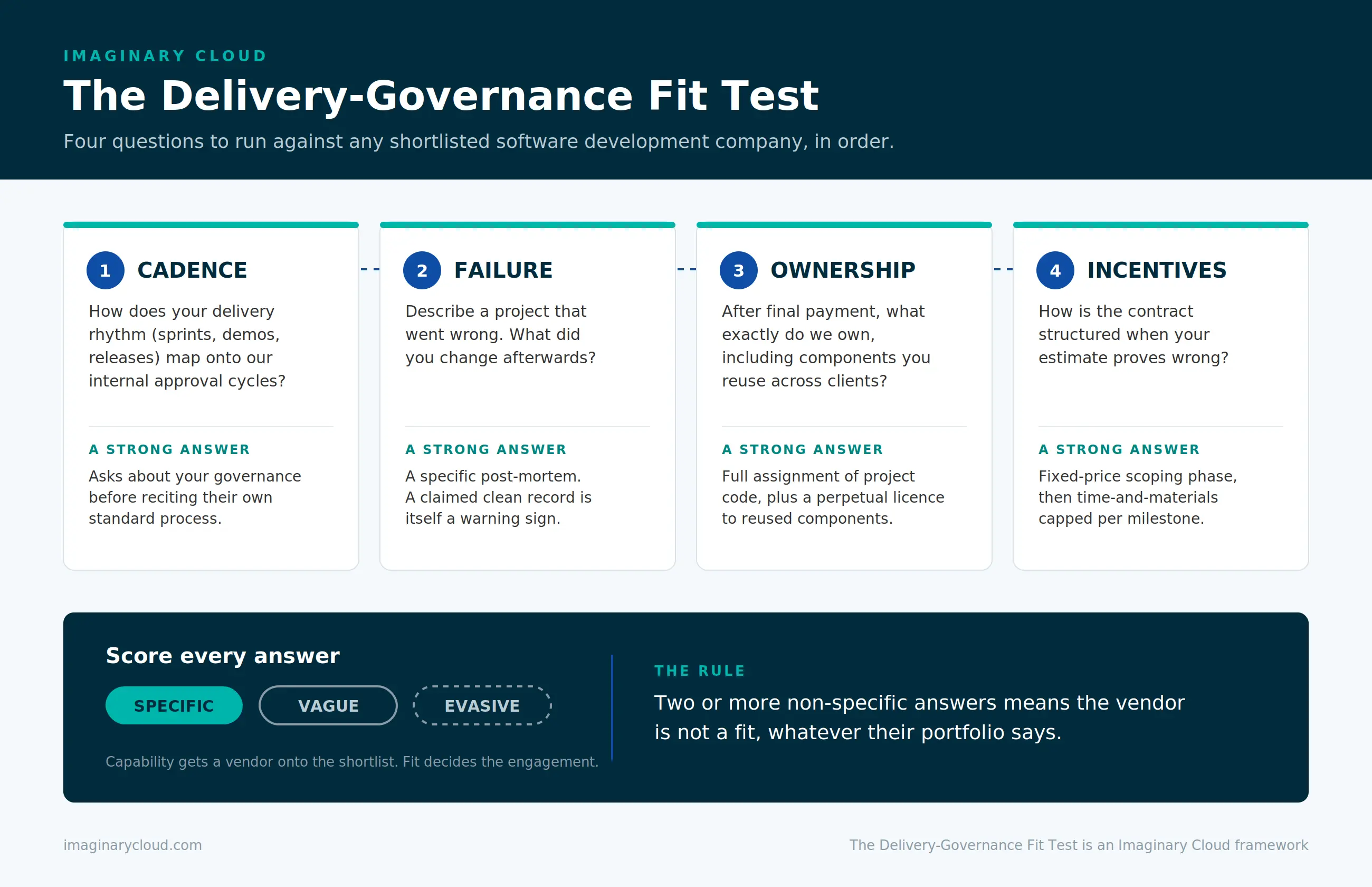
The Fit Test is the framework this article is built on, distilled from patterns we have seen across sixteen years of engagements at Imaginary Cloud. Four questions. Put them to every shortlisted vendor and score each answer as specific, vague, or evasive. Two or more non-specific answers means the vendor is not a fit, whatever their portfolio says.
Question 1: Cadence. How does your delivery rhythm, meaning sprint length, demo frequency and release process, map onto our internal approval cycles? A vendor who asks about your governance before answering is thinking correctly. One who recites their standard process is telling you, politely, that you will be the one adapting.
Question 2: Failure. Describe a project that went wrong and what you changed afterwards. A partner who claims a clean record is either new or not being straight with you. The quality of the post-mortem is the signal.
Question 3: Ownership. After final payment, what exactly do we own, including any components you reuse across clients? The acceptable answer is complete assignment of project code plus a perpetual licence to reused components, flowing through any subcontractor agreements. Anything fuzzier is a future dispute with a start date you have not agreed yet.
Question 4: Incentives. How is the contract structured when your estimate proves wrong? The structures that work align incentives: a fixed-price scoping phase that produces a costed backlog, then time-and-materials delivery capped per milestone with a defined change process.
That's the whole test. The rest of this article expands on each element and on the capability screening that comes before it.
First, the term itself. Software development uses programming languages and tools to design, build, test, and manage software applications or systems that satisfy user or corporate needs. And the stakes of choosing a partner badly are measurable: CB Insights' analysis of startup post-mortems found that product missteps, from building something with no market need to running out of cash mid-build, rank among the most common reasons startups fail. A development partner cannot fix a flawed business model. The wrong one, though, can turn a viable product into an unrecoverable budget hole.
Each factor below is a question you can put to a prospective software development company in a first call, and each has answers that are either verifiable or not. If a company cannot give you a specific answer? That is your answer.
Walk through ten vendor websites and you will meet a "software development company", a "software engineering firm", a "software house" and a "digital product studio", all describing much the same work. So which one do you actually need? Mostly, the label is marketing. The work underneath, designing, building, testing and maintaining software, is the same craft whatever the sign on the door.
The words do carry mild signals, and they are worth reading. "Software engineering firm" tends to lean technical: complex systems, architecture, teams that talk in trade-offs. "Development agency" or "studio" usually signals a design-led shop, stronger on product and interface than on heavy back-end. "Software house" is the older, catch-all term, still common in Europe. "Software development firm" and "software development company" are the neutral defaults, used interchangeably.
Read them as hints, not guarantees. A firm that calls itself an engineering company still has to answer the same Fit Test questions as everyone else. The name tells you how a vendor wants to be seen. The four questions tell you what they are.
Ask which technologies the company would use for your project and why, and expect an answer that references your constraints, not a stock list. A partner recommending a stack before understanding your existing systems is selling what they have, not solving what you need.
What about methodology? Agile, the practice of building software in short cycles with working releases at the end of each, remains the dominant approach: the State of Agile report has consistently found that the large majority of software organisations use Agile practices in some form. But the label tells you almost nothing. What matters is whether their specific cadence fits your internal approval cycles, which is Question 1 of the Fit Test, and it is worth thirty minutes of a first call on its own.
If your industry carries regulatory or domain complexity, such as fintech, healthtech, or legaltech, ask for a named project in that sector and what specifically the team learnt from it. Generic claims of "industry experience" are not evidence. A case study with a named client and a described constraint is.
Plus, check whether they can handle both complex and simple projects. A company that only shows you its largest engagements may struggle to scope a lean MVP, a minimum viable product, meaning the smallest version of a product that can be released to real users, without over-engineering it.
Does a five-star average guarantee the engagement will succeed? No. Read verified reviews for patterns rather than scores: three reviews mentioning missed deadlines tell you more than an aggregate 4.7 rating. Then ask the vendor directly: of your last five projects, how many shipped within the original budget envelope, and what happened on the ones that did not? This is Question 2 of the Fit Test in its budget form. A good partner answers with specifics; an evasive answer is a data point.
Development cost varies with duration, team size, and technology stack, but the number on the proposal is not the full cost. Technical debt, the accumulated future cost of shortcuts taken during development, determines what you pay after launch. A cheaper build that ships unmaintainable code costs more within eighteen months than a disciplined build at a higher day rate. Cheap now, expensive later.
Ask prospective partners how they manage technical debt: code review standards, test coverage expectations, refactoring cadence. Companies with real answers name their practices. Companies without them talk about "clean code" in the abstract.

Established companies bring documented process and a track record you can verify; their delivery may be more structured and slower to start. Newer businesses can move faster and take more product risk, but you are underwriting their learning curve. Neither is wrong. The question is which risk profile matches your project: a regulated enterprise system favours the established partner, an experimental product bet can tolerate the newer one.
Poor communication is not a soft factor. PMI's research on project communications identifies ineffective communication as a primary contributor to project failure. The good news: you can test it before signing anything. Note how long proposals take to arrive, whether answers to your questions are direct or padded, and whether the people in the sales calls are the people who will run your project. A vendor's pre-sales behaviour is the best-case version of their delivery behaviour. It only goes downhill from there.
A good partner will also meet you in person or over video to understand your business environment before proposing anything. If the first artefact you receive is a quote rather than questions, be cautious.
A larger team costs more and does not automatically deliver faster. McKinsey's work on small independent teams finds that small, autonomous teams often outperform larger structures on speed and innovation, because they carry less coordination overhead.
A practical rule: choose a company where your project would be among their meaningful engagements, not their smallest. Too large a vendor and you get the B team. Too small and they may lack the depth for a complex build.
The best companies create interfaces users can navigate without instruction, and they can show you the research process behind that outcome, not just the polished screens. Ask to see a usability testing report or a before-and-after conversion result from a past project. UX investment demonstrably affects conversion rates; a partner who treats design as decoration is leaving that value on the table.
Software is not finished at launch. Ask what happens in month two when a dependency ships a breaking change: who responds, how fast, and at what cost? A good partner has a named support model with response-time commitments. If post-launch support is an afterthought in the proposal, it will be an afterthought in practice.
Several companies on this list run distributed models, so the location question deserves direct treatment. There are three options, and the trade is the same in each case: cost against communication overhead.
Onshore means a partner in your own country: the highest rates, no time-zone gap, the simplest legal position. Nearshore means a partner in a nearby country with substantial working-hours overlap. For a UK or German buyer, that typically means Portugal, Spain or Poland; for a US buyer, Latin America. Rates drop meaningfully while daily standups, live demos and same-day answers remain possible. Offshore means a distant location with little or no overlap. Headline rates are lowest, but coordination costs, including handover delays, asynchronous decisions and rework from misread requirements, quietly absorb part of the saving, and they grow with project complexity.
The decision rule we give clients: the more your project depends on iteration and frequent decisions, the more working-hours overlap is worth paying for. A well-specified maintenance backlog tolerates offshore. A product being shaped week by week usually does not. For a fuller treatment, including survey data from 322 technology professionals on how companies actually use these models, see our guide to nearshore software development.
Truth be told, outsourcing development is a trade: you exchange direct control for capabilities you would otherwise spend twelve to eighteen months hiring. Whether that trade pays off depends on choosing well. When it works, the benefits are concrete.
Hiring a senior AI engineer or a cloud architect takes months and carries salary commitments that outlast the project. A development partner gives you that expertise for exactly the duration you need it, applied by people who have solved similar problems for other clients.
An established partner arrives with a working delivery process: tooling, automated build-and-release pipelines (known as CI/CD, for continuous integration and continuous delivery), and review practices already in place. You skip the six months an internal team spends building that machinery before it builds your product.
Outsourcing is often more economical than maintaining an in-house team, particularly for specialised or intermittent work. You avoid recruitment cost, employment overhead, and the carrying cost of skills you only need for one phase of the project.
Your internal team keeps working on the things only they can do: your product strategy, your customers, your domain. The partner handles the build. The alternative, pulling your best people onto a side project, has a cost that rarely appears in any budget line (though your roadmap feels it).
Experienced partners have shipped enough projects to recognise failure patterns early: scope drift, unrealistic timelines, integration surprises. That pattern recognition, applied before problems compound, is one of the least visible and most valuable things you are paying for.
Selecting a development partner is a capital allocation decision, and the questions that matter at board level are not the ones most vendor comparisons answer. Four deserve direct attention, and they map onto the four Fit Test questions.
Delivery risk. Ask each shortlisted vendor to walk you through a project that went wrong and what they changed afterwards. Then check the structural signals: team seniority, staff retention, and whether the vendor's delivery cadence fits your governance model. A misfit there shows up as missed milestones within a quarter.
Intellectual property. The contract should state plainly that all code, designs, and documentation produced for you are assigned to you on payment, including work built on the vendor's internal tooling. Ask specifically about pre-existing components the vendor reuses across clients: you need a licence to them that survives the relationship. If the vendor's team includes subcontractors, confirm IP assignment flows through those agreements too.
Contract structure. Fixed-price contracts push risk onto the vendor and invite corner-cutting when estimates prove wrong; pure time-and-materials pushes all risk onto you. The structures that work align incentives: a fixed-price discovery or scoping phase that produces a costed backlog, followed by time-and-materials delivery with a capped budget per milestone and a defined change process.
Early indicators. The first four weeks predict the engagement. Look for questions that show the team is thinking about your users rather than just your spec, a working slice of software delivered early, and bad news surfaced promptly. A partner who tells you about a problem in week three is worth more than one who hides it until week twelve.
Selection is half the work. The engagement still has to be run, and four practices prevent most of the failures we see in inherited projects.
Name a single decision-maker on your side. Vendors stall most often not from lack of skill but from waiting on client decisions. One named person with authority to answer scope and priority questions within 48 hours keeps delivery moving.
Hold a short weekly review against working software, not status reports. A demo of running code cannot hide slippage the way a slide can. If a vendor resists demoing early and often, treat it as a warning.
Track two numbers monthly: budget consumed against backlog delivered, and defect escape rate. Together they tell you whether you are buying progress or merely activity. Ask for both in the vendor's own reporting; a partner with disciplined process already measures them.
Run a joint retrospective at each milestone. Not a blame exercise: a review of what to change in the working arrangement itself. The willingness to adjust process mid-engagement is what distinguishes a partner from a supplier, and it is where the ownership you selected for shows up in practice.
No single ranking source is reliable on its own. Review platforms can be gamed, portfolios curate away failures, and awards measure marketing as much as delivery. So we assessed each company using a combination of publicly available data, verified customer feedback, technical capabilities, and business maturity, weighted as set out below. For a broader view of how analysts assess technology service providers, Gartner's research on software engineering and IT services is a useful reference point for the criteria enterprise buyers apply.
| Evaluation Criterion | Weight | What We Looked For |
|---|---|---|
| Client Reviews & Satisfaction | 25% | Verified reviews, overall ratings, review quality, and consistency across projects. |
| Technical Expertise | 20% | Breadth of technologies, software engineering capabilities, cloud platforms, AI expertise, and modern development practices. |
| Portfolio & Industry Experience | 15% | Complexity of previous projects, industries served, and notable clients. |
| Delivery Capability | 15% | Company maturity, delivery methodology, scalability, project management, and team structure. |
| Market Reputation | 10% | Awards, recognitions, certifications, and overall industry reputation. |
| Innovation & Digital Capabilities | 10% | Adoption of emerging technologies such as Artificial Intelligence, Machine Learning, cloud-native development, and automation. |
| Business Stability | 5% | Years in operation, company growth, and organisational maturity. |
To ensure consistency across the ranking, every company included had to meet the following baseline requirements:
Our evaluation is based on information gathered from multiple publicly available sources, including:
Where available, we cross-referenced information to improve consistency and reduce reliance on a single source.
Clutch remains one of the most recognised B2B marketplaces for evaluating software development companies because it verifies client reviews through interviews and project validation. However, Clutch was not the only factor considered in this ranking. We also evaluated each company's technical capabilities, service offering, portfolio, years of experience, delivery model, and overall market presence.
Although Imaginary Cloud publishes this article and is included in the ranking, every company was assessed using the same evaluation framework described above. Because software development is a fast-moving industry, this article is reviewed and updated periodically to reflect significant market changes, new recognitions, and evolving technology capabilities.
There is no sponsorship in this case.
The list above narrows the field. The evaluation itself fits into three conversations per shortlisted vendor, each with a defined purpose. Let's walk through them.
Conversation one: fit. Run the four Fit Test questions: cadence, failure, ownership, incentives. Add two checks that surface culture: give the team a real constraint from your project and watch how they reason about it, and note whether they propose a solution shaped by your context or a standard package. If the vendor is distributed, confirm working-hours overlap and communication cadence here too.
Conversation two: proof. Ask for a reference client in a similar situation to yours and actually call them; do not rely on the testimonials the vendor selects. In the same conversation, ask for their release checklist and test coverage expectations, and for a case study in your sector with a named client and a described constraint.
Conversation three: terms. Walk through the contract clause by clause: IP assignment including reused components, scope-change pricing and approval, post-launch support with response times in writing, and the exit provisions if either side wants out. Understand every term before signing. Ambiguity in a contract always resolves in favour of the party who wrote it.
A vendor who handles all three conversations with specifics has passed a harder test than any ranking can apply.
This article has made one argument: capability gets a software development company onto your shortlist, but fit determines whether the engagement succeeds. The organ has to match the blood type. The ten companies listed cleared a defined capability bar, at least 20 verified reviews, a 4.8 or higher rating, five years in business, applied equally to all, Imaginary Cloud included. What no ranking can measure is the fit between a vendor's delivery model and your governance, because that depends on your approval cycles, your risk appetite, and your contract structure. The Delivery-Governance Fit Test, four questions on cadence, failure, ownership and incentives, is how you measure it yourself, and the three-conversation structure above is how you run it in practice. The vendors who answer with specifics are the ones worth a second conversation.
Map their cadence against your governance. Ask the vendor for their sprint length, demo frequency and release process, then compare each against your internal cycles: budget approvals, security reviews, and any architecture sign-off. Friction points are visible on paper before they cost you anything. Two practical tests: ask how they handled a client whose approvals were slower than their sprints, and run a small paid scoping phase before the full build, which reveals the working relationship at low cost.
Beyond cost and timeline, six questions do most of the work: Who exactly will be on my team, and what is your staff retention rate? How does your delivery cadence fit our internal approval and release cycles? Walk me through a project that went wrong and what changed afterwards. Who owns the code, designs, and any reused components after final payment? How are scope changes priced and approved? What are your response-time commitments after launch? A credible partner answers all six with specifics; hesitation on IP or past failures is a warning sign.
You do not need to evaluate code quality directly; you can evaluate the signals around it. Compare verified client reviews for patterns, not scores. Ask each vendor to explain their proposed approach in plain language, because a team that cannot explain its plan to a non-technical stakeholder will struggle to communicate during delivery. Ask for a reference client in a similar situation to yours and actually call them. Finally, insist on a small paid discovery or scoping phase before committing to a full build.
In practice, very little. Both design, build, test and maintain software, and most firms use the terms interchangeably about themselves. Where a difference shows, it is one of emphasis: "engineering firm" tends to signal complex systems and architecture-heavy work, while "development company", "agency" or "studio" often leans more towards product and design. Treat the label as a hint about a firm's centre of gravity, then verify it against their portfolio and their answers to the Fit Test, not the word on their homepage.
It depends on how much iteration your project needs. Onshore gives the simplest communication at the highest rates. Nearshore, a partner in a nearby time zone, cuts cost substantially while preserving daily overlap for standups and live decisions. Offshore offers the lowest headline rates but adds coordination cost that grows with project complexity. The rule of thumb: the more your product is being shaped week by week, the more working-hours overlap is worth paying for. Our nearshoring guide covers the trade-offs in depth.
Hourly rates in this list range from roughly $25 to $199, driven mainly by team location, seniority, and specialisation. But the rate is only part of the cost equation. A senior nearshore team at $75 per hour that ships maintainable software often costs less over two years than a $30 per hour team whose output needs rework. Total cost is driven by scope clarity, the amount of rework, and post-launch maintenance, so a vendor's process discipline affects your budget more than their day rate.
Agile is a way of building software in short cycles, usually one to two weeks, each ending in a working, testable increment of the product. Instead of specifying everything upfront, the team adjusts priorities between cycles based on what users and stakeholders learn from each release. It is the dominant methodology in commercial software development, and its practical benefit for buyers is visibility: you see running software every couple of weeks rather than a report.
Waterfall defines all requirements upfront and progresses through fixed stages, design, build, test, release, with each completed before the next begins. It suits projects with stable, well-understood requirements and a fixed regulatory shape. Agile builds in short iterative cycles and accommodates changing requirements, which suits products still being shaped by user feedback. The practical difference for a buyer: with Waterfall you commit early and see the product late; with Agile you commit incrementally and see working software throughout.
It varies with complexity, the number of features, the methodology used, and the team's size and experience. A focused MVP, the smallest releasable version of a product, can ship in two to four months; a complex enterprise system can take a year or more. Iterative approaches shorten the time to a first usable release, which is usually the number that matters commercially.
If you are evaluating development partners for a scale-up or enterprise project, we offer a structured scoping session: a working meeting where we help you define requirements, surface the technical risks, and assess fit before any commitment on either side. Get in touch to arrange one.
Alexandra Mendes is a Senior Growth Specialist at Imaginary Cloud with 3+ years of experience writing about software development, AI, and digital transformation. After completing a frontend development course, Alexandra picked up some hands-on coding skills and now works closely with technical teams. Passionate about how new technologies shape business and society, Alexandra enjoys turning complex topics into clear, helpful content for decision-makers.
Inês Silva is a Project Manager with over four years of experience writing about software delivery, agile methodologies, and tech leadership. Because she started her career as a developer, Inês brings a real, deeply technical understanding to the management side of things. She loves bridging the gap between big-picture business strategy and day-to-day engineering execution, and she's passionate about sharing practical tips that help teams collaborate better and ship great products.
People who read this post, also found these interesting: