Written by:


Last Published:
04 August 2026
•

Nobody buys a house off the estate agent's photographs. You book a survey and go up into the loft. Choosing a software development company deserves the same instinct, and it rarely gets it, because the photographs are so good. Four things predict the outcome more than anything on that website: real depth in the technology you need, a delivery process you can inspect week by week, a contract that transfers source code and IP to you, and a verified answer to where the developers actually sit. Everything else, price included, comes after those four.
Is the effort worth it? McKinsey's landmark 2012 study with the University of Oxford examined more than 5,400 IT projects and found that large software projects run, on average, 45% over budget while delivering 56% less value than predicted. Vendor selection is where most of that risk is priced in or designed out.
Most selection processes fail in the same three moves. They begin with a search instead of a specification. They compare vendors on price, because price is the only number that lines up neatly in a spreadsheet. Then they sign a contract written entirely for the happy path.
We built the Partner Fit Framework out of the pattern we kept seeing from the other side of the table: more than a decade of client engagements, plus the rescue projects that arrived after somebody else's selection went wrong. It runs in four stages. Each one produces something the next stage actually uses.
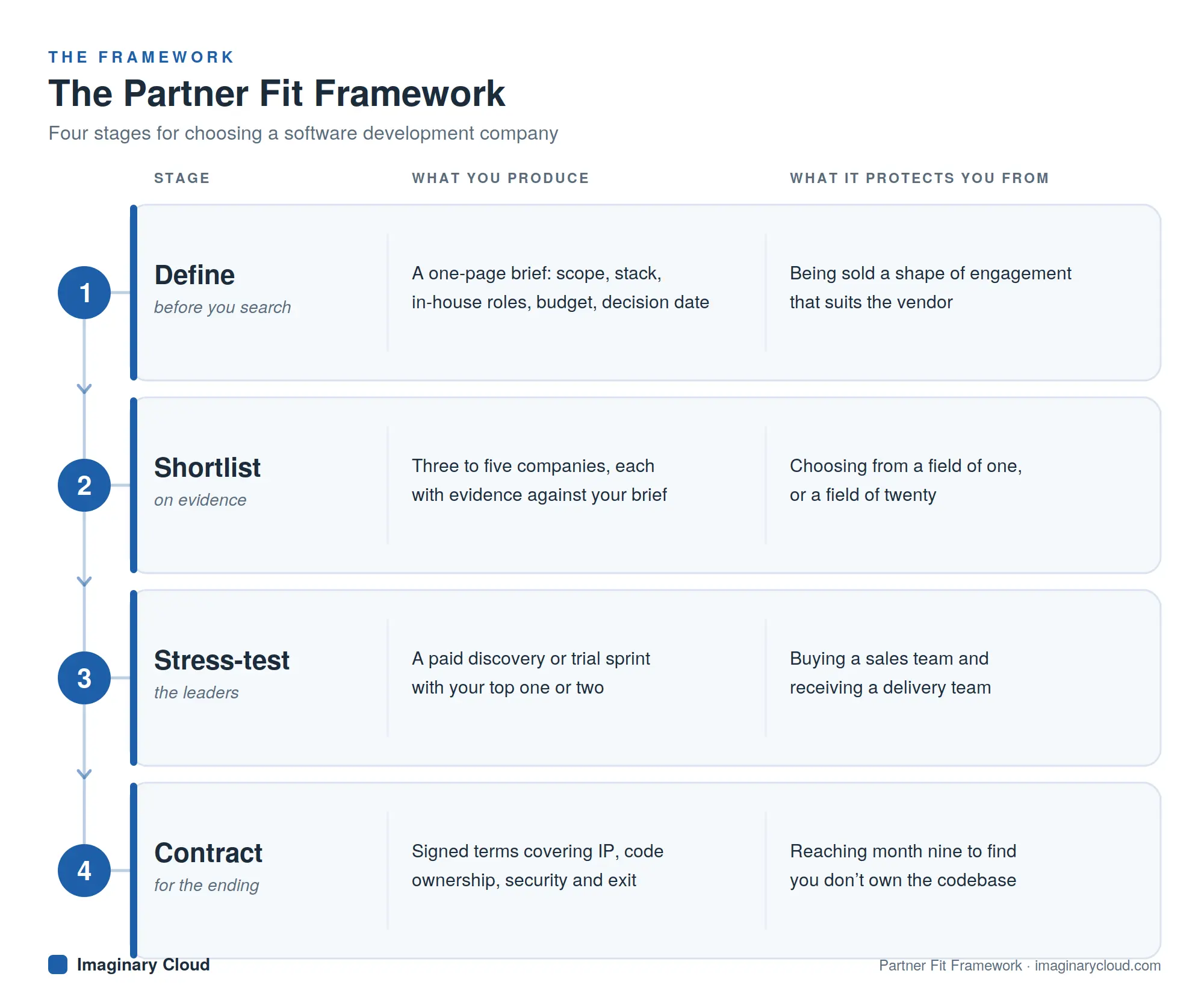
Write the brief first. What type of application you want, whether you are starting from scratch or extending something that already exists, which roles and technologies you already have in-house, and the budget band you can genuinely approve. Add your decision date, because a selection process without one drifts for months.
One page does more work here than it looks like it should. It turns a vendor conversation from a pitch into an assessment, and it is the reason you will spot a company proposing a model that suits its bench rather than your problem.
Now you research. Directories such as Clutch and Techreviewer publish verified client reviews, and Google will surface the rest. Read the negative reviews at least as carefully as the positive ones. A vendor with no criticism anywhere has either done very little work or curates very aggressively. It is also worth reading a curated shortlist or two: our own rundown of the top software development companies is a reasonable place to calibrate expectations.
Aim for three to five companies. Fewer than three gives you no basis for comparison, more than five and the process collapses under its own weight.
Start with the portfolio, and look for case studies close to yours, whether in problem shape or in market. Where the portfolio lists live websites and applications, open them. Use them. A portfolio you can test is worth more than one you can only read.
Then the reviews, and where the work includes mobile applications, the ratings in the Apple App Store or Google Play. Do not rely on testimonials alone, because they are the easiest part of any website to manufacture. Ask your own network, and look for named reviewers on Clutch you could plausibly ring.
With technology, less is usually more. You want people who work daily in the technology they claim, not people who list it.
So be careful when a software development company's landing page carries thirty logos. If you need a React front end, find a company working mainly in React or something adjacent to it. Breadth on a landing page is a sales decision; depth in a repository is a capability. Ask how many of their developers have shipped production work in your primary technology in the last twelve months, and treat a vague answer as an answer. If you are still weighing the stack itself, our guides to choosing a tech stack and the Kotlin versus Java decision walk through the trade-offs in more depth.
A process you can inspect leads to a product you can predict. Find a company that runs retrospectives, meaning the structured end-of-sprint reviews where a team examines its own delivery and changes something as a result. Then ask what they changed after the last one. The pause before the reply is informative.
The Agile methodology is the default now, so its presence tells you almost nothing. The tooling and the cadence tell you plenty: which chat tool the team actually lives in, such as Slack, which tracker holds the work, such as Jira, how often you see running software rather than a status update, and who picks up the phone when something slips.
Pick a company roughly your own size and you get one significant advantage: you are a real customer rather than a rounding error. A vendor several times your size will staff you accordingly. A vendor much smaller may never have run at your scale.
Which is why partnering with a company far larger than yours is a trap rather than a prize. The attention you get during the sales process is not the attention you will get during delivery.
It is easy to get pulled into comparing hourly rates and hunting the cheapest option. The rate is not the relevant number, though. Total cost of ownership over the first two or three years is what counts: build, rework, hosting, and the people who will maintain whatever you were handed.
Choosing on price alone tends to produce technical debt, the accumulated cost of shortcuts that later get paid back with interest. In the rescue work that reaches us the pattern is consistent: a build that came in materially under the rest of the market, and a rewrite starting inside two years. That build was not cheaper. Ask any prospective partner what happens to your codebase if you stop working with them, and price the answer.
Take a real one. When FlippedNormals, a computer-graphics marketplace carrying more than 28,000 products and several terabytes of asset libraries, came to us, the constraint was not price but a stack that had stopped scaling. We chose to re-platform rather than keep patching: the database moved from WordPress MySQL to PostgreSQL, and the infrastructure from Heroku, whose scaling limits were the whole problem, to AWS. The first stage completed in two months, traffic rose 4%, and the engagement then continued as ongoing development, from payment integrations to campaign tooling to an SEO audit, rather than ending at handover. The point is not the tooling. It is that the expensive decision had been taken years earlier: to build somewhere that could not grow.

Sales conversations select for good salespeople. Truth be told, the only reliable way to assess a delivery team is to buy a small amount of delivery: a paid discovery, a technical audit of what you already have, or a two-week trial sprint with the developers who would actually be assigned to you. It costs a fraction of the engagement, and it surfaces in a fortnight what a reference call never will.
Insist on meeting the named people, not the account team. Ask how long they have been there, because a vendor with high turnover will be onboarding a new developer onto your codebase every few months, at your expense.
Working relationships are built on candour more than warmth. You will be discussing scope, cost and disappointment with these people for months, so the test is not whether the first meeting was pleasant. It is whether anyone was willing to disagree with you in it.
A partner who accepts every requirement without challenge is either not listening or not experienced. Transparency and open communication are what let you find the problem in week three rather than month six.
Being kept updated on progress only means something when the update is running software. Constant demos, at the end of every sprint, against something you can click: that is what makes a delivery timeline verifiable. It runs both ways, mind. The team needs specifications and decisions from you at the same cadence, and a vendor who says so out loud is describing how delivery actually works.
At Imaginary Cloud we make demos a fixed part of the process rather than a milestone, because a fortnight is the longest useful interval between a wrong assumption and its discovery.
Success is not only a function of the technology. A development partner should be able to challenge a proposed feature on commercial grounds, help you sequence a roadmap around revenue rather than around architecture, and tell you plainly when the cheaper option is good enough.
That is why we staff cross-functional teams with Business Analysts and Project Managers alongside developers, and why we keep business and engineering in the same conversation. It shortens the feedback loop between a commercial decision and its technical consequence.
Communication has to survive time zones and language. English fluency is a baseline in this market rather than a differentiator, and you want to hear it from the developers, not the account manager.
Think twice before outsourcing to a market with a very different working culture. Not because talent is unevenly distributed, but because assumptions about escalation, deadlines and disagreement are.
Then confirm where the team really is. Some companies present as United States or Europe based while the development work sits elsewhere, and that has consequences for security, working hours and IP enforceability. Checking takes five minutes: open the company's LinkedIn page, look at the employee list, read the locations. If the sales team is in London and the ninety developers are not, you now know what you are buying, and you can decide whether you mind.
Every project is uncertain to a different degree, and the pricing model should match the degree. If mockups, specifications and user stories are not settled, a time and materials engagement is the honest structure: you pay for work performed, and scope moves as you learn.
If you have a well-documented product and prior experience building something similar, fixed price can work. Just know that a fixed-price bid carries a risk premium to cover what the specification does not say, and in the proposals we see it usually runs at a quarter or more of the estimate. A fixed price does not remove uncertainty. It pays someone else to carry it.
The contract is written while everyone is optimistic and read when they are not. So make sure it addresses the end of the relationship as clearly as the start: who owns the source code, what handover looks like, what notice applies, what happens to credentials and infrastructure.
At minimum, insist on a clear statement that you own the source code with IP rights transferred to you on payment, and on documented security measures protecting your intellectual property and your users' data.
The eleventh criterion is the one companies discover too late: losing control of the asset they paid to create. Intellectual property protection is not standard in every vendor contract, and its absence is rarely advertised.
Do this work before signing, not after. Have your own contract drafted, or ask for theirs early enough that legal counsel can review it without holding up a start date. The instruments that matter:
A partner worth having will not flinch at any of this. Some of our own most significant work, such as our engagement with EY, sits permanently behind an NDA, which is precisely the point: the confidentiality you ask for is the confidentiality your own users and competitors will one day rely on.
Since this framework was first written, one thing has reshaped the market: nearly every credible team now writes code with AI assistance. That has two consequences for how you choose a partner, and they pull in opposite directions.
The first is on price. Through 2024 and 2025, published rates in Eastern Europe and parts of Asia softened as AI tooling lifted throughput, while nearshore Latin America held firmer on the strength of time-zone overlap. So the rate card you compared eighteen months ago is not the one you are comparing today, and a two-year total cost of ownership matters more than ever, not less.
The second cuts the other way. When a junior developer with a good model can produce plausible-looking code in an afternoon, "we use the latest AI tools" tells you nothing; everyone does. What separates teams now is review discipline: who reads the generated code, who owns the architecture the model cannot see, and who is accountable when an AI-suggested dependency turns out to be abandoned or insecure. Ask a prospective partner how they review AI-assisted work before it reaches your repository. A team that treats the model as a drafting tool under human ownership is buying you speed. A team that treats it as a substitute for senior judgement is selling you technical debt with a faster clock on it.
The practical upshot: AI makes the depth-beats-breadth test and the inspect-the-process test more important, not less. Speed is now cheap. Judgement is not, which is the whole reason the four stages above still hold.
Some signals are worth walking away from rather than negotiating around:
Geography drives cost, overlap in working hours and legal exposure. Four common models, and each buys you something different.
Onshore development means working with a company in your own country. You collaborate with teams in your language, your time zone and your legal jurisdiction, and enforcing a contract is straightforward. The drawback is cost, typically well above the alternatives.
Offshore development means engaging a team in a distant country to deliver the work remotely. The main benefit is price. The costs are the ones that never appear on the invoice: limited working-hour overlap, slower feedback loops, harder legal recourse.
Nearshore development is the middle ground, a team in a country close enough to share most of your working day. It balances efficient communication against real cost savings, which is why it has quietly become the default for European and North American buyers. We have written a fuller guide to picking a nearshore development partner if that is the route you are weighing. It is the model we run ourselves, from Lisbon and Coimbra alongside a London office.
Hybrid outsourcing combines management in your region with development elsewhere. You deal with people in your language and working hours while they absorb the time zone difference. It works when the management layer has real authority, and adds a layer of relayed messages when it does not.
Rate cards vary by an order of magnitude across these models, and they have moved recently: 2024 and 2025 brought softening rates in several offshore regions as AI tooling raised throughput, while nearshore rates held on the strength of overlap. Treat any published figure as perishable. The current bands on Clutch are a starting point only; then compare a two-year total cost of ownership rather than an hourly rate.
Fixed-price pricing looks like the safer model. A known number, a defined scope, a delivery date. It reduces the risk of overspending only if the specification is genuinely complete.
In a fixed-price model, every business and product decision and the full scope of work has to be decided, documented and contracted before development begins. Which is why it pairs with Waterfall project management, the sequential approach where each phase completes before the next one starts.
Time and materials, which pairs with Agile, bases cost on time actually spent at an agreed hourly or daily rate. Scope stays adaptable as business, design and engineering teams learn what users need.
| Fixed price | Time and materials | |
|---|---|---|
| Scope flexibility | Low. Exact scope and requirements are fixed before development begins | High. Requirements and shape can change as business circumstances do |
| Speed to a working product | Determined by specification quality. Fast if scope holds, but long projects are hard to size, which risks delay | Varies. Specification quality still drives speed, but the team absorbs change faster |
| Product-market fit | Constrained by the scope defined up front and the quality of its validation | Higher. New value discovered during delivery can be built |
| Cost | Defined up front, negotiable in some cases, and carries a risk premium | Harder to forecast. Cheaper in some cases, dearer in others, with potentially higher ROI per pound spent |
| Who carries the risk | The vendor, priced into the premium | You, in exchange for control |
Building a minor feature, with both the requirement and the solution clear? Either model works.
Building a complete product for a stable market, requirements documented, no significant unknowns? Either can work well.
In practice, though, requirements change. If time to market is critical or the runway is limited, the requirements analysis will never be complete, so enter a fixed-price engagement expecting scope renegotiation. Plan for it rather than resent it.
And if you are building for a fast-moving market, or you are not yet certain how the product should work, time and materials is the right structure. You give up cost certainty and gain a much higher probability of getting what you actually need. Where there is a runway, make sure everyone in the engagement knows the budget.
One more distinction shapes what you should be shopping for. A custom software development company builds a bespoke system end to end and owns delivery of it. Staff augmentation places developers inside your existing team, under your management. A dedicated product team sits between the two: a standing cross-functional group that owns a product area alongside you.
Go the custom build route when you have no internal engineering capacity to direct, staff augmentation when you have strong technical leadership and a capacity gap, and a product team when the work is continuous rather than a project with an end.
Cost depends far more on region and seniority than on the individual vendor. As of 2026, published rate data puts North American and Western European senior teams several times above South and Southeast Asian rates, with Eastern Europe and Latin America in between, though those bands shifted through 2024 and 2025 as AI tooling raised throughput. Rather than compare rates, compare a two-year total cost of ownership including rework and maintenance.
Open the company's LinkedIn page and read the employee locations. A company presenting as European or American while most of its engineers are elsewhere is not automatically a poor choice, but you should know before signing, because it affects working hours, security and how enforceable your contract is.
Only whoever the contract says. Ownership is not automatic and it is not always included by default. Require a clause transferring copyright and IP in all deliverables to you on payment, covering source code, designs and documentation, and confirm what happens to repository access if the relationship ends.
Six things: IP and source code transfer, an NDA, scope and change-control terms, security and data-handling obligations, notice periods, and a handover clause covering code, credentials and documentation. Have your own counsel review it, and ask for the draft early so the review does not delay your start date.
Usually yes, and the gap is meaningful without being as wide as offshoring. Nearshore teams share most of your working day, which reduces the coordination overhead that erodes offshore savings. For most European and North American buyers, nearshoring gives the best ratio of cost saving to communication quality.
Four to eight weeks for a serious process: one week to write the brief, two to three to shortlist and meet, two to four for a paid discovery or trial sprint. Compressing it below that usually means skipping the stress-test stage, which is the stage that tells you the most.
A custom software development company owns delivery of a bespoke system, providing the team, the process and the accountability. Staff augmentation supplies developers who work under your management inside your existing team. Choose the first when you lack engineering leadership capacity, the second when you have it and need more hands.
It lowers the value of speed and raises the value of judgement. Assume every team uses AI tooling; the real question is who reviews the output, owns the architecture and is accountable for AI-suggested dependencies. Ask how AI-assisted code is reviewed before it reaches your repository.
No clear answer on code ownership, a quote well below the market, a landing page claiming every technology, generic testimonials with no named client, and reluctance to name the developers who would work on your project. Any one of these justifies ending the conversation.
Here is the whole thing in one line: go up into the loft before you buy the house. Define the brief before you look, shortlist three to five companies on evidence, stress-test the leaders with paid work rather than reference calls, and write the contract for the ending as carefully as the beginning.
Avoid the common traps too. Do not partner with a company so much larger than yours that you become a rounding error, do not choose on rate, and do not sign anything that leaves source code ownership ambiguous.
If it would help to talk your brief through with people who do this work daily, we are glad to have that conversation. Imaginary Cloud runs discovery sessions and technical audits as standalone engagements, precisely so you can assess a partner before committing to one. You can browse the work itself while you decide.
Alexandra Mendes is a Senior Growth Specialist at Imaginary Cloud with 3+ years of experience writing about software development, AI, and digital transformation. After completing a frontend development course, Alexandra picked up some hands-on coding skills and now works closely with technical teams. Passionate about how new technologies shape business and society, Alexandra enjoys turning complex topics into clear, helpful content for decision-makers.
Inês Silva is a Project Manager with over four years of experience writing about software delivery, agile methodologies, and tech leadership. Because she started her career as a developer, Inês brings a real, deeply technical understanding to the management side of things. She loves bridging the gap between big-picture business strategy and day-to-day engineering execution, and she's passionate about sharing practical tips that help teams collaborate better and ship great products.
People who read this post, also found these interesting: