A legacy platform isn't just slow but a tax on growth. NotaryCam's story shows what happens when you finally pay it.
NotaryCam, a leader in online notarization and mortgage eClosing solutions with over 30 years in the US market, faced a familiar tech crossroads. The business was thriving. Fortune 500 customers, 98% customer satisfaction, millions in transaction volume. But the platform running it all? Built on WordPress. Designed for content, not for the complex transaction workflows modern notarization demands.
By 2024, that constraint had become existential. The company wanted to scale to one million remote notarization transactions. The existing architecture couldn't safely deliver it.
Here's how NotaryCam and Imaginary Cloud tackled legacy modernisation, and what the results reveal about moving from outdated tech to cloud-native infrastructure without losing the trust your customers have placed in you.
WordPress powers roughly 43% of the web, and for good reason. It was built well for what it was designed to do: publish content. But WordPress becomes a constraint the moment your business logic outpaces its architecture.
For NotaryCam, the symptoms were classic:
The economics were plain: stay on WordPress and hit a ceiling; invest in modernisation and unlock growth.
This is where legacy modernisation starts. Not with technology choices. With the honest question: does our current stack let us serve customers at the level they expect?
NotaryCam's answer was no.
Modernisation isn't binary. You don't have to choose between ripping everything out and limping along with patches forever. But NotaryCam's situation called for a real rebuild, and there's a specific reason why.
The company couldn't achieve its goals through incremental updates because the problem wasn't superficial. It wasn't a slow API or a clunky UI but an architectural mismatch. WordPress is document-focused; NotaryCam needed a transaction-focused platform. Patching that gap would mean wrapping so many API layers and middleware around WordPress that they'd lose the simplicity and performance gains they were after.
So NotaryCam and Imaginary Cloud committed to a redesign. Not a rewrite of the entire business, but a modern front-end layer and rethought user flows.
The approach followed Imaginary Cloud's Product Design Process:
Analysis: Research into NotaryCam's user journey, pain points, and competitive positioning. What workflows matter most? Where do users drop off? What does modern notarization UX look like?
Ideation: Based on findings, design new workflows. How should a mobile user experience a notarization? How can the interface communicate status and trust?
Execution: Build the new front-end (React), integrate with proven back-end logic, migrate customer data safely.
MVP Launch: Phased rollout, parallel running, gradual cutover.
This is legacy modernisation in practice: design first, code second. Modern architecture follows from understanding what users actually need, not the other way around.
NotaryCam's team worked with Imaginary Cloud's Specialised Squad model: UX/UI designers, front-end developers, and a project manager aligned on the same goal. Deliver a platform that scales to one million transactions while improving the user experience.
The technical decision was React for the front-end. React's flexibility, performance, and ecosystem made sense for a platform handling complex workflows at scale. The WordPress back-end wasn't discarded (it still powers content and integrations), but the transaction layer decoupled from it.
This matters because it shows a pragmatic approach to legacy modernisation. You don't burn down the whole building to fix the roof. You identify the core bottleneck (in this case, the front-end and user experience), modernise that layer, and leave working infrastructure in place.
The real work, though, was design. Imaginary Cloud's team mapped user journeys: how does a notary conduct a remote signing? How does the client experience it? Where do we lose people? What signals trust? The team researched remote notarization standards and best practices to ensure compliance and user confidence.
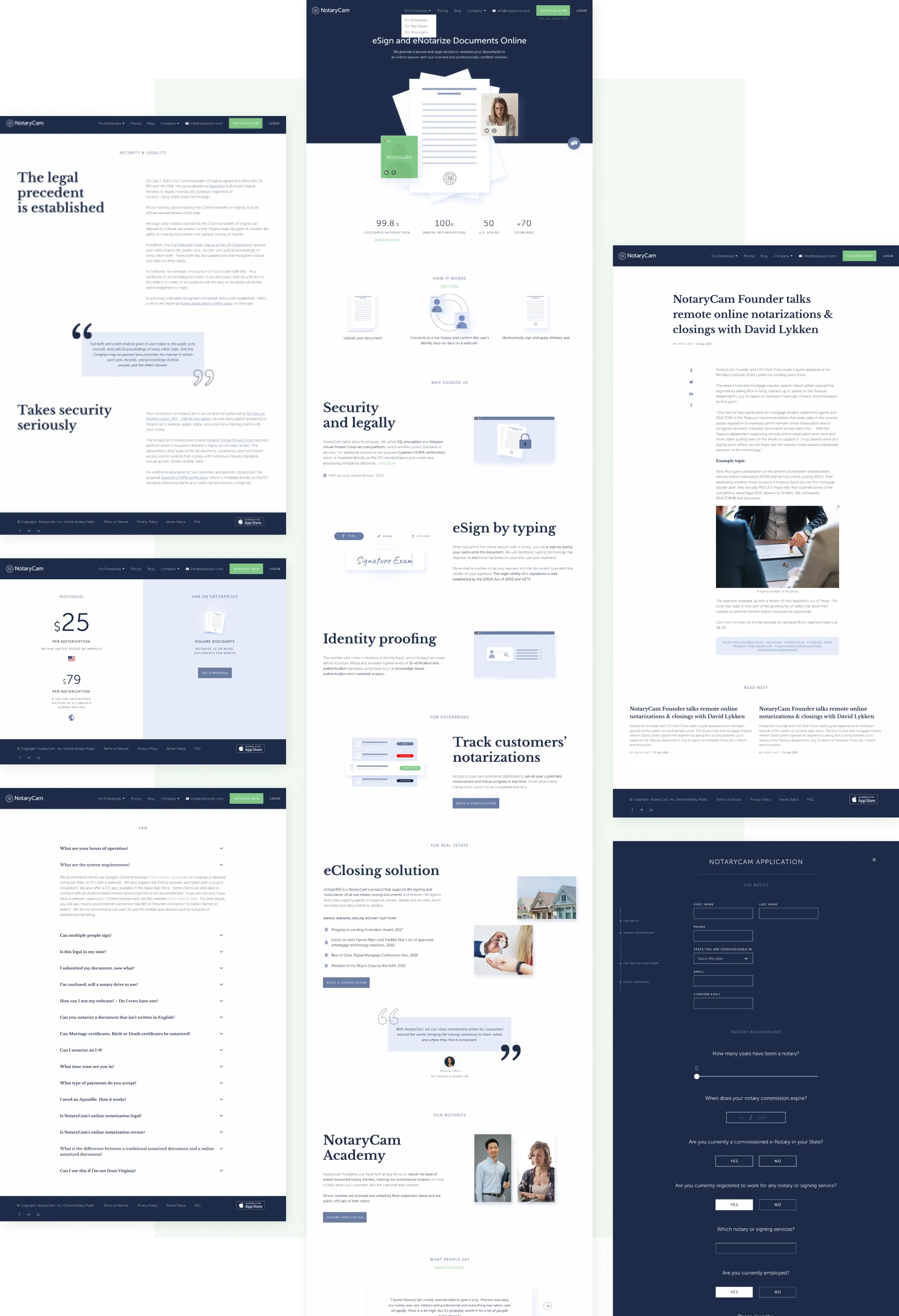
From research came a redesigned interface:
The result was a notarization platform that felt modern. Customers could see immediately that this wasn't a legacy system getting a coat of paint. This was a rebuilt experience.
NotaryCam achieved one million remote notarization transactions on the new platform. Not despite the modernisation. Because of it.
The metrics tell the story:
But numbers alone don't capture what happened. The platform that was a constraint became an asset. NotaryCam could now:
This is what legacy modernisation achieves when done right. It doesn't just solve yesterday's problems. It unlocks tomorrow's opportunities.
If your fintech, legal, or mortgage platform runs on legacy tech, you've probably had this conversation: "Should we rebuild or improve what we have?"
The answer depends on one thing: is your current architecture a limiting factor on growth?
Warning signs you need modernisation:
If three or more of these apply, modernisation isn't optional. It's the difference between growing and plateauing.
The good news: modernisation doesn't have to be all-or-nothing. NotaryCam's approach was phased. The company could test new infrastructure, run parallel systems, and cut over gradually. Risk was managed; customers saw zero disruption.
The timeline varies, but the principle is constant. Cloud migration best practices show that phased approaches reduce risk and improve success rates. Modern platforms enable growth that legacy platforms foreclose.
When your platform becomes a visible constraint on business goals, whether that's transaction volume, feature velocity, or customer satisfaction, it's worth the investment. NotaryCam saw one million transactions as the outcome, not the justification. The justification was "we can't scale safely on this architecture."
Not if you do it right. Parallel running, phased rollout, and careful cutover mean customers stay on stable infrastructure throughout. NotaryCam's customers didn't have to change behaviour during the transition.
It depends on your approach. NotaryCam kept the WordPress back-end for content and integrations (no point rewriting what works). The transaction layer was rebuilt in React because that's where the bottleneck was. Don't modernise for the sake of modernising. Modernise where it matters.
Scaling does help, up to a point. But there are architectural ceilings. You can throw infrastructure at WordPress until it handles 10 million transactions per month, but you'll spend far more on hosting, maintenance, and engineering workarounds than you would on a proper redesign. Plus, you still won't get the user experience improvement, feature velocity, or talent attraction that modern architecture brings.
Ask: "Is this a bottleneck for the customer experience or our business growth?" If yes, modernise it. If no and it's working, leave it alone. Unnecessary rewrites are expensive and risky. Modernise strategically, not evangelically.
Legacy modernisation isn't about chasing new tech for its own sake. It's about recognising when your platform has stopped serving your business and committing to fix it.
NotaryCam went from a company constrained by its architecture to a company competing on platform quality. One million transactions wasn't the goal. It was the proof that modernisation worked.
If your business is built on legacy infrastructure, the question isn't whether you can afford to modernise. It's whether you can afford not to.
Want to explore how modernisation could unlock your platform's potential? Imaginary Cloud's Digital Product Design services specialise in helping companies transition from legacy systems to cloud-native, scalable architectures. We start with research, not assumptions.
For more on platform modernisation and tech stacks, see Webflow vs WordPress: Why Platform Choice Matters (coming soon).

Alexandra Mendes is a Senior Growth Specialist at Imaginary Cloud with 3+ years of experience writing about software development, AI, and digital transformation. After completing a frontend development course, Alexandra picked up some hands-on coding skills and now works closely with technical teams. Passionate about how new technologies shape business and society, Alexandra enjoys turning complex topics into clear, helpful content for decision-makers.
People who read this post, also found these interesting: