Here is a confusion worth clearing up early. Elm tends to get filed away as a developer's pet language, a functional-programming curiosity for people who enjoy that sort of thing. That framing misses the point for anyone running a product. Front-end reliability is a business problem long before it is a technical one.
When a web interface throws a runtime error in production, the bill does not arrive as one dramatic outage. It trickles in. Support tickets, emergency fixes, a slipped release, the QA hours spent chasing a defect the compiler could have caught before anyone shipped. For a large JavaScript front end, that trickle runs for years. A quiet tax on velocity.
So let's weigh the Elm programming language the way you would weigh any other bet: what it gives you, what it costs, how you would actually get there, and where it fits. Teams that adopt it tend to report the same three things. Fewer bugs. Fewer production incidents. Less time on the sort of QA that exists only to catch crashes.
Elm is a framework and a typed functional programming language built for the front end. Functional programming, in plain words, means you build software by composing pure functions: small units whose output depends only on what you feed them and which change nothing else behind your back. Elm takes its cues from Haskell but leaves most of the intimidating parts at the door, staying close to what a JavaScript developer already knows.
It compiles to JavaScript and runs in any browser. What makes it different is the pairing of a static type system, meaning the compiler checks every value's type before a line ships, with a runtime that quietly handles side effects for you. Between them they guarantee things JavaScript leaves to willpower and test coverage. Plus, if your team has lived in Redux, the shape will feel familiar: Redux borrowed heavily from Elm, not the other way round (we trace that lineage in our piece on React Hooks vs Redux).
The whole philosophy traces back to Elm's creator, Evan Czaplicki, and his talk Let's be mainstream. He built the language around a single user, the working JavaScript programmer, and told everyone to "forget what you have heard about functional programming", the jargon and the theory, and keep only the parts that make everyday work more reliable.
Forget elegance for a moment. The question that matters to you is whether Elm shifts the numbers you actually answer for: incident rate, QA effort, onboarding time, the running cost of keeping a front end upright as it grows. Three effects do the work.
Elm has no runtime exceptions by design. A team at NoRedInk ran a 100,000-line Elm system in production with zero runtime exceptions since 2015. That figure does not come from the people who built the language. It comes from an engineering team reporting their own results at QCon London.
In a JavaScript codebase, a good chunk of your tests exist for one reason: to check the thing does not fall over on bad input or missing data. Elm hands that job to the compiler. The team at Pivotal Tracker described the move as going from test-driven development to a shift they called types-driven development, where a whole category of tests simply stops being yours to write and maintain.
Because Elm enforces its own conventions, a codebase touched by a dozen engineers over several years stays coherent. Teams talk about opening an Elm project left alone for years and finding it still builds and runs. Anyone who has fought a JavaScript dependency tree back to life knows how rare that is, and how directly it bears on technical debt.
You do not have to take any of this on faith. Baseline it. Before a pilot, write down two numbers for the module in question: front-end runtime incidents a month, and the QA hours each release burns confirming the interface holds together. Run a bounded pilot in Elm. Compare. The public figures give you a sense of the ceiling, zero runtime exceptions across 100,000 lines at NoRedInk, onboarding measured in days at Pivotal Tracker, but it is your own before-and-after that will convince a finance director.
At Imaginary Cloud we build front-end and integration software for enterprises, and after 16 years one pattern shows up more often than not: front-end failures rarely trace back to a bad framework. They trace back to interfaces built without a clear picture of the people, and the systems, meant to use them. A safer language helps. It only helps inside a decision made on purpose.
So when a client asks whether to adopt something like Elm, we run it through three questions. Call it a Reliability, Fit and Cost-of-Change lens.
Elm scores well on reliability, middling on fit, and needs a careful eye on cost of change. The rest of this piece walks each one.
Safety is Elm's headline promise, and it rests on a type system with three consequences that show up in production: no runtime errors, no null values, and control statements forced to handle every case.
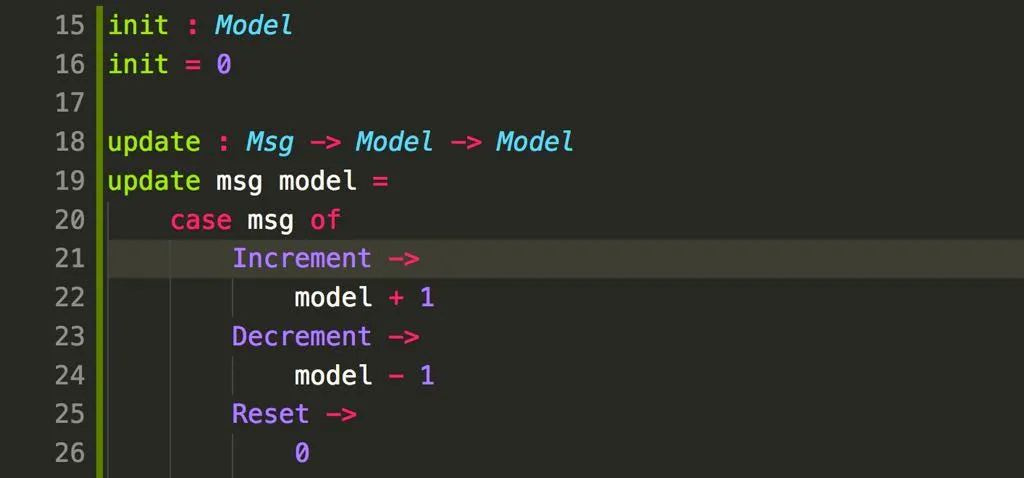
Most languages treat failure as a built-in feature: exceptions, errors, try and catch. Elm ships none of those. Instead the chance of failure lives in the types a function hands back. Something that might not produce a value returns a Maybe (either "just something" or "nothing") or a Result (either success or a described error), and the compiler refuses to build until your code deals with both. Failure becomes a thing you plan for. Not a thing that jumps out at you at 2am.
Same machinery, and it is how Elm gets rid of null. There is no null in the language, so there are no null-reference errors, the single most common crash in mainstream code. Picture null as a trapdoor left open in a floor everyone walks across; sooner or later somebody drops through it. Tony Hoare, who put the null reference into a language back in 1965, later called it his "billion-dollar mistake" and admitted he simply "couldn't resist the temptation to put in a null reference". Elm nails the trapdoor shut: if a value might be missing, the type says so, and the compiler makes you handle it.
Elm is a pure functional language, so every branch of a conditional has to return a value, and every case has to cover every possible input. Add a new variant to a type later on, and the compiler lights up every spot that now needs attention. Refactoring stops being a game of hoping you found all the call sites. The compiler just hands you the list.
Here is the shape of it. Add a fifth OrderStatus variant to the type below and Elm will not build until statusLabel handles it too:
-- An order status arriving from the surrounding JavaScript app.
-- Add a variant here and the compiler flags every `case` that has
-- not caught up yet. No forgotten branch ever ships.

type OrderStatus
    = Draft
    | Submitted
    | Approved
    | Rejected String -- carries the reason, so it cannot go missing


statusLabel : OrderStatus -> String
statusLabel status =
    case status of
        Draft ->
            "Draft"

        Submitted ->
            "Awaiting review"

        Approved ->
            "Approved"

        Rejected reason ->
            "Rejected: " ++ reason
The upshot for a team like Pivotal Tracker was blunt: "we've had zero run-time failures". Management there ended up mandating that new code be written in Elm.
Elm leans on Haskell, yet it is far friendlier to pick up, and that gap is deliberate. Czaplicki designed it through what he calls usage-driven design: start from who the user is and what they need, then add only the features that earn their place.
The clearest example is a thing Elm chooses not to have: typeclasses. (A typeclass is a Haskell mechanism for writing one function that works across many types. Powerful, yes, but it drags a wall of mathematical vocabulary in behind it.) Elm drops the feature outright. It can, because it is solving a smaller problem. Haskell is general-purpose; Elm is a front-end language and nothing else. Much of what typeclasses exist to wrangle, side effects and mutation, gets handled inside the Elm runtime rather than dumped on the developer.
The other thing that lowers the barrier is Elm's error messages. The type system knows exactly what it expected and exactly what it got, with no typeclasses fogging the view, so the compiler tells you plainly what went wrong. Then it goes further, guessing what you probably meant and suggesting a fix. For a team meeting functional programming for the first time, the compiler reads less like a bouncer and more like a patient teacher. Which is a fair part of why Pivotal Tracker had most of its developers productive in under two days.
Reliability is one half of the story. The other is how fast a team moves once Elm stops feeling strange.
Development loops through the same four beats: thinking, typing, compiling, testing. Testing is where the hours and the tedium pile up. Elm drags a lot of that effort forward into the compile step, so you spend a little longer getting the thing to build and a lot less time testing, because by then the only open question is whether the software does what the business asked, not whether it crashes. You hear about your mistakes sooner. And cheaper.
Elm's syntax is spare: two control statements, a handful of reserved words, everything centred on the function. Definitions need no ceremony of special characters, type signatures are optional and inferred, and every function is curried, meaning you can hand it some of its arguments now and the rest later, which keeps higher-order code tidy. Pipe and composition operators let you thread transformations together instead of drowning in nested brackets.
Start an Elm project and a lot arrives already assembled, no toolchain to bolt together:
Here is the question actually on your mind if you already run a product. Not "is Elm any good?" but "how would we get there without a rewrite?" Good news: Elm is built for moving in gradually, and you almost never convert a whole app in one go.
The usual route is to embed Elm inside what you already have. An Elm program compiles down to a JavaScript module you can drop into a single component, page or widget, a new dashboard, a busy form, a reporting view, while everything around it carries on unchanged. Think of it as building a new wing onto a house with the family still living in it. Two mechanisms carry traffic across the join:
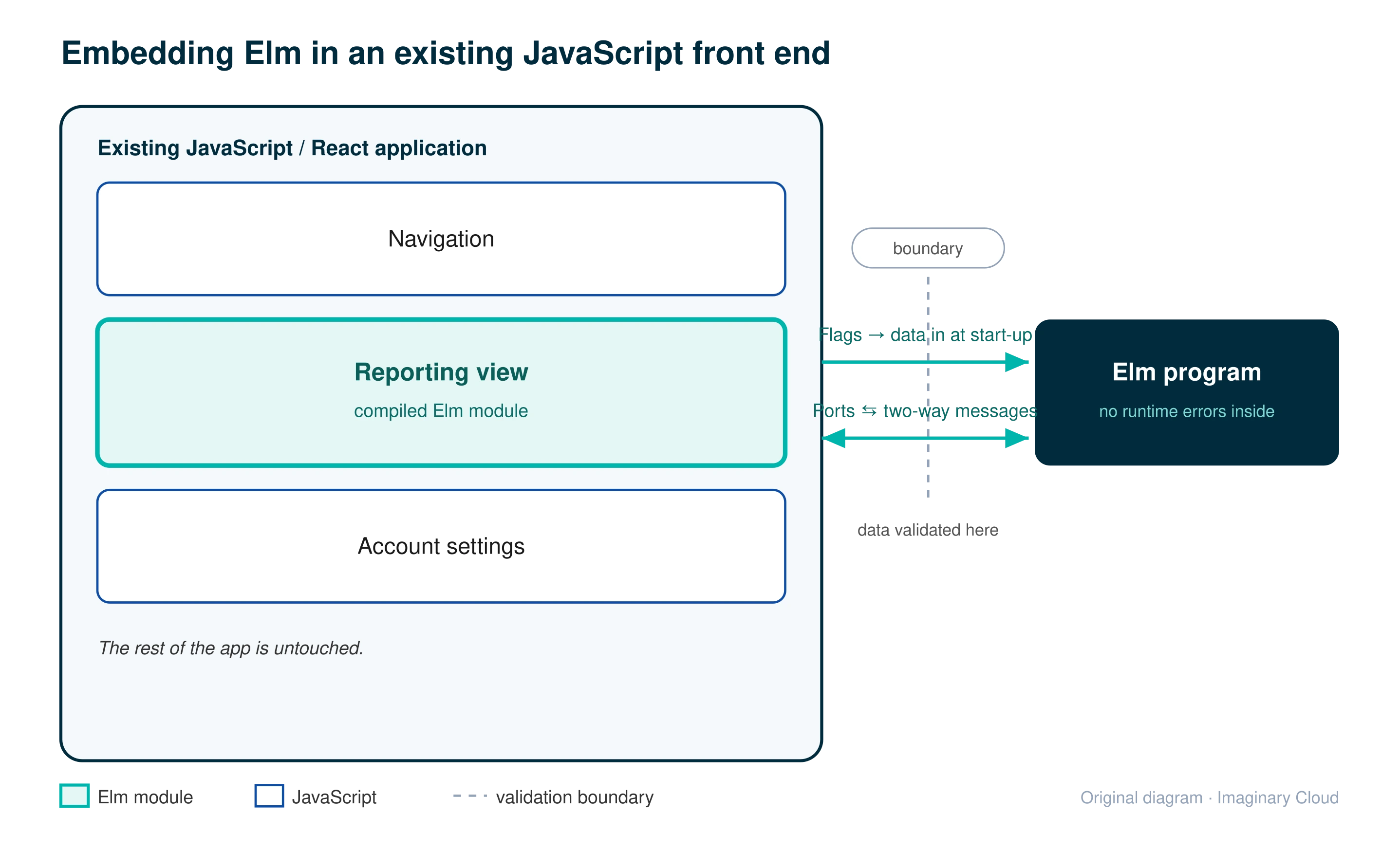
That join is also where the "no runtime errors" guarantee stops. Data coming in through ports gets validated on the way into Elm, and anything left on the JavaScript side keeps JavaScript's usual risks. In practice teams grow the Elm footprint outward from that first module once they trust it, which is roughly how Pivotal Tracker wove Elm into an existing Rails and Backbone codebase.
Because it is incremental, the decision looks more like any other stack choice than a bet-the-company gamble; our guide to choosing a tech stack for web development covers the wider picture.
Elm's professionals number is smaller than React's. That is a real cost, just a more manageable one than the raw headcount suggests. The language is deliberately small and the compiler is unusually good at holding a newcomer's hand, so teams keep reporting short ramp-up for anyone who already knows JavaScript. Pivotal Tracker measured it in days.
More often than not, organisations adopting Elm retrain the front-end engineers they already have rather than hunting for Elm specialists, and lean on tooling like elm-review, an Elm-native linter, to keep a growing team consistent. The real question is less "can we hire for this?" and more "are we comfortable owning a niche skill, in-house or with a partner?"
An honest look has to deal with Elm's most-argued-about weakness: how rarely it ships. The language sat on version 0.19.1 from October 2019 through a long silence with no releases at all. Unusual for live software. A fair worry for anyone staking a product on it.
The fuller picture is less alarming. Elm's core has been stable and treated as feature-complete for years, with no critical blockers, which is exactly why it could sit still without rotting. And the silence has broken: Elm 0.19.2 landed on 6 July 2026, the first of a planned run of small, non-breaking releases heading towards a 1.0. All the while the ecosystem kept moving through community projects like elm-review, elm-pages and the full-stack platform Lamdera.
So is Elm dead? No. "Slow releases" and "unmaintained" are not the same word. Elm's stillness is, in a real sense, the whole point: a project that does not need constant dependency churn is a cheaper project to keep running.
Three risks deserve saying out loud at board level. First, direction risk: Elm's evolution sits largely in its creator's hands, so the roadmap is less predictable than a foundation-backed framework's. Second, ecosystem risk: fewer off-the-shelf packages means now and then you build what you would otherwise install, a cost of change worth budgeting for. Third, concentration risk: a niche skill held by a handful of engineers is a dependency in its own right, managed through documentation, linting standards or a delivery partner.
Against all that sits a build-versus-buy point that cuts the other way. Much of what you would wire together and babysit in a JavaScript stack, a state container, immutability, type checking, a debugger, comes built in and stable, which trims the long tail of upgrade and integration work. None of these risks is a deal-breaker. They are reasons to scope adoption on purpose rather than swallow it whole.
Strip it all back and Elm is one clear trade. You take on a less mainstream language, a smaller hiring pool and a deliberately slow release cadence. In return you get a front end with no runtime exceptions, no null errors, every edge case handled because the compiler insists, a smaller QA surface and code that stays maintainable for years rather than quietly rotting. NoRedInk and Pivotal Tracker have reported precisely that.
For most teams the smart path is not a rewrite. It is a bounded pilot: Elm dropped in where reliability matters most, its effect on incidents and QA hours weighed against a baseline before you go any further. Make that call with a clear view of your systems, your team and how much risk you can carry. Then let the numbers decide.
Building reliable front-end web applications. It compiles to JavaScript and runs in the browser, and it shines on interfaces where stability really matters, dashboards, data-heavy tools, single-page apps, because it rules out runtime crashes by design.
Yes. NoRedInk and Pivotal Tracker have both run substantial Elm codebases in production. NoRedInk reported a 100,000-line system with zero runtime exceptions since 2015; Pivotal Tracker built its dashboard in Elm after trialling it against Redux.
For the code you write in Elm, yes, in practice. The type system keeps null-reference and type errors out of production, and the language has no exception primitives. Errors can still surface at the boundary where Elm talks to JavaScript through ports, but the core language is built to run without crashing.
It depends on what you are optimising for. React is the safer default on hiring and off-the-shelf components, with far wider adoption and a deep ecosystem. Elm wins on built-in safety and long-term maintainability where those dominate. For a lot of enterprises it is not either/or: they embed Elm modules inside a larger React or JavaScript app, starting with the riskiest screens.
Incrementally. An Elm program compiles to a JavaScript module you mount into one page or component, passing data in through flags and talking two-way through ports. Teams usually start with a single reliability-critical view and grow the Elm footprint as confidence builds, rather than rewriting the lot.
For the right project, yes, with your eyes open. The core is stable, the production track record is strong, and 0.19.2 in July 2026 signals fresh release activity towards a 1.0. The risks to weigh are a leaner ecosystem and talent pool and a creator-led roadmap, which is why a scoped pilot beats an all-in commitment.
Stable, not dead. After the long gap following 0.19.1 in 2019, Elm 0.19.2 shipped in July 2026, kicking off a run of small non-breaking releases aimed at a future 1.0, with an active community throughout.
Less than most functional languages. It was designed around the JavaScript developer, drops complex features like typeclasses, and offers unusually clear, hint-driven error messages. Pivotal Tracker had most of its developers productive in under two days.
It can be. Community tools like elm-pages support static-site generation and server-rendered output, which answers the SEO worry that comes with fully client-rendered single-page apps.
If you are weighing Elm, or a functional front-end approach more broadly, for a new product or a reliability-critical corner of an existing one, it pays to talk it through with people who have made the call before. Speak to our engineering team about what that move looks like in practice: where Elm fits, what it costs to adopt, and how it hooks into the systems you already run. Or if you would rather start by finding where your front-end risk actually lives, a technical and UX audit is a sensible first step.

Rails developer with 10+ years of experience with diverse technologies. I am interested in functional programming.
People who read this post, also found these interesting: