Written by:


Last Published:
23 July 2026
•

Ask two engineers whether you should use gRPC or REST and you will get three answers, a benchmark and a strong opinion about Protocol Buffers. Most of that argument is about the wrong thing.
The protocol comparison is real enough. gRPC runs on HTTP/2 with binary Protobuf messages and is measurably faster on the wire. REST runs on ordinary HTTP with JSON that any engineer can read in a browser tab. But we have sat on both sides of this decision on client platforms, and the thing that actually settles it is rarely latency. It is who is calling your API, and what your team can afford to run alongside it.
This guide covers the differences that matter, the benchmark figures and what they leave out, what gRPC genuinely costs to adopt, and a framework for deciding. Short version: REST at the edge, gRPC inside, and be honest about your call volume before you commit.
In short:
API stands for Application Programming Interface. It is a software intermediary: it sets the rules by which two applications talk to each other, carries a request from a user to a system, and carries the system's answer back.

Imagine you are booking a hotel. You open the booking page on your laptop, that page sends your request off to a server, and the server retrieves the data, works out what you asked for, executes it and sends the answer back to your screen. Every one of those handovers happens through an API. The page never touches the hotel's database, in the same way that you never walk into the back office to check the room list yourself.
An API also specifies the types of request one application can make to another: how to make them, which data formats to use, and the conventions consumers have to follow.
In a monolithic application, all the functionality lives in a single codebase. A microservice architecture splits that into smaller services which communicate over protocols like HTTP. Those services talk to each other through APIs. Take the APIs away and a microservice architecture is just a set of programs that cannot reach each other.
There are three main models for building an API: RPC (Remote Procedure Call), REST (Representational State Transfer) and GraphQL. This guide focuses on the first two.
RPC uses a client-server model. The requesting server — the client — sends a message that RPC translates and passes to another server. That server receives the request and sends the response back. While the call is being processed the client is blocked, and all the message passing between servers stays hidden.
RPC lets the client request a function in a particular format and get the response back in exactly the same format. The method being called sits in the URL. It works for remote procedure calls in local and distributed environments alike.
Like a REST API, RPC sets the rules of interaction: how a user submits calls to invoke methods and interact with the service.
REST is an architectural style rather than a protocol. Responses reach clients as JSON or XML, and the model conventionally maps onto HTTP verbs — though nothing in REST requires HTTP/1.1 specifically, and REST over HTTP/2 works perfectly well.
When a REST API is publicly available, each service in the application is presented to the consumer as a resource, reachable through the familiar commands: GET, POST, PUT and DELETE.
gRPC stands for Google Remote Procedure Call, a variant built on the RPC architecture. It uses HTTP/2 as its transport, except HTTP is never presented to the API developer or the server. You do not have to think about how RPC concepts map onto HTTP verbs and status codes. That is one whole layer of complexity gone.
The point of gRPC is to move data between services faster. It works by defining a service, then establishing its methods, their parameters and their return types so they can be called remotely.
It expresses that model in an IDL (interface description language). By default the IDL is Protocol Buffers, which describes both the service interface and the structure of the payload messages.

Now that we have the overview, here is where the two genuinely diverge.
REST APIs follow a request-response model, most commonly built on HTTP/1.1. If a service receives multiple requests from multiple clients, it handles them one at a time and the whole system slows down behind the queue. REST can be served over HTTP/2, but the request-response model stays the same, which stops it from making the most of what HTTP/2 offers.
gRPC is built on HTTP/2 and can take multiple requests from several clients and handle them simultaneously, streaming information continuously. It handles unary interactions too — a single request answered by a single response, which is how every REST call works.
So gRPC covers unary interactions and three kinds of streaming:

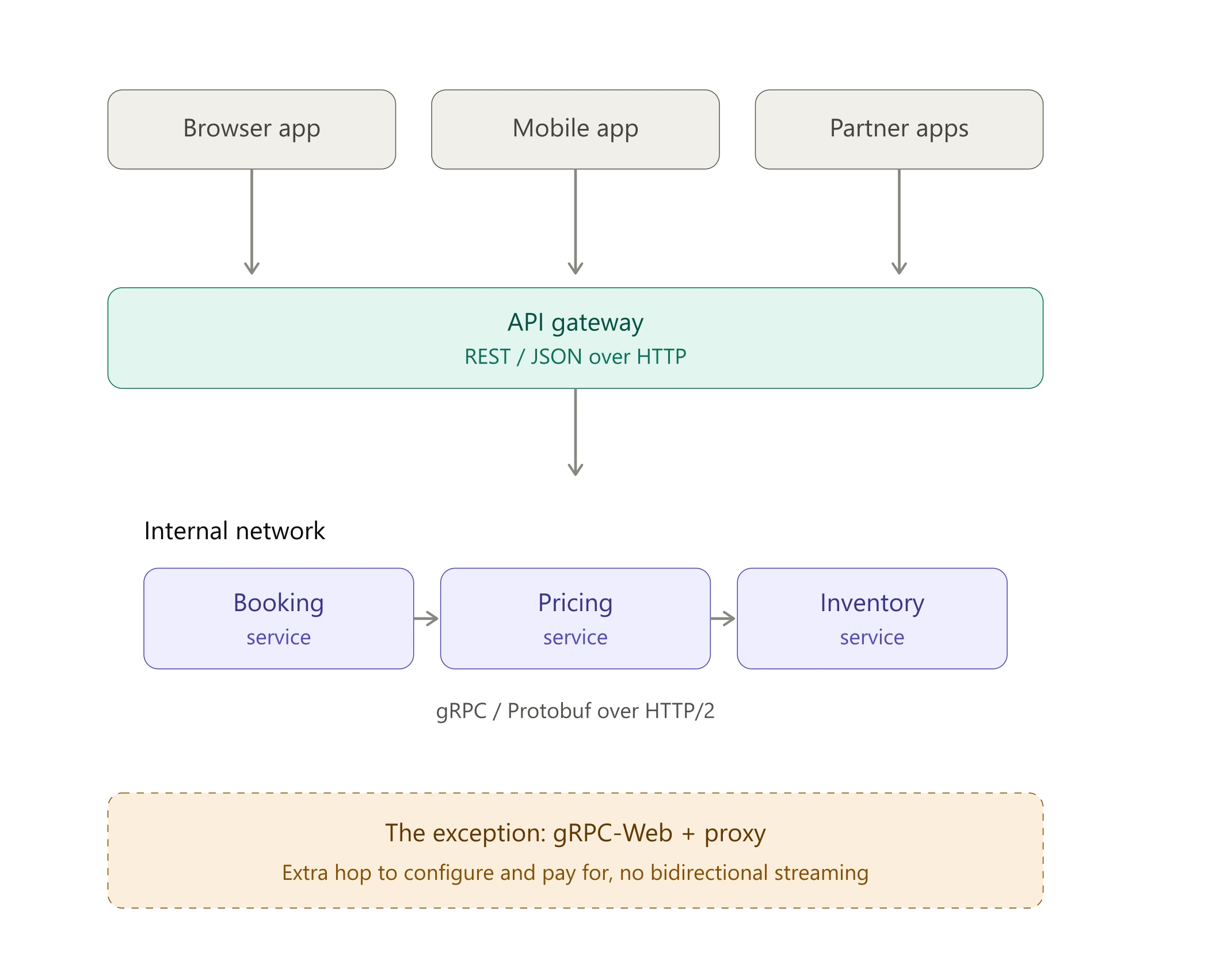
This is REST's single biggest advantage. REST is supported by every browser. gRPC is not: it needs gRPC-Web plus a proxy layer to translate between HTTP/1.1 and HTTP/2, which is why gRPC tends to live in internal and private systems.
That proxy is not a footnote. It is a component your team installs, configures, monitors and pays to run, sitting on the path of every browser request. Envoy is the default, and it has a dedicated gRPC-Web filter to do the job.
There is a second catch that most comparisons omit. gRPC-Web does not support client-side or bidirectional streaming — server streaming only. So the moment a browser is involved, the streaming advantage that gets quoted most often in gRPC's favour is half gone.
gRPC uses Protocol Buffers by default to serialise payload data. It is lighter, because the format is compact and the messages come out smaller. Protobuf is binary, and those strongly typed messages convert automatically into whichever language the client and server are written in.
REST mostly relies on JSON or XML. REST does not mandate any structure, and JSON won on flexibility: it will carry dynamic data without insisting on a strict shape. It is also readable by a human being, which Protobuf is not. Think of JSON as a parcel with the contents written on the outside in plain handwriting, and Protobuf as the same parcel with a barcode. One you can read at a glance. The other the machine reads instantly, and you need a scanner.
That readability has a price. JSON is not as light or as fast in transmission, because it must be serialised and converted into the language used on both sides. An extra step in the journey, and one more place for things to go wrong.
REST — a resource, and a shape you infer from the response:
GET /api/v1/bookings/8f2c1e HTTP/1.1
Host: api.example.com
Accept: application/json
{
"id": "8f2c1e",
"guestName": "A. Fernandes",
"roomType": "double",
"checkIn": "2026-08-14",
"nights": 3,
"totalCents": 42000,
"currency": "EUR"
}Nothing stops a service adding discountCents next Tuesday, and nothing stops a client quietly ignoring the fact that totalCents now means something slightly different.
gRPC — the contract is a file, and it exists before either side is written:
syntax = "proto3";

package booking.v1;

service BookingService {
  rpc GetBooking (GetBookingRequest) returns (Booking);
  rpc WatchAvailability (AvailabilityRequest) returns (stream AvailabilityUpdate);
}

message GetBookingRequest {
  string booking_id = 1;
}

message Booking {
  string   booking_id = 1;
  string   guest_name = 2;
  RoomType room_type  = 3;
  string   check_in   = 4;  // ISO-8601 date
  uint32   nights     = 5;
  Money    total      = 6;

  // field 7 was `total_cents`, removed in v1.4 — never reuse the number
  reserved 7;
  reserved "total_cents";
}

enum RoomType {
  ROOM_TYPE_UNSPECIFIED = 0;
  ROOM_TYPE_SINGLE      = 1;
  ROOM_TYPE_DOUBLE      = 2;
}
Two lines there do work the REST version cannot. stream on WatchAvailability declares the streaming case in the contract rather than bolting it on with polling or a websocket. And reserved 7 is the versioning argument in miniature: that field number can never be reused, so a client compiled against the old schema cannot silently misread the new one. The compiler enforces what REST leaves to a convention someone has to remember.
The cost is visible in the same snippet. That file has to be compiled, versioned and distributed to every consumer before anyone can make a single call — and none of it is readable in a browser tab.
REST APIs have no built-in code generation. Developers reach for a third-party tool such as Swagger or Postman to produce request code, or work from the framework they already use.
gRPC generates code natively through its protoc compiler, which supports a wide range of languages. That matters most in systems where services are written in different languages on different platforms. The same generator also makes building an SDK considerably less painful.
Both run over TLS, so neither is inherently more secure at the transport layer, and gRPC has built-in support for TLS and token-based authentication. The difference is everything around them. REST inherits the entire HTTP security estate: API gateways, web application firewalls, OAuth flows and rate limiters all understand it out of the box.
gRPC needs tooling that speaks HTTP/2 and Protobuf to do the same job. Gateway support exists, but the field is narrower. And an inspection layer that cannot read a binary payload cannot enforce a rule about what is inside it.
REST leans on HTTP status codes, which every client library, log aggregator and monitoring tool already speaks. A 404 means the same thing everywhere.
gRPC defines its own status codes, such as NOT_FOUND and DEADLINE_EXCEEDED. They are richer for service-to-service calls, and they sit outside the HTTP vocabulary your existing tooling grew up with. Adopting gRPC means teaching your monitoring stack a second language for failure.
This is where a contract-first approach earns its keep. Protobuf identifies fields by number rather than by name, so adding a field is backwards compatible by design and older clients quietly ignore what they do not recognise. The schema is the contract, and the compiler checks it.
REST offers no equivalent guarantee. Compatibility rests on discipline: versioned URLs, clients written to ignore fields they do not know, and a convention everyone remembers to follow. It works. Nothing enforces it.
A REST call can be inspected with curl, a browser tab or a log line, by anyone, with no preparation at all. A gRPC call cannot. The payload is binary, so you need a tool like grpcurl and the right proto file before you can read it.
That gap never shows up in a benchmark. It shows up on a Friday evening, in how long it takes an on-call engineer to see what a failing request actually contained.
The differences concentrate in three places: latency, payload size and throughput.
On payload size. An independent benchmark of JSON-compatible binary serialisation specifications found Protocol Buffers achieved a median size reduction of around 67% against best-case compressed JSON: with a wide spread, and cases where Protobuf came out larger. This is worth dwelling on, because the "Protobuf is ten times smaller" figures in circulation almost always compare against uncompressed JSON. Enable gzip on your REST endpoints and a good deal of the gap closes for nothing.
On response time. Niswar et al. (2024) benchmarked REST, GraphQL and gRPC across three containerised Go microservices, measuring response time and CPU utilisation at loads of 100 to 500 requests, fetching both flat and nested data. gRPC returned the fastest response times of the three; GraphQL consumed the most CPU. Note the load range: this is a study of hundreds of requests, not hundreds of thousands.
On concurrency. Google's own gRPC documentation reports lower response times and higher efficiency in high-concurrency environments, attributed to HTTP/2 multiplexing. Vendor documentation, so read it as directional rather than neutral.
gRPC is generally more performant than REST in high-load, low-latency environments. REST remains perfectly sufficient for standard web-based interactions.
One caveat worth holding on to. Those gains are per call, so they compound with volume. On a service handling a handful of requests a second, the difference is real and completely irrelevant. On one handling thousands, it is the difference between buying capacity this quarter and not.
Seeing where each style ends up in production makes the choice clearer than any feature list.
Internal service-to-service communication. Backend systems where performance and efficiency are critical and both ends of the call are owned by the same organisation. The payoff is reduced latency and efficient binary communication, and it arrives in proportion to call volume.
Real-time streaming. Live data feeds, chat systems and trading platforms, where bidirectional streaming is declared in the contract rather than improvised on top of polling. Bear in mind the gRPC-Web limitation above if a browser sits at one end.
Mobile and IoT. Smaller payloads matter most where bandwidth is constrained or metered: mobile clients on poor connections, and devices sending frequent small messages.
Public APIs and third-party integrations. External developers have REST tooling already installed and REST knowledge already in their heads. Every unit of friction you add at the edge is paid by someone who has not committed to you yet.
CRUD-based applications. Standard create, read, update and delete operations with no streaming requirement. gRPC adds machinery here and returns very little.
Simpler architectures. Where ease of implementation, readability and hiring flexibility matter more than throughput — which is most teams, most of the time.
| Feature | REST | gRPC | Best choice |
|---|---|---|---|
| Architecture style | Resource-based communication | Remote procedure calls between services | Depends on system design |
| Data format | Usually JSON | Protocol Buffers by default | REST for readability, gRPC for efficiency |
| Transport | Transport-agnostic; commonly HTTP/1.1, works over HTTP/2 | Built on HTTP/2 | gRPC for speed and multiplexing |
| Performance | Good for standard web use cases | Typically faster with smaller payloads | gRPC |
| Streaming support | Limited, usually request-response | Client, server and bidirectional | gRPC (but see gRPC-Web caveat) |
| Browser support | Excellent and universal | Requires gRPC-Web and a proxy | REST |
| Ease of debugging | Inspect with standard tools | Binary payloads need dedicated tooling | REST |
| Security tooling | Works with existing gateways, WAFs and OAuth | Needs HTTP/2 and Protobuf-aware tooling | REST |
| Versioning | Convention-based, enforced by discipline | Schema-based, backwards compatible by design | gRPC |
| Learning curve | Lower | Higher | REST for simpler adoption |
| Best use cases | Public APIs, web apps, integrations | Microservices, internal systems, real-time | REST externally, gRPC internally |
Most comparisons on this topic stop at the protocol and leave you to work out the commercial side on your own. For whoever signs off the decision, the cost sits in four places, and not one of them turns up in a benchmark.
The proxy layer. Browser clients need gRPC-Web and a proxy to translate between HTTP/1.1 and HTTP/2. That is infrastructure to configure, monitor, secure and pay for, sitting on the path of every request. REST needs none of it.
Team capability. The learning curve is higher, and it is not only the protocol. It is the schema workflow, the generated code in your build pipeline, and that second set of status codes your monitoring stack has to learn. Budget for the ramp-up, not just the implementation.
Support and debugging time. Binary payloads are opaque without the right tool and the right proto file. Invisible in a project plan. Extremely visible during an incident.
Migration. Adding gRPC to an existing REST estate means running both while services move across, and paying for the translation between them until they have. The interim state is the expensive part, and it lasts as long as your slowest service takes to move.
Against all that sits the return, and it scales with internal traffic. The saving is per call, so a service handling thousands of requests a second recovers the investment quickly, while one handling dozens may never recover it at all. If your internal call volume is modest and your team is comfortable with REST, the honest answer is that gRPC will cost you more than it gives back.
Time to value cuts the same way. REST reaches a first working integration faster, because the tooling is already on every machine in the building. gRPC takes longer to stand up and pays back later — in throughput, and in contracts that break at compile time rather than in production.

Both can solve similar problems. They are optimised for different situations.
Use REST when:
Use gRPC when:
Use both when:
That hybrid is increasingly common, because it lets teams balance flexibility, performance and ease of integration without giving up much of any of them.
Now read those three lists again. Only the middle one is really about speed. The other two are about who is standing at the other end of the call, which is why the better question is not which protocol is faster. It is who consumes this API.
Both have their use cases. gRPC excels in high-performance environments, supports bidirectional streaming and uses Protocol Buffers for efficient serialisation. REST is simpler, more flexible and better suited to web applications and to talking with a wide range of clients you do not control.
REST, or Representational State Transfer, is an architectural style for building web services. It uses standard HTTP methods like GET, POST, PUT and DELETE to communicate between clients and servers. REST is known for its simplicity and statelessness — each request carries everything the server needs to answer it — which makes it well suited to web applications and microservices. It typically uses JSON or XML for data exchange.
gRPC is an open-source framework developed by Google for high-performance communication between services. It uses HTTP/2 for transport and Protocol Buffers for serialisation, and supports unary calls plus server, client and bidirectional streaming.
The key differences lie in transport, data format, contract enforcement and streaming. gRPC uses HTTP/2 and Protobuf, giving smaller payloads, a compiler-enforced schema and bidirectional streaming. REST commonly uses HTTP/1.1 with JSON or XML, focusing on stateless communication and resource manipulation through standard HTTP verbs. REST is easier to consume and debug; gRPC is faster and stricter.
No. gRPC is generally faster thanks to HTTP/2 and Protobuf, but the margin depends on payload shape, network conditions and whether you have compression enabled on the REST side. Benchmarks comparing Protobuf against uncompressed JSON overstate the gap. At low request volumes the difference is measurable and, in practice, irrelevant.
Not directly. Browsers need gRPC-Web plus a proxy such as Envoy to translate between HTTP/1.1 and HTTP/2. gRPC-Web also supports server streaming only — no client-side or bidirectional streaming — so some of gRPC's headline advantages do not survive the trip to the browser.
Yes. It is actively developed and particularly favoured in microservices architectures where performance and efficient communication matter. Support across many languages and platforms keeps it popular in cloud-native ecosystems.
Performance, efficiency and cross-language support, plus a contract-first workflow that catches breaking changes at compile time rather than in production. For large service estates in multiple languages, code generation from a shared schema removes a whole category of integration work.
There is no standard figure, because the cost depends on how many services you are moving and how long the two styles have to run side by side. The larger expense is usually the interim period rather than the implementation, since you pay to translate between REST and gRPC until the migration finishes. Scope the migration by internal call volume first: if it is low, the return may not justify the move.
gRPC is faster on the wire and stricter about contracts. REST is easier to consume, debug and hire for. The choice is settled less by the benchmark than by who is calling your API and what your team can afford to run alongside it.
If you are weighing that up for a platform you are building or scaling, we are happy to talk it through — including the parts a benchmark does not cover. Tell us about your project and we will tell you what we would do.
Marketing Intern with a particular interest in technology and research. In my free time, I play volleyball and spoil my dog as much as possible.
Your everyday web developer who likes to hide in the backend. Javascript and Ruby are my jam. I still fumble with Docker and my builds break quite often.
People who read this post, also found these interesting: