Written by:


Last Published:
21 July 2026
•
.webp)
Almost every business runs on the cloud now. Almost nobody agrees on which one to pick. That is the confusion worth clearing up, so let's clear it up.
A cloud service provider (CSP) rents you computing over the internet: storage, servers, databases, networking, software. Think of it as leasing a fully serviced building instead of buying land and pouring your own foundations. You get the floors when you need them, someone else fixes the plumbing, and you pay for the space you actually use.
So the hard question was never whether to move in. It is which landlord to sign with. Sign with the wrong one and you inherit a lease that stings every time you want to grow, or leave. This guide compares the leading cloud service providers on the things that decide that, and shares the framework we use at Imaginary Cloud to help clients choose. Let's compare them.
A cloud service provider is a company that delivers computing services such as storage, servers, databases, networking, and software over the Internet. By offering on-demand access to scalable resources, CSPS help businesses avoid the cost and complexity of owning and maintaining physical infrastructure.
Cloud computing service providers hold up most of modern IT. Digital transformation, remote work, AI workloads, fast software delivery: all of it runs on rented floors. And adoption has crossed the point of no return. Flexera's 2026 State of the Cloud report puts 73% of organisations on a hybrid estate spanning at least one public and one private cloud, three points up on the year, with multi-cloud creeping up alongside it.
Which means the cloud itself is no longer the edge. It is the floor everyone stands on. The advantage now comes from picking the right provider and running it well, so that your spend turns into speed, resilience and margin rather than a bill nobody saw coming.
For the fuller picture of what sits underneath that floor, from virtualisation to service models, see our guide to cloud infrastructure.
Here is how the five leading providers stack up, and the one trade-off you should weigh for each. Two of them carry most of the market: Flexera's 2026 survey found AWS running active enterprise workloads at 83% of organisations and Azure at 79%, with Google Cloud a distant third.

is the biggest building on the block, with the widest catalogue of compute, storage, database and machine learning services, and the deepest talent pool to match. That range suits organisations that need maximum depth and proven global scale. What you pay for it is complexity. Pricing is intricate and the learning curve is steep, and teams new to the platform routinely overrun on both the budget and the onboarding schedule they set themselves.

is wired tightly into the Microsoft world, which makes it the obvious pick if you already run Microsoft 365, Active Directory and Windows Server. It brings mature security, compliance and hybrid cloud tooling. The catch? Much of that value depends on staying inside Microsoft licensing. Walk out later and the integration savings that sold you on Azure start to unwind.

leads on data analytics and AI, with open tooling that engineers tend to find quick to work in. Its container orchestration runs on Kubernetes (an open-source system that automates deploying and scaling applications across many servers), and it is strong on heavy data workloads, so it fits companies whose product lives or dies on analytics or machine learning. The catch is reach: a smaller partner network and regional footprint than AWS or Azure.

blends traditional infrastructure with newer technology, including AI and quantum computing, and comes with serious industry-specific compliance. It earns its place in heavily regulated sectors like finance and healthcare, where audit controls and hybrid deployment are not optional. Where it thins out is ecosystem. Fewer native services and a smaller developer community mean more custom work, and a longer wait when you need to hire someone who has done it before.

is built for high-performance computing and database workloads, with predictable pricing and fast networking. Running Oracle databases or applications at scale? OCI makes clean sense. Running a mixed, general-purpose stack? Most of its advantages quietly fade.
Most comparisons stop at a feature table. We think that is the wrong place to stop. Across years of cloud-native engineering for clients in fintech, healthtech and retail, we have watched the feature list lose to something plainer, every time: fit. So at Imaginary Cloud we judge every provider decision against the IC Cloud Fit Framework, three questions asked in order.
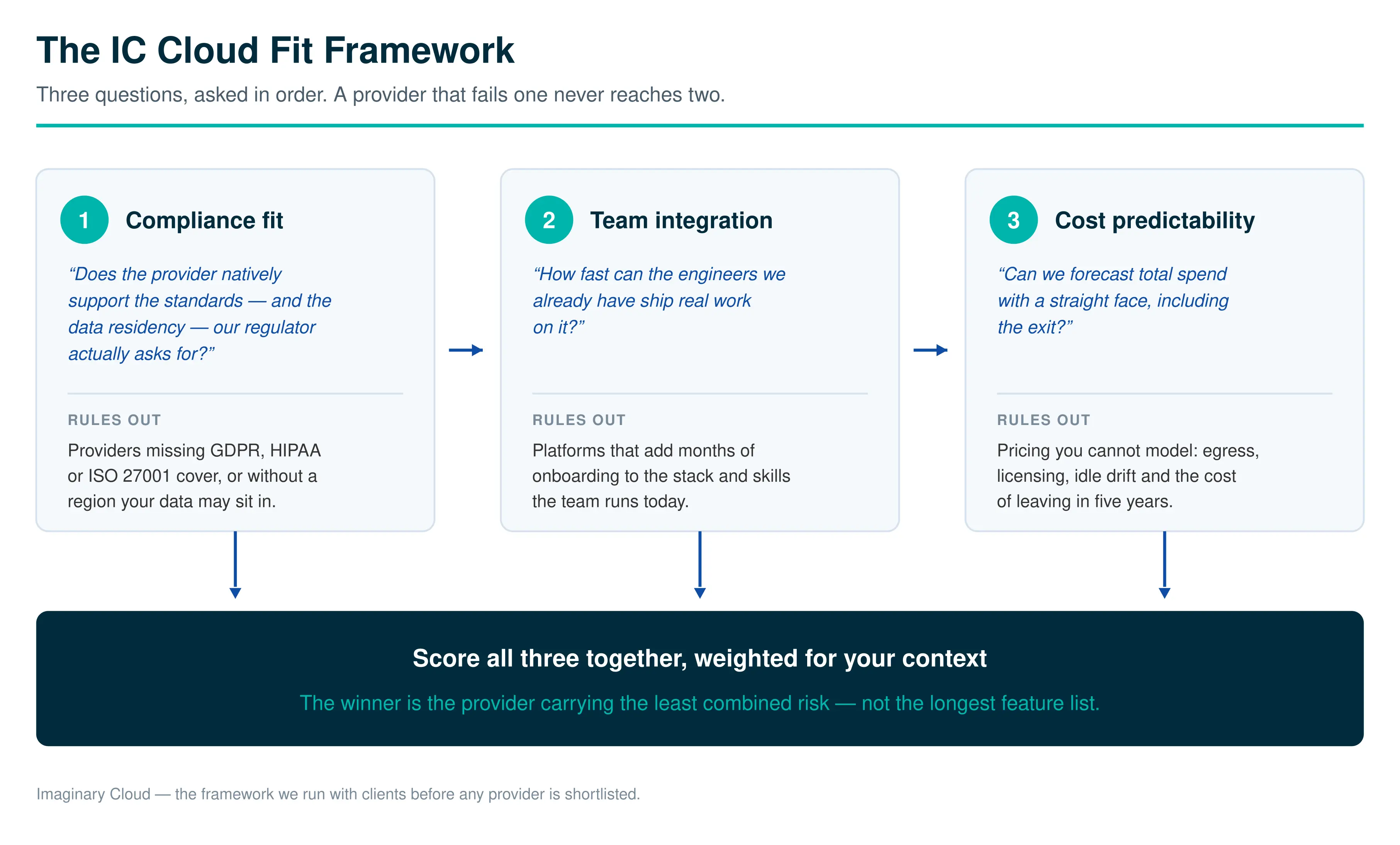
The first is compliance fit. Does the provider natively support the standards your industry demands, such as GDPR, HIPAA, ISO 27001 or local data residency? A provider that folds audit-readiness into its managed services takes a recurring cost and a recurring worry off your desk. For a regulated client, this question often beats price outright.
The second is team integration. How fast can your engineers actually get productive? A provider that lines up with your existing stack (Azure for a Microsoft team, GCP for a data team) shortens onboarding and gets working software out the door sooner. The best platform on paper is worthless if your people cannot ship on it.
The third is cost predictability. Past the headline unit price, can you forecast total spend with a straight face, including data egress fees (the charge a provider adds to move your data out of its cloud), licensing and the slow creep of idle resources? A provider with transparent cost modelling is the one that spares you the surprise bill.
We plot each client's case across all three. What comes out is not a single "best" cloud service provider, but the one carrying the least combined risk for that specific business. Take a scenario we see often. A healthtech company weighs AWS against GCP; AWS scores higher on raw service breadth, lower on team integration, because its engineers already live in a data-and-Python world closer to GCP. Weigh all three questions together and GCP wins on faster time-to-value and lower egress cost, even though AWS looked stronger on a feature count alone. (Imaginary Cloud to swap in a named, anonymised client engagement with verified figures before publication.)

The three questions turn straight into the checks worth running before you sign anything.
On compliance fit, confirm the provider supports the exact standards your regulator asks for, and, just as important, where your data will physically sit. Coverage is not equal across providers, and residency rules can knock out an otherwise strong option before you have started. If you work in a regulated sector, weigh our guidance on choosing for regulated industries before you draw up a shortlist.
On team integration, map each option against your current stack and the skills your engineers already hold. Run on Microsoft tooling and Azure usually slots in with the least friction. Invested in Oracle databases and OCI may do more for less effort. The point is to cut the time and risk of getting productive, not to collect the longest feature list.
On cost predictability, test pricing with real workloads instead of list prices. Look for clear pricing, cost calculators and native budgeting tools, then run a short pilot in your own region to check latency, reliability and the service level agreement (SLA), which is the provider's contractual promise on availability and response times. Fixed pricing suits steady workloads. Usage-based pricing suits spiky ones. And if a move is on the cards, our cloud migration strategies guide lays out how to estimate and contain the switching cost
More than hosting, and it is worth being specific about what. Four things stand out in the language a leadership team actually tracks.
First, speed. Cloud-native delivery shortens the road from idea to production, moving teams from quarterly releases to weekly, sometimes daily. What has changed is how that speed gets judged. In the report we already mentioned from Flexera, 64% of organisations now assess cloud progress by value delivered to business units, up 12 percentage points in a year, which puts the burden on delivery rather than on the migration itself. Underestimate the learning curve and the speed arrives late, and late speed is the most common reason cloud migrations disappoint on return.
Second, capital efficiency. Cloud shifts IT from capital expenditure, the big upfront spend on hardware, to operating expenditure, where you pay for what you use. That frees up cash and lets a younger company stay lean, while the provider quietly absorbs maintenance and upgrades.
Third, access to things you would otherwise have to build from scratch. Leading providers ship ready-made AI, machine learning and serverless services, and take-up is quick: generative AI climbed to the third most widely used public cloud service in 2026, at 58% of organisations, up from 50% a year earlier. Native access to these tools is a genuine lever, not a nice-to-have.
Fourth, resilience. Global infrastructure, built-in redundancy and mature disaster-recovery tooling hand your business a level of continuity that is painful and pricey to build in-house. Downtime costs money and reputation. This is how you buy that risk down.
For a closer look at how the two biggest providers handle this specifically, see our comparison of AWS and Azure disaster recovery options.
Here is the plot twist. The most common way cloud adoption goes wrong is not technical. It is financial. Flexera's 2026 report has managing cloud spend as the number-one cloud challenge for the third year running, named by 85% of organisations. Worse, estimated waste has ticked back up to 29% of infrastructure and platform spend, reversing five straight years of improvement, as AI workloads and new pricing models outrun the forecasting. That is why FinOps (the practice of putting financial accountability on variable cloud spend, so engineering and finance share the bill) has grown from a nicety into a core discipline: 63% of organisations now run a dedicated FinOps team.
Total cost of ownership (TCO) risk hides in the costs that never make the sticker: data egress fees, over-provisioned or idle instances, licensing surprises, and the slow drift away from the forecast you signed off. Leave them alone and a first-year bill sails past plan.
So before you commit, answer three questions. What would it cost to leave? If you had to switch providers inside five to seven years, price the re-engineering in both money and months, because breaking the lease and moving out mid-refit is where the real pain lands. Who owns the spend? Make sure the contract carries the transparency, budgeting tools and anomaly detection to keep costs predictable, and name the person inside who owns that discipline. Can your team run it efficiently, or will hidden hiring and training costs eat the savings? Treat provider selection as a total-cost-of-ownership and risk call, not a feature bake-off, and you separate the cloud programmes that deliver margin from the ones that quietly leak it.
Three decisions sit next to provider choice and shape it more than any feature grid admits.
The first is whether to run multi-cloud. A multi-cloud strategy means spreading workloads across two or more public clouds, so each one lands where it runs best and costs least. Hybrid estates are now the norm at 73% of organisations, and multi-cloud adoption rose again in 2026, though often through mergers and decentralised teams rather than any deliberate plan. The upside is flexibility and a little leverage at renewal time. The cost is governance, because every extra platform adds tooling, security policy and skills to keep up. Multi-cloud pays off only when your workload mix is varied enough to earn the overhead.
The second is how you migrate. Moving off on-premises, or between providers, is where cloud programmes most often stall on cost and timeline. The switching cost of proprietary services can run to months of re-engineering, so decide the approach, rehost, refactor or rebuild, before the provider is locked in, not after.
The third is managed versus self-managed. Run the platform yourself and you keep full control, but you pay for scarce, expensive expertise to do it. Hand it to managed services and you trade some control for lower operational load and faster delivery. For a lot of mid-size organisations the honest answer is a blend: keep core product engineering in-house, let a partner run platform operations. Our round-up of top managed IT service providers covers how to make that call.
Cloud spend has become a board-level line. Gartner expects public cloud services to grow 21.3% in 2026, with the market on track to reach 1.48 trillion US dollars by 2029. At that size, cloud is a real slice of the profit and loss account, and the organisations that win are the ones pairing adoption with discipline, not the ones simply spending more.
Cost management has not budged from the top of the worry list. Flexera's 2026 report keeps it there for a third year, at 85%, while waste climbs back to 29%. Read plainly: in 2026, advantage comes as much from squeezing value out of the spend you already have as from bolting on new services.
Hybrid and multi-cloud are the default, not the exception. With 73% of organisations running hybrid cloud and most large enterprises spread across several public clouds, the motive has shifted from dodging lock-in to putting each workload where it runs best. Gartner expects that to intensify: by 2030, more than 60% of enterprises will run intensive AI model activity in one cloud while their data sits in another, up from under 10% today. The price of that freedom, as above, is the governance it drags along.
Data residency has become a buying criterion in its own right. Gartner forecasts worldwide sovereign cloud IaaS spending at 80 billion US dollars in 2026, up 35.6% year on year, with Europe growing fastest among the major regions. If your regulator cares where the data sits, that question now sits at the front of the shortlist rather than in the contract annexe.
Generative AI has moved from experiment to operations. Flexera reports 81% of organisations using generative AI in 2026, up from 72% a year earlier, with 45% using it extensively. Because capability and cost now vary sharply by provider, your AI roadmap has quietly become a selection criterion, not a someday concern.
Edge computing is stepping out of the niche. Edge computing means crunching data close to where it is created, rather than in a central data centre, to cut latency and bandwidth cost. As connected devices multiply, more workloads need it, and an edge strategy has to line up with your provider's roadmap, because switching mid-deployment adds real time and cost.
There is no single cheapest provider, because cost follows your workload. Google Cloud and Oracle Cloud tend to offer lower data egress fees and steadier pricing, which helps data-heavy or predictable workloads. AWS and Azure can win at scale through committed-use discounts. The bigger risk is not the unit price but usage nobody is watching, so cost governance matters more than the rate on the page.
Multi-cloud means running workloads across two or more public cloud providers at once. Businesses do it to place each workload where it runs best and costs least, to keep some leverage at renewal, and to avoid leaning on a single vendor. The trade-off is more governance, security and tooling to manage, so it suits organisations with a genuinely varied workload mix.
Cloud migration usually takes one of three paths: rehosting (moving applications as they are), refactoring (adapting them to use cloud-native services), or rebuilding (redesigning them for the cloud). The right path depends on your budget, your timeline, and how much the application stands to gain from cloud-native features. Decide the approach before you lock in a provider, because switching later gets expensive. Our cloud migration strategies guide covers it in detail.
Google Cloud is a popular pick for smaller and growing tech businesses, thanks to a generous free tier, a straightforward setup and strong AI tooling. Azure is often the better fit for businesses already standardised on Microsoft products, because the integration is simpler and cheaper.
Both lead the market, and they lead in different lanes. AWS offers the broadest service range and global reach, which suits complex enterprise deployments. Azure slots neatly into Microsoft tooling, making it the stronger fit if you already run Microsoft 365 or Windows Server. The better choice is the one that fits the stack and skills you already have.
IBM Cloud and Oracle Cloud are strong choices for heavily regulated sectors like finance and healthcare, with enhanced data protection, audit controls and support for standards including HIPAA, GDPR and ISO 27001. Azure and AWS also hold broad compliance certifications, so the deciding factor is usually data residency and the specific certifications your regulator insists on.
A cloud service provider is the company delivering the services, such as AWS or Microsoft Azure. A cloud platform is the set of tools and services that provider offers for building, deploying and managing applications in the cloud.
Run it yourself and you keep maximum control, but you need scarce, costly expertise on hand. Managed services cut the operational load and speed up delivery in exchange for some of that control. Plenty of mid-size organisations blend the two, keeping product engineering in-house while a partner runs platform operations.
So which is the best cloud service provider? None of them, and all of them. There is only the one that fits your goals, workloads, compliance obligations and team today while keeping your options open tomorrow. The leaders who get this right treat the choice as a total-cost-of-ownership and risk decision, judged on three questions: compliance fit, team integration and cost predictability. Score each candidate on all three, weight them for your context, settle your migration and multi-cloud approach before you commit, and pilot in your own region before you sign. That is the whole argument in one breath, and it is how we run the decision with clients.
Pick the wrong cloud service provider and it costs a business months of delay and millions in re-engineering nobody budgeted for. We help technology leaders make that call with confidence, and we build nearshore engineering teams (skilled developers in nearby time zones who work as an extension of your own team) that reduce cloud delivery risk and shorten time-to-value. Talk to us about your next build.
.webp)
Alexandra Mendes is a Senior Growth Specialist at Imaginary Cloud with 3+ years of experience writing about software development, AI, and digital transformation. After completing a frontend development course, Alexandra picked up some hands-on coding skills and now works closely with technical teams. Passionate about how new technologies shape business and society, Alexandra enjoys turning complex topics into clear, helpful content for decision-makers.
Inês Silva is a Project Manager with over four years of experience writing about software delivery, agile methodologies, and tech leadership. Because she started her career as a developer, Inês brings a real, deeply technical understanding to the management side of things. She loves bridging the gap between big-picture business strategy and day-to-day engineering execution, and she's passionate about sharing practical tips that help teams collaborate better and ship great products.
People who read this post, also found these interesting: