Written by:


Last Published:
24 June 2026
•

Most teams pick a frontend framework for the wrong reasons. Because the last developer knew it. Because everyone on Reddit swears by it. Because it happened to be first in the tutorial. Then they live with that choice for three to five years, which is a long time to regret a Tuesday afternoon.
Here is what is actually on the table. The framework you choose shapes who you can hire, how fast you ship, and what it costs to keep the thing running once the launch buzz dies down. Get it wrong and the bill turns up late: the contractors you cannot find, the upgrade you keep deferring, the rewrite nobody budgeted for.
So let's compare them properly. This article walks through the top frontend frameworks to use in 2026, what each one is good at, where each one falls down, and the brands running them in production. We will weigh them on performance, ease of use, learning curve, community support and adoption, using current survey and download data rather than vibes. And we will frame the whole thing the way you actually have to decide it: as a trade-off between what a framework can do, who can build with it, and what it costs to live with.
TL;DR: Choose a frontend framework on three axes at once: performance fit, team fit and commercial risk, rather than on popularity or raw speed alone. For most enterprise teams in 2026, React, Vue and Angular remain the lowest-risk defaults. React has the deepest hiring pool, Angular the most prescribed structure, and Vue the gentlest learning curve, while Svelte, SolidJS and Qwik offer stronger performance at higher commercial risk. The clearest warning sign in any framework choice is declining developer satisfaction or a slowing release cadence, because both predict rising maintenance cost and a shrinking talent pool. That is the most expensive liability a framework can leave you with three years on.
A frontend framework is a commercial commitment before it is a technical one. Four things decide whether that commitment pays off, so let's take them one at a time.
Total cost of ownership (TCO). The licence is free. The framework is not. Cost piles up in upgrades, security patching, third-party dependencies and the senior hours spent keeping all of it current. Heavier, more opinionated frameworks such as Angular fold more of that maintenance into the core, which lowers integration cost but raises the cost of staying on a supported version. Lighter libraries such as React hand those decisions, and their long-term cost, to your team.
Hiring market depth. The pool of people who can build, and more importantly maintain, your application varies sharply by framework. In the Stack Overflow 2025 Developer Survey, React was used by 44.7% of professional developers, Angular by 18.2%, Vue by 17.6% and Svelte by 7.2%. A bigger pool means faster hiring, easier handover and lower key-person risk. A smaller pool can still be the right call. It is just a risk you price in rather than ignore.
Technical debt risk. Frameworks with declining satisfaction or a slowing release cadence rack up debt faster, because the ecosystem around them stops keeping pace. Choosing on popularity alone, because everyone else has, is how teams inherit a stack that is hard to staff three years later.
Time-to-value. How quickly your team ships its first production-quality release comes down to the framework's defaults, its tooling and the skills already in the room. Meta-frameworks (frameworks built on top of a base library to add routing, rendering and conventions, such as Next.js on React) shorten that runway. New reactivity paradigms lengthen it while everyone learns.
These four pull against each other more often than not, and the right answer depends on your situation. Here is how we weigh them.

Most comparisons rank frameworks on a single scale, usually raw speed. That is not how the decision works. Think of the choice as a three-legged stool. Performance, the team, and the commercial risk are the three legs, and a stool with two strong legs and one weak one still drops you on the floor. At Imaginary Cloud we assess any frontend framework on all three at once, and a candidate has to hold up on each one for the job in front of us.
Every framework below carries a short three-axis read, so the comparison stays honest instead of drifting into preference. No single leg holds the stool up on its own. We are after the framework that clears all three for your situation.
Frontend development is the work of building the parts of a website or app that people actually see and touch: the buttons, the forms, the layouts, the animations. It runs on HTML, CSS and JavaScript. Frontend developers own the user interface (UI) and user experience (UX), and they work hand in hand with backend developers so the two halves of a system meet cleanly in the middle.
Done well, the payoff is concrete. Pages load faster, server requests drop, the site behaves itself across desktop, tablet and mobile, and you get the interactive bits, the forms and sliders and live updates, that a flat static page simply cannot do.
So what is a framework? It is software that makes large projects easier to build and keep alive. Front end development frameworks bundle ready-made code, libraries and conventions so your team is not starting from a blank page every time. They hand you a structure to extend and bend to the project, and they sit alongside the wider set of front-end development tools a team leans on day to day. The catch: every framework also bakes in its own assumptions. Which is exactly why the choice matters.

React is a JavaScript library for building user interfaces, looked after by Meta. Two things define it. JSX, a syntax extension that lets you write HTML-like markup right inside your JavaScript, and the virtual DOM, an in-memory copy of the page that React diffs against the real thing so it only updates what changed. React 19 added the React Compiler, which now handles much of the performance tuning teams used to do by hand.
It suits large, complex applications: single-page applications, e-commerce, the big social platforms.
When to use:
When not to use:
Brands using React: Meta, Netflix, Airbnb, Uber, Instagram.
Three-axis read: Performance: strong with modern patterns and the new compiler. Team: the deepest hiring market by a wide margin. Commercial risk: low, though you own every architectural decision React leaves open.

Angular is a full framework from Google, written in TypeScript. You get two-way data binding, dependency injection and a modular, component-based structure out of the box. Recent versions added Signals for fine-grained reactivity, which updates only the exact slice of the page tied to the data that changed rather than re-rendering a whole component, and made zoneless change detection the default in Angular 21. Change detection is simply the process that keeps the rendered page in sync with your data. The zoneless version runs it only when data actually changes, instead of after every async browser event.
Angular suits large enterprise applications: e-commerce platforms, and regulated financial or healthcare systems.
When to use:
When not to use:
Brands using Angular: Google, Microsoft, IBM, Intel.
Three-axis read: Performance: solid, sharpened by Signals. Team: large pool, but the steepest onboarding of the bunch. Commercial risk: low, with predictable long-term support, though staying current is real, ongoing work.

Vue.js is a progressive framework created by Evan You. It is lighter than Angular and gentler than React, with reactive data binding, a virtual DOM and a component-based structure. The Composition API is now the default in new codebases, and Vue 3.6 introduced an experimental Vapor Mode that skips the virtual DOM for some components to shave off overhead.
Vue suits small to medium applications, and increasingly mid-sized products, especially where readability and an easy on-ramp matter.
When to use:
When not to use:
Brands using Vue: Alibaba, Xiaomi, GitLab, Baidu.
Three-axis read: Performance: strong, with Vapor Mode promising more. Team: easy onboarding and a healthy pool. Commercial risk: low, with particularly strong adoption across Asia-Pacific.

Svelte is a component framework from Rich Harris. Instead of shipping a runtime to the browser, it compiles your components into small, direct JavaScript at build time. Svelte 5 introduced Runes, a signal-based reactivity system, and the framework now turns up at the top of developer satisfaction surveys year after year.
It suits projects where bundle size and runtime performance carry real weight, from snappy interactive interfaces to smaller commercial sites.
When to use:
When not to use:
Brands using Svelte: The New York Times, Square, and a growing list of product teams.
Three-axis read: Performance: among the best, no virtual DOM. Team: highest satisfaction, but a smaller pool to hire from. Commercial risk: moderate, given the younger ecosystem.

Ember is an opinionated framework created by Yehuda Katz. It picks convention over configuration, with two-way data binding, a component-based structure and a capable CLI for generating code and wrangling dependencies.
Ember suits long-lived applications that prize stability and a settled set of conventions over constant change.
When to use:
When not to use:
Brands using Ember: Microsoft, Square, LinkedIn.
Three-axis read: Performance: fine for structured, data-heavy apps, not a speed play. Team: small, niche hiring pool that stretches out recruitment and handover. Commercial risk: very stable in the short term, but a shrinking community pushes up long-term maintenance cost, which makes Ember a deliberate choice rather than a default.

Next.js is a React-based framework from Vercel. It gives you server-side rendering (SSR), where the page's HTML is built on the server so it lands ready to display, alongside static site generation (SSG), which pre-builds pages into plain HTML at build time, plus hybrid approaches in between. Routing and image optimisation come built in.
It suits applications where search visibility and quick first loads matter, from media sites to commerce.
When to use:
When not to use:
Brands using Next.js: Twitch, TikTok, Notion, Hulu, Nike.
Three-axis read: Performance: strong, server-first rendering. Team: inherits React's large pool. Commercial risk: low on hiring, though growing complexity and tight coupling to one vendor are worth a hard look.

Nuxt.js is the Vue answer to Next.js, built on Vue 3 and Vite. You get a modular structure, file-based routing, and SSR and SSG with very little configuration.
Nuxt suits SEO-sensitive Vue applications and content-heavy sites.
When to use:
When not to use:
Brands using Nuxt.js: Louis Vuitton, Upwork, GitLab.
Three-axis read: Performance: strong, server-first. Team: Vue's pool plus Nuxt conventions. Commercial risk: low, and the standard choice for full-stack Vue work.

SolidJS is a declarative framework from Ryan Carniato. It uses fine-grained reactivity and compiles to direct DOM operations with no virtual DOM, which buys it React-like ergonomics with very low runtime overhead. It is growing steadily, though from a small base.
When to use:
When not to use:
Brands using SolidJS: early adopters and a growing set of open-source and product teams.
Three-axis read: Performance: excellent. Team: small pool, newer mental model. Commercial risk: higher, given the young ecosystem.

Qwik is a framework from the Builder.io team, built around resumability: the application picks up on the client exactly where the server left off, without first re-running the setup work (the step most frameworks call hydration). The point is to keep Time to Interactive (TTI), how long before a loaded page actually responds to a tap, very low no matter how big the app gets.
Is it the future? Maybe, but tread carefully. Developer satisfaction for Qwik has slipped across recent State of JS surveys, so it earns a proper proof-of-concept before any production commitment.
When to use:
When not to use:
Brands using Qwik: Builder.io and a small set of early adopters.
Three-axis read: Performance: strong on TTI specifically. Team: very small pool. Commercial risk: high, given declining satisfaction and limited adoption.

Alpine.js is a small library that bolts declarative reactivity straight onto your HTML. It offers a slice of Vue's reactive features in a much smaller footprint, which makes it handy for sprinkling interactivity onto server-rendered pages without dragging in a full framework.
When to use:
When not to use:
Brands using Alpine.js: the Laravel ecosystem (Livewire), Statamic, Tailwind Labs.
Three-axis read: Performance: quick where it belongs, on server-rendered pages with light interactivity. Team: minimal learning curve and next to no onboarding cost. Commercial risk: low as a sidekick to a server-rendered stack, high if you stretch it into the primary application framework it was never built to be.
Numbers and tiers do a lot of the talking here, so let's lay them side by side.
Neither of these usually decides a framework on its own. Both shape commercial risk, and both are a pain to retrofit, so they belong in the comparison.
Accessibility is mostly about how you build, not what you pick. All ten can produce accessible interfaces. The real differences are in tooling and convention: Angular ships official accessibility guidance and CDK primitives, React and Vue have mature accessibility ecosystems and linting, and the meta-frameworks (Next.js, Nuxt.js) help by rendering real HTML on the server, which assistive technology gets along with far better than a blank shell hydrated in the browser. Smaller frameworks like SolidJS, Qwik and Alpine.js can be made fully accessible too. They just lean harder on your team's own discipline.
Security and patching cadence track ecosystem health. React and Angular have corporate backing (Meta and Google) and predictable security releases. Vue, Svelte, Next.js and Nuxt.js keep up active cadences. The risk pools in two places: heavy reliance on third-party dependencies, most acute in React's open ecosystem, where every added library is its own patching surface, and frameworks with thinning communities, like Ember, where fixes can land more slowly. Meta-frameworks add a server runtime to secure on top of the client.
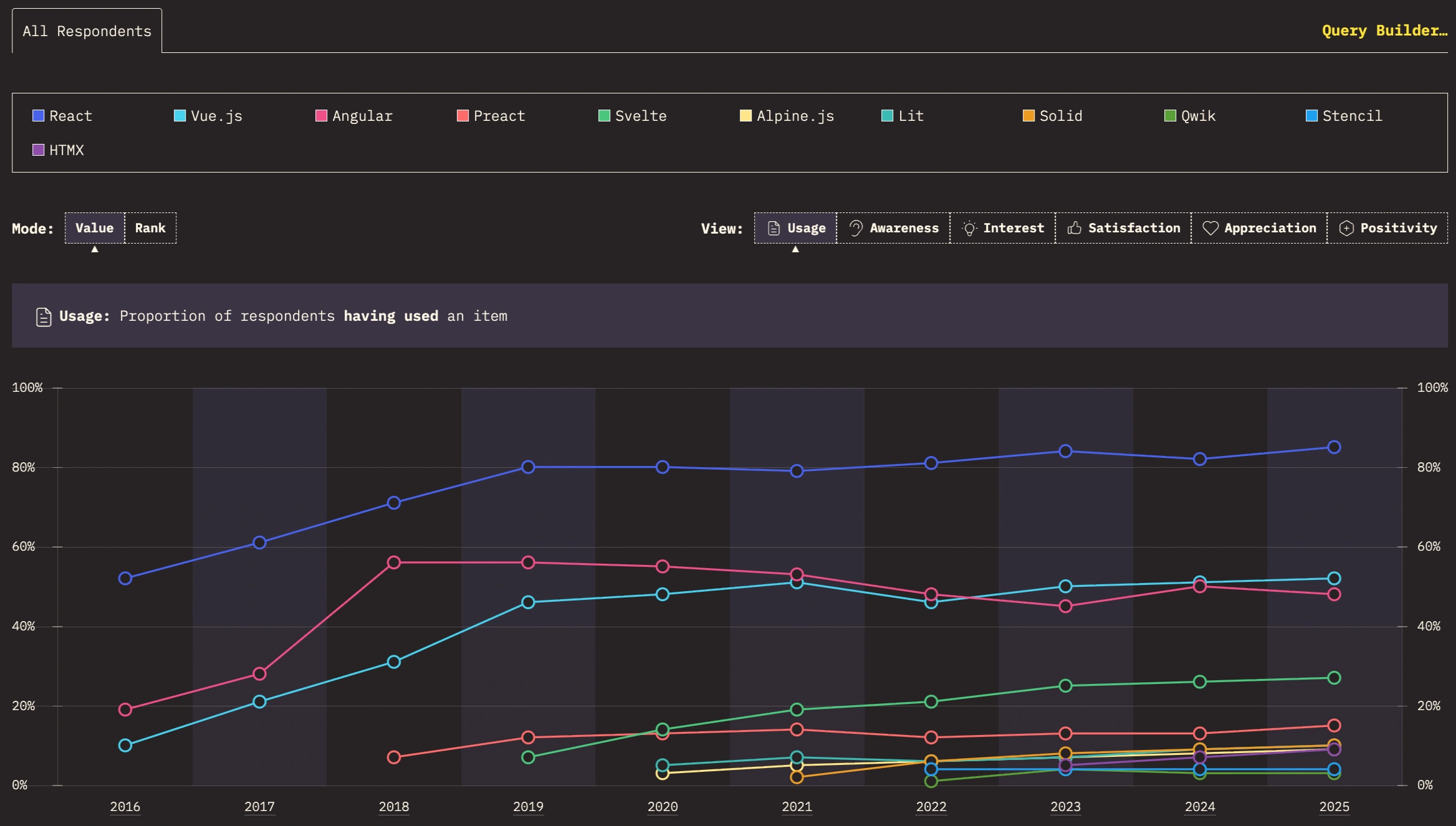
Across the State of JS 2025 survey, React stays the most used framework while its satisfaction slips, and Svelte holds the highest satisfaction of the major options.
A good framework is not the one with the longest feature list. It is the one that clears all three legs of the stool for the job in front of you. Here is how each plays out in the real world.
Performance fit is about matching the rendering model to the workload, and this is far easier to get right at the start than to fix later. Mobile-first is the obvious case. Most web traffic now arrives on mobile, often over a flaky connection, so a framework's bundle size and first-load behaviour are not a detail you tune at the end. They decide which framework you should pick in the first place. A heavy framework on a content site that lives or dies by search ranking is a structural mistake, not a tuning problem. Same with rendering: if first-load speed and SEO matter, server-side rendering needs to be a first-class part of the framework or its meta-framework, not something you bolt on afterwards.
Team fit decides how fast you ship and how cheaply you maintain. The honest test is not the documentation. It is a small proof of concept built by the people who will actually own the code, watching how fast they get productive and how readable their work is to whoever inherits it next. A framework that demands rare expertise, or that only one person on the team really understands, is quietly charging you whether or not the bill shows up in sprint one. Compatibility with the rest of your stack, and how painlessly you can wire in the external tools you already depend on, belong in the same assessment. Friction here gets paid every week, not once.
Commercial risk is the leg teams skip and later regret. Community size, documentation quality and release cadence are not vanity metrics. They are leading indicators of how expensive a framework will be to live with. A large, active community means faster answers, more libraries and a deeper hiring pool, which drags key-person risk down. A slowing release cadence or a thinning ecosystem is technical debt arriving on a timetable. Popularity sits here too, but as a signal about hiring and longevity, not a reason in itself. Choosing a framework only because everyone else did is how teams end up with a stack nobody can staff. For more on keeping that exposure in check, see our guide to technical debt.
The most used frontend frameworks are still React (Meta), Angular (Google), Vue.js and Svelte. They cover the bulk of production work, and they have the resources to back it up.
According to the State of JS 2025 survey, React is the most widely used framework, though its satisfaction score has slipped, while Svelte records the highest satisfaction of the leading options. The Stack Overflow 2025 Developer Survey tells the same story on usage: React 44.7%, Angular 18.2%, Vue 17.6% and Svelte 7.2% among professional developers.
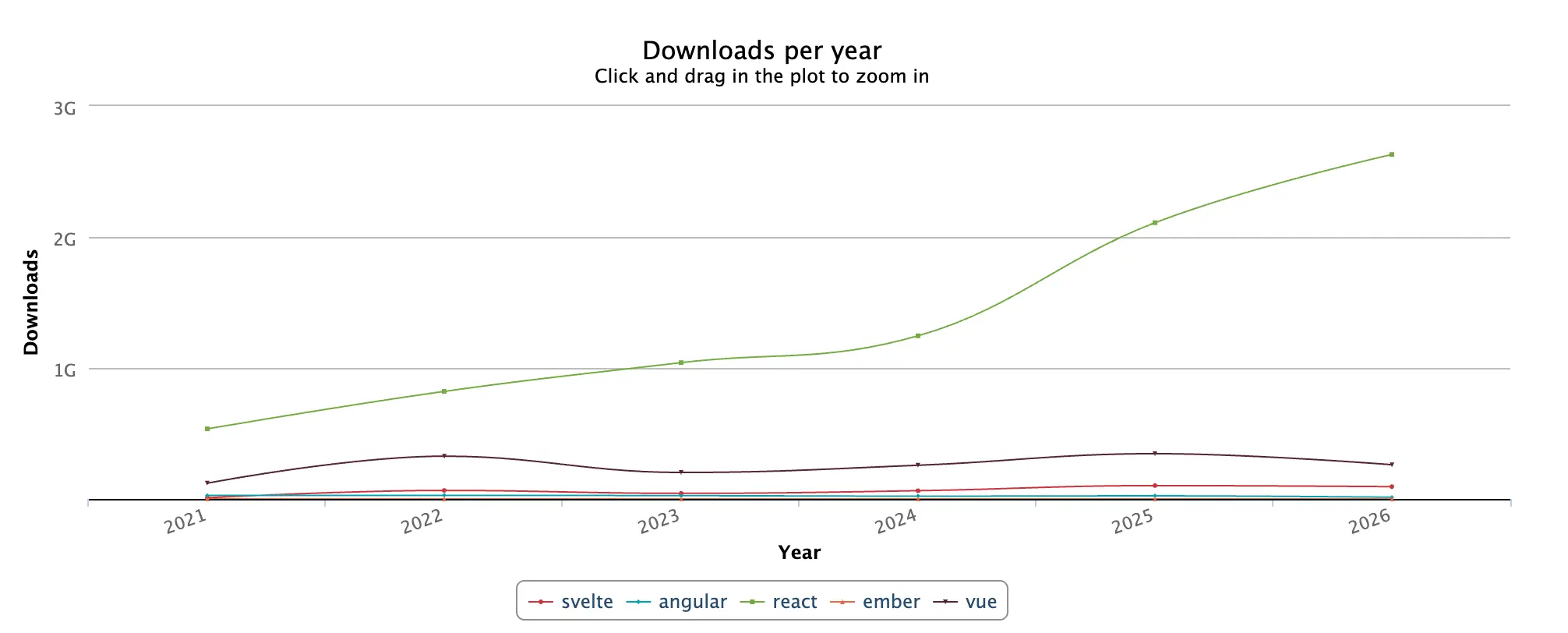
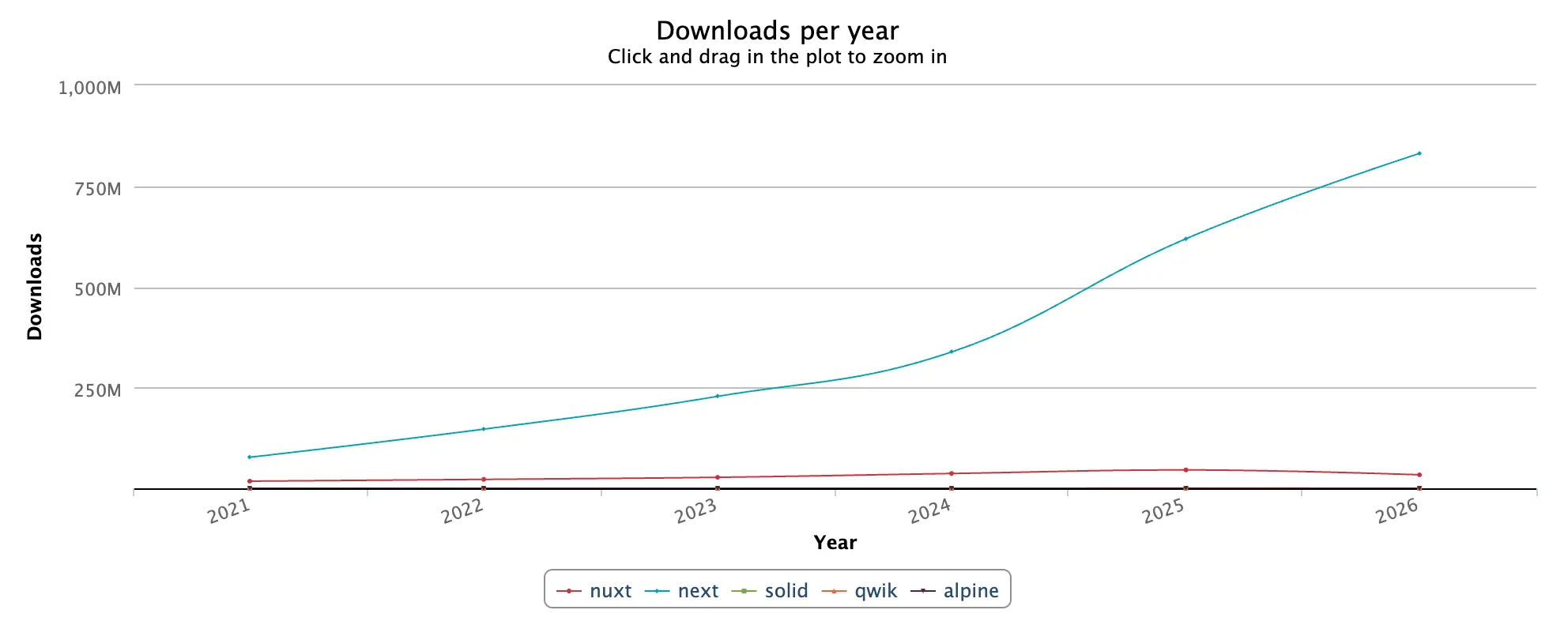
The download data agrees. On npm trends, React pulls well over 100 million weekly downloads, many times its nearest rival, with Vue, Svelte and Angular trailing behind. One caveat. Raw download counts overstate the gap, because continuous-integration pipelines and transitive installs puff the numbers up. Read them as a signal of ecosystem scale, not precise market share.
Picking from a top-ten list is one job. Settling a straight fight between two names is another. Once React, Angular and Vue make your shortlist, the useful question stops being "what's best overall" and becomes "which of these two suits us". So we've fought each match-up out on its own. One at a time.
React or Angular, when structure matters and you're hiring for the long haul: React versus Angular. React or Vue, when you want the gentler on-ramp without losing the ecosystem: React versus Vue. Want routing and server-side rendering in the box? Next.js versus React. And if the real argument is about the language underneath rather than the framework on top, TypeScript versus JavaScript settles it.
A framework is a box of tools. What you build with it is the thing that pays the bills, and the two questions are not the same. The same React that runs a single-page app also runs a progressive web app and half an enterprise dashboard.
Not sure which kind of app you're even making? Start with the 10 types of web applications and work backwards. If your users live on their phones and you want app-like behaviour without the app store, progressive web apps is the one. And if you want the page to load once and feel instant ever after, single-page applications lay out the trade-off.
Choosing a framework is the easy afternoon. Building with it, staffing it, and keeping it upright at 3am is the rest of the year. Truth be told, that second part is where most budgets quietly go.
Rather bring in people who've shipped this before? Here's how we approach web development, and the web development companies worth a shortlist. Both make sense once the framework is chosen and the project is real.
So what is the answer? There isn't a universal one. The right framework is simply the one that clears all three legs for your specific use case, now and over the next few years. You can see some of the thinking behind this in Imaginary Cloud's front-end projects.
For most enterprise teams, React, Angular or Vue is the lowest-risk choice, because all three pair a mature ecosystem with a deep hiring pool. Decide on three axes: performance fit (does the rendering model match the workload?), team fit (can you staff and maintain it?), and commercial risk (what does it cost to live with over three to five years?). React gives you the largest talent pool, Angular the most prescribed architecture for regulated or large teams, and Vue a lighter middle ground.
React's main long-term risks are architectural, not technical. Because React is a library rather than a full framework, your team owns the calls on routing, state and structure, so inconsistent choices can quietly build up as technical debt without strong conventions. Leaning on a meta-framework such as Next.js adds vendor and complexity questions to weigh. The flip side: React offers the deepest hiring market and the widest ecosystem, which lowers key-person and handover risk. The fix is disciplined architecture and a deliberate decision about how much of the surrounding ecosystem you take on.
React, by a clear margin. In the Stack Overflow 2025 Developer Survey, 44.7% of professional developers reported using React, ahead of Angular (18.2%), Vue (17.6%) and Svelte (7.2%). Where staffing speed, handover and key-person risk are priorities, that depth is a direct commercial advantage. Salary swings far more on region, seniority and company than on framework, so treat hiring-pool depth, not headline pay, as the reliable signal.
Across recent surveys, Svelte records the highest satisfaction of the major frameworks, helped along by the Svelte 5 reactivity system, while React's satisfaction has slipped even as it stays the most used. Satisfaction tends to predict future adoption, so it is worth watching. But a smaller hiring pool means high satisfaction alone does not settle an enterprise decision.
Migration is rarely a like-for-like swap, so budget for more than the rewrite. The real costs are re-testing every interface, retraining or rehiring around the new framework, and running both stacks in parallel during the changeover. Moves between related tools are cheaper: shifting a Vue app onto Nuxt, or adopting a new reactivity model inside the same framework, reuses most of your code and skills. Cross-framework moves (React to Svelte, say) are effectively a rebuild, and should be justified by a concrete problem, unfillable roles, a framework in decline, or performance the current stack cannot reach, rather than by preference. The lower-risk path is usually incremental: migrate one slice at a time behind a stable interface instead of a single big cutover. If a move is on the table, an honest proof of concept and a staffing plan matter more than the feature list.
Both turn up in regulated sectors, and the call comes down to how much structure you want enforced. Angular is a full framework with prescribed architecture, TypeScript throughout and most tooling supplied by the core, which suits large teams and compliance-heavy environments where consistency, auditability and a single sanctioned way of doing things lower risk. React is a library, so it is more flexible but leaves architecture, routing and state to your team. Workable under regulation, but only with strong internal conventions and governance to stop the drift. Rule of thumb: pick Angular when you want the framework to enforce structure across a large or rotating team, and React when you have the senior discipline to impose your own and want the deeper hiring pool. Either way, staffing is the swing factor. See our guide to finding skilled React developers for how the hiring side tends to play out.
For a platform you expect to run for years, the safest bet is the framework you can keep staffed and patched, not the quickest one in a benchmark. React, Angular and Vue all qualify: large hiring pools, active maintenance and predictable release cadences keep total cost of ownership and key-person risk low. Among them, React offers the deepest talent market, Angular the strongest enforced structure for large teams, and Vue the gentlest onboarding. The real danger is rarely picking the wrong mainstream framework. It is choosing a niche one whose community thins out, leaving you with rising maintenance cost and roles you cannot fill. If you do go with something smaller like Svelte or SolidJS, do it for a specific performance reason and price in the narrower hiring market.
There is no single best framework. React, Vue, Svelte, SolidJS and Next.js each lead for different use cases. Choose on performance fit, team fit and commercial risk for your specific project, rather than on popularity.
Start from the work, not the framework. Pin down the application's size, interactivity and performance needs, then weigh candidates on performance fit, team fit and commercial risk. Build a small proof of concept with your real team before you commit, and weigh hiring depth and long-term maintenance cost alongside the features.
Here is the whole comparison in one line: pick the framework that clears all three legs of the stool for your use case, then back it with a team that will own the outcome. Choosing is the start, not the finish. If you want a hand selecting a stack, or delivering on it with a senior team that takes ownership, get in touch, or see how we approach web and mobile development.
.webp)
Alexandra Mendes is a Senior Growth Specialist at Imaginary Cloud with 3+ years of experience writing about software development, AI, and digital transformation. After completing a frontend development course, Alexandra picked up some hands-on coding skills and now works closely with technical teams. Passionate about how new technologies shape business and society, Alexandra enjoys turning complex topics into clear, helpful content for decision-makers.
Web developer focused on the front-end side of things, but I am also interested in RESTful application programming interfaces.
People who read this post, also found these interesting:
















.webp)