Written by:



Last Published:
21 July 2026
•
Every Python team building an API eventually hits the same fork in the road: Flask or FastAPI. Both work. Both ship. So which should you reach for? That is the whole FastAPI vs Flask question, and the honest answer starts with what you are building.
Here is the blunt version. Reach for FastAPI when you are building high-throughput APIs and microservices that need async concurrency, automatic validation, and documentation that writes itself. Reach for Flask when you want something light and flexible for smaller apps, prototypes, or a team already comfortable in its world. Same destination, different vehicles. Let's compare them properly, with sourced numbers, a decision matrix, and a section for the people who sign off on the bill.
The short version: FastAPI (you will sometimes see it written as "fast api") is the quicker, more opinionated pick for API-first products under real load. Flask is the simpler, more established pick for smaller services and teams that prize flexibility over built-in structure. Benchmarks favour FastAPI. But the decision really turns on two things: how much concurrency your workload genuinely needs, and how fluent your team is in async Python. Neither framework is "better" in the abstract. Choosing wrong just moves the cost somewhere you will feel it later, in maintenance and technical debt.

Flask is a web framework and Python module for building web applications with a small, simple core. It is a microframework, which means it arrives without an ORM (an Object-Relational Mapper, the translator that sits between your Python objects and your database tables) or much else bolted on. Want the hands-on version? Our guide to building REST APIs with Flask walks through it.
That bareness is the whole idea. Flask hands you routing and templating, then gets out of the way, which is exactly why it is so quick to pick up. It runs on the Werkzeug toolkit and the Jinja2 templating engine, so your app stays light and cheap to run.
Flask runs on WSGI (the Web Server Gateway Interface), the long-standing standard that lets a Python app talk to a web server one request at a time, in a queue. It extends easily through third-party libraries and keeps a tidy project structure. Uber, Microsoft, and Explosion AI all run it in production.
Where Flask shines: a shallow learning curve that gets new developers productive quickly, first-class unit testing, a built-in development server for local work, and easy incremental extension. It scales further than its reputation suggests, as long as you keep the underlying design honest.
Where Flask bites back later: it is single-threaded and synchronous by default, so throughput sags under concurrent load unless you reach for extensions. No built-in session management. No database migration support. No automatic API documentation. And because it is HTML-first rather than API-first, there is no single blessed way to structure API code, which is an open invitation to inconsistency as a project grows. Leave that manual scaffolding unmanaged and it sets like concrete into technical debt. If you are weighing Flask against a full-stack option instead, our Flask vs Django comparison covers that trade-off.

FastAPI (you will sometimes see it as "fast api") is a Python microframework built for one job: APIs. It runs on ASGI (the Asynchronous Server Gateway Interface), which lets it handle many requests at once rather than making them queue. Jinja2 is there if you want templating, and FastAPI plays nicely with most databases and ORM styles. Microsoft, Uber, Netflix, and Cisco run it in production, and for a lot of teams starting a new Python API today, it is the default.
Where FastAPI is strong. Independent TechEmpower benchmarks put FastAPI under Uvicorn among the fastest Python frameworks going, behind only Starlette and Uvicorn themselves, the two parts it is built on (per FastAPI's benchmarks documentation). Concurrency is native: you declare a path function as a coroutine with async def and await, and there is no event loop to babysit.

It also ships a dependency injection system, a pattern where a component's requirements (a database connection, an authenticated user) get handed to it from outside rather than built inside, which keeps your classes loosely coupled and easy to test.
Validation and documentation, included. FastAPI leans on Pydantic, a data validation library that checks incoming data against your Python type hints and turns away anything malformed before it reaches your logic. Think of it as a bouncer on the door: wrong type, wrong shape, no entry, and a clear note explaining why. On top of that, it generates interactive API documentation straight from your code.
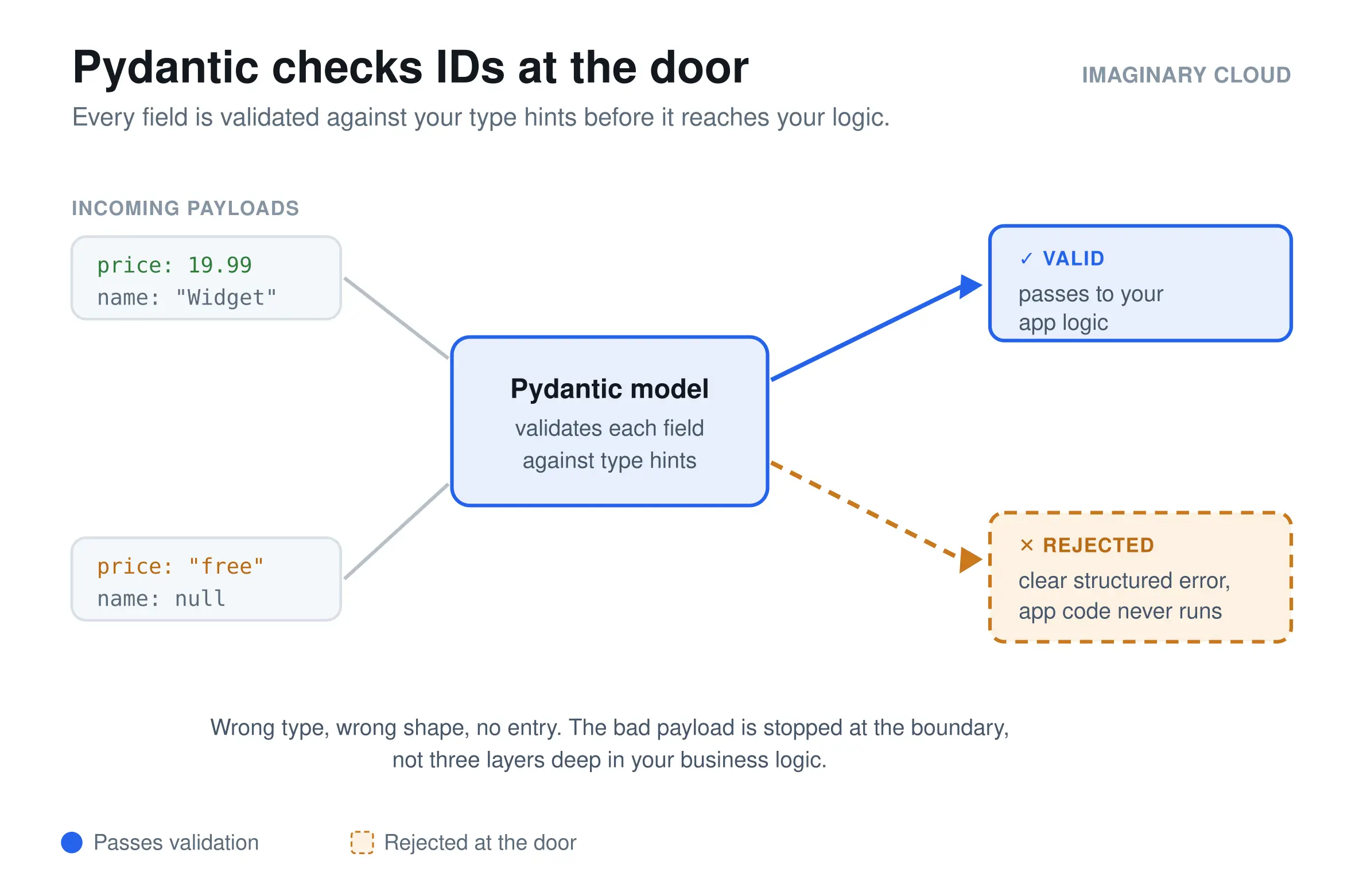
FastAPI's maintainers reckon this typing-first approach cuts human-induced errors by around 40%, an internal estimate rather than an audited figure, but one that squares with what strong typing buys you in practice.
Where FastAPI costs you. Security is not switched on by default: the separate fastapi.security module handles it (OAuth2.0 included), so it is on you to wire it up deliberately. And because FastAPI is younger than Flask, the pile of books, tutorials, and long-form guides is thinner, which stings when you are stuck at 2am hunting for someone who has hit your exact error before.
Most comparisons trudge through the same checklist. Here is that detail in a table you can actually scan, then the three areas that decide more real projects than requests-per-second ever will: testing, deployment, and type checking.
Testing. Both test well, truth be told. Flask ships a built-in test client and pairs naturally with pytest, part of why teams who care about coverage love it. FastAPI brings its own TestClient (built on HTTPX), and because requests and responses are declared as types, a whole species of malformed-input bug gets caught by validation before a single test runs. For async endpoints, FastAPI's async test support skips the workarounds synchronous frameworks need.
Deployment. Flask deploys behind a WSGI server such as Gunicorn or uWSGI, a mature and well-trodden path. FastAPI deploys behind an ASGI server such as Uvicorn, usually with Gunicorn marshalling the worker processes. Both containerise cleanly with Docker, and both run serverless, though FastAPI's async model wants an ASGI-aware adapter (Mangum on AWS Lambda, say) rather than the standard WSGI handler. Neither is meaningfully harder to ship. The real question is which server stack your platform team already runs.
Type checking and tooling. This is where FastAPI's design quietly pays you back. Because endpoints, parameters, and models are all expressed as type hints, tools like mypy and your editor's autocomplete catch mistakes as you write them, not in production at midnight. You can annotate Flask code too, of course. But Flask neither requires it nor rewards it the way FastAPI does, so your safety net is only as strong as your team's discipline in keeping it up.
If you are a CTO or an engineering lead, this is not a benchmark decision. It is a total-cost-of-ownership one. FastAPI's async model and built-in validation trim boilerplate and catch errors early, but they assume a team fluent in async/await, type hints, and Pydantic. If your engineers have only ever shipped synchronous Flask, budget for the ramp-up.
Flask's gentler learning curve buys you faster time-to-value today. The catch: it can push cost downstream, where manual validation, hand-rolled async, and inconsistent API structure quietly set into technical debt once a "simple" service outgrows its brief.
Concurrency is where the money actually sits. A handful of internal endpoints will not trouble Flask's synchronous model. Customer-facing APIs under real concurrent load, the kind you see in fintech, healthtech, and platform engineering, are where FastAPI's architecture saves you an expensive re-platforming down the line.
Hiring pulls the other way. The Flask talent pool is bigger and cheaper to hire from, while FastAPI experience costs a premium and stays scarcer (though that gap narrows every year). Framework risk is low either way, since both are open-source and actively maintained, so the danger is not the framework failing: it is picking an architecture your team cannot yet run. If that is a live worry for an existing codebase, an independent technical audit will surface the mismatch before production does.

Most FastAPI vs Flask comparisons stop at the feature list. In our project-scoping work at Imaginary Cloud, we have found the call really turns on two variables that predict how things actually play out: how much concurrency the app genuinely needs, and how mature your team's Python and async skills are. Plot your project against both.
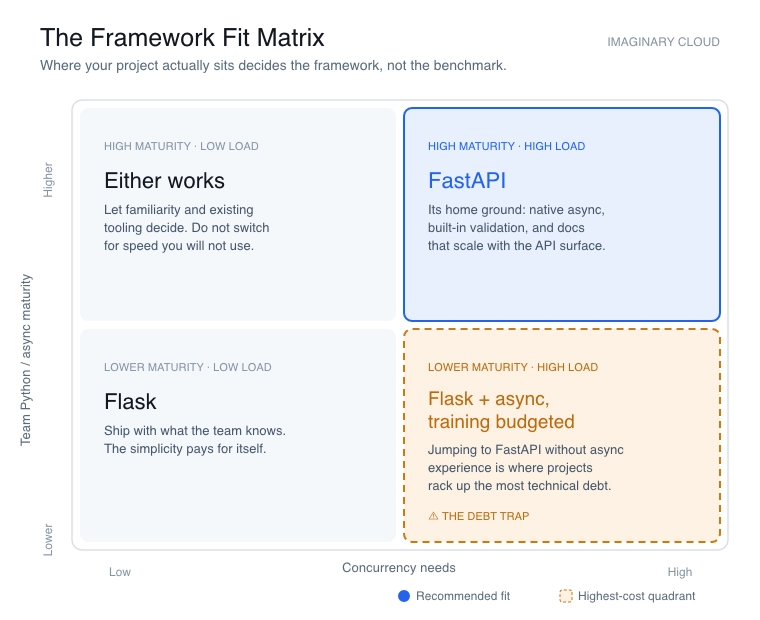
| Low Concurrency Needs | High Concurrency Needs | |
|---|---|---|
| Lower Python/Async Maturity | Flask. Ship with what the team knows; the simplicity pays for itself. | Flask with async extensions, and training budgeted in. Jumping straight to FastAPI without async experience is where projects rack up the most technical debt. |
| Higher Python/Async Maturity | Either. Let team familiarity and existing tooling decide; do not switch frameworks for speed you will not use. | FastAPI. Its home ground: native async, built-in validation, and documentation that scales with the API surface. |
One quadrant causes more grief than the rest: top-right, high concurrency paired with a team still finding its async feet. That is where "we chose FastAPI for the performance" curdles into months of chasing blocking calls hiding inside async def functions. The fix is not to retreat to Flask. It is to budget the ramp-up before you commit to the architecture. It is also, more often than not, where a cloud-native platform engineering partner earns its fee.
In fintech and healthtech, this choice carries weight beyond throughput. Regulated workloads demand auditable request handling, strict input validation, and clean data contracts, which is precisely where FastAPI's Pydantic models earn their keep: every field typed, validated, and self-documenting at the boundary. That shrinks the surface area for the malformed-payload bugs that have a nasty habit of becoming compliance incidents.
Does that rule Flask out? Not at all, plenty of regulated systems run happily on it. But Flask puts the weight of validation and documentation on your team rather than the framework, which raises the cost of proving your controls to an auditor. For high-concurrency regulated APIs, FastAPI's async model also soaks up peak load without the thread exhaustion that drags a synchronous service to its knees. The deciding factor is the same as everywhere else in this piece: a framework your team cannot operate with confidence is a compliance risk in its own right.
FastAPI is the stronger pick for API-first products under concurrent load, thanks to native async, built-in Pydantic validation, and documentation it generates for you, and it leads Flask in independent TechEmpower benchmarks. Flask is the better fit for smaller services, prototypes, HTML-rendering web apps, and teams already fluent in it, with a shallower learning curve and a deeper hiring pool.
The performance gap only bites if your workload is genuinely I/O-bound and concurrent; below that line, either one is fine. The costliest mistake is marrying high concurrency to a team that has not learned async yet, so weigh your team's Python maturity as seriously as the workload itself. Use the matrix above to sense-check the call before you commit.
FastAPI is built around asynchronous request handling, automatic Pydantic validation, and auto-generated API documentation, which makes it purpose-built for modern API work. Flask is a synchronous microframework with a smaller core, so you get more flexibility but you set up validation and documentation yourself. Both build the same applications. They differ in how much arrives built in versus how much you assemble by hand.
Yes, in most benchmarked scenarios. TechEmpower's independent benchmarks show FastAPI on the ASGI server Uvicorn outpacing Flask's synchronous WSGI setup, especially under concurrent load. The gap grows as simultaneous connections climb, because FastAPI's async model dodges the thread exhaustion that hobbles synchronous frameworks. For low-traffic or non-I/O-bound apps, though, you will rarely notice the difference.
Flask, for most people. Its synchronous model maps cleanly onto how most of us first learn Python, so beginners get moving faster. FastAPI asks you to be comfortable with type hints, async/await, and Pydantic models, which is extra overhead if that is new ground for your team. Developers already at home with modern Python typing tend to pick FastAPI up quickly.
Is FastAPI killing off Flask? Not really. It has taken a big share of new API projects and its growth outpaces Flask's there, but "replacing" overstates it. Flask is still the go-to for HTML-rendering web apps, smaller services, and teams with existing Flask investment. More and more, the two serve different jobs, API-first backends versus general-purpose web apps, rather than fighting over the same projects.
Migrate for a specific reason, not a vague one: a real concurrency bottleneck, a need for automatic API documentation, or validation logic that has become painful to maintain by hand. The cost is concrete: refactoring request handling, rewriting validation as Pydantic models, swapping the WSGI server for ASGI, and regression-testing everything you touch. Performance alone does not justify it if your app is not I/O-bound. And for template-rendering apps, migration usually is not worth the upheaval.
It does, up to a point. Flask 2.0 added native support for async def view functions, and extensions fill some gaps, but Flask is not built async-first the way FastAPI is. It will handle some async work, yet it will not match FastAPI's concurrency under heavy load. If you need async as a core capability rather than a bolt-on, FastAPI is usually the better starting point.
Flask has the larger, more affordable talent pool, having been mainstream for over a decade and a common first framework. FastAPI experience is scarcer and pricier, though the candidate pool is filling out quickly as adoption rises. If you need to scale a team fast in the near term, Flask's availability is a genuine edge. If you are building an API-first platform for the long haul, investing in FastAPI skills tends to pay off.
FastAPI's typed, self-validating Pydantic models suit regulated workloads that need auditable data contracts and strict input validation, and its async model copes with peak load. Flask is used successfully in regulated systems too, but it shifts the validation and documentation burden onto your team, which raises the cost of demonstrating controls. In both cases, your team's ability to operate the framework with confidence matters more than the framework itself.
Both serve ML models widely; load decides it. FastAPI's async support and built-in validation suit ML APIs juggling concurrent inference and complex input payloads. Flask stays common for internal tools, prototypes, and lower-traffic ML services, especially where the team already knows it inside out.
The framework you choose shapes your delivery speed, your hiring plan, and your maintenance bill for years. If you would like a second opinion grounded in your actual workload and your actual team, our engineers are happy to help you pressure-test the call before you build a line of it. Talk to the Imaginary Cloud team about your project, or take a look at our AI-enabled custom development work.
Alexandra Mendes is a Senior Growth Specialist at Imaginary Cloud with 3+ years of experience writing about software development, AI, and digital transformation. After completing a frontend development course, Alexandra picked up some hands-on coding skills and now works closely with technical teams. Passionate about how new technologies shape business and society, Alexandra enjoys turning complex topics into clear, helpful content for decision-makers.
Software developer who loves the backend side, agile and RoR addicted. A fan of football and an enthusiast of cycling. Let's ride!
Software developer with a big curiosity about technology and how it impacts our life. Love for sports, music, and learning!
People who read this post, also found these interesting:
















.webp)