Written by:


Last Published:
20 July 206
•

Most people treat MVP and MMP as the same idea at different sizes. They are not. If you are holding the budget for a first release, you are choosing between two development strategies that spend your money on completely different things: MVP (Minimum Viable Product) and MMP (Minimum Marketable Product). An MVP buys you evidence. An MMP buys you a launch.
Think of MVP and MMP as two sides of the same coin, because that is what they are. Same budget, same team, same calendar. You just decide which face it lands on. MVP is like a prototype, letting you test your product idea in the market with just enough features to validate it. An MMP offers a complete set of features and a compelling design that appeals to customers.
Product design, development time and budget all pull on that decision, and they pull in different directions. Both strategies are expensive to get wrong, in different currencies. Which is why the choice deserves an hour before the build takes a quarter.
Let's compare them.
A minimum viable product is a development strategy focused on delivering a product with the bare minimum features necessary to satisfy early adopters. The idea is to get customer feedback as quickly as possible and use that feedback to improve the product. It is a popular choice for startups and businesses that want to validate their product idea before investing significant resources into development.
The term has a more interesting history than most articles admit, and the history matters because it explains why teams argue about what an MVP is. Frank Robinson coined it in 2001, and his definition was commercial rather than experimental: the product that "maximizes return on risk for both the vendor and the customer". Steve Blank carried the idea into customer development in The Four Steps to the Epiphany (2005). Eric Ries then made it famous, and shifted its centre of gravity: in The Lean Startup (2011), the MVP is the version of a product that produces the most validated learning for the least effort.
Those two definitions pull in different directions, which is exactly why MVP scoping meetings go round in circles. Robinson's MVP is sized to make money. Ries's MVP is sized to answer a question. If your team cannot agree on what belongs in the first release, it is usually because half the room is using one definition and half is using the other. Settle that first and the feature argument tends to resolve itself.
Everything below follows from Ries's version, because that is the one most businesses mean when they say MVP. An MVP is not a small product. It is an instrument for buying evidence, and every characteristic it has exists to keep the price of that evidence down.
Aurora Analytica shows what that looks like when the vision is large. Their Aurora Suite is a big-data platform for clinical trials, and the full product runs to eleven Decision Engines covering more than fourteen assessments: market access, trial design, country and site selection, clinical operations. We built one of them. The Geo Matrix Decision Engine went first: a tool letting CRO users run scenarios against their own data, with a world map rendering the results of the matrix calculations and CSV import and export so teams could bring their existing datasets in rather than retype them.
One engine out of eleven is a scoping decision, not a budget cut. The question was never "how much of the suite can we afford", it was "which engine, standing alone, is worth using before the other ten exist". Get that wrong and you ship something that only makes sense as part of a product nobody can see yet. That is the actual difficulty in MVP scoping, and it is why the choice sits with people who understand the domain rather than with whoever is holding the estimate.
Three things follow from the purpose, and they are less flattering than most MVP articles admit.
Functionality stops at the minimum needed to satisfy early adopters, because anything past that is money spent answering a question nobody asked. The design is plain. Not ugly — plain. It exists to get the product in front of users, not to win a design award, and teams who forget that lose weeks polishing a screen they will throw away. And the launch is quiet. No campaign, no press push. You want the honest reaction of a hundred people who chose to be there, not the arms-length verdict of ten thousand who were interrupted.
What you get in return: speed, and a bill you can live with. Limited scope means a build measured in weeks rather than quarters, at a fraction of full-product cost, and feedback arriving early enough to change what you build next. That last one is the whole point. The other two are just how you afford it.
Discover everything about the minimum viable product in our ultimate guide.
Every one of these is the price of the evidence. Worth paying when you need the evidence. Hard to justify when you do not.
Invisible Homes is a UK platform for buying off-market properties, and it reached us after its own MVP had already launched. The product worked, in the sense that it existed. It was also buggy, and adoption was running below what the business had planned for. We were brought in to take over the project and build a roadmap out of it.
The interesting part is where the bugs were coming from. The platform was built in Ruby on Rails, and we kept that codebase rather than restarting, but test coverage was thin, and thin coverage is why defects kept surviving all the way to production. We took coverage up to 80% and swapped out the deprecated libraries the original build had accumulated.
None of that is glamorous work, and none of it was in anyone's original budget. That is the point. "Additional development and investment" is an easy bullet to skim past in an MVP article; on this project it meant paying down the testing and dependency debt of a product that was already live in front of users. Once it was paid, the numbers moved: adoption recovered, the community passed 35,000 registrants, and more than a hundred agencies signed up.
The lesson is not that the MVP was a mistake. It got a real product in front of a real market, and the demand turned out to be there. The lesson is that the second bill always arrives, and the teams who plan for it fare better than the teams who are surprised by it.

A minimum marketable product is a development strategy focused on delivering a product with enough features and functionality to make it appealing to the target market. The goal is a product that is marketable, which means the release has to stand on its own in front of customers who never signed up to be early adopters. MMP is a popular choice for established businesses and large-scale projects.
One point of confusion worth clearing up. MMP is often mixed up with the minimum marketable feature (MMF), and the two work at different scales. An MMF is a single feature small enough to ship on its own while still being worth something to a user. An MMP is the whole product at its smallest sellable form. The MMF is a brick. The MMP is the house you can actually move into.
A minimum viable product approach suits businesses looking to test a new product idea and refine it over time based on feedback. The three situations below are the same condition wearing different clothes: you do not know enough yet, and the cheapest way to find out is to ship.
Read more about how to build your MVP efficiently with agile methodology.
An MMP approach suits businesses that want to deliver a complete product to customers and compete in a crowded market. These three share a condition too, and it is the opposite one: you already know enough, so the risk has moved from being wrong to being late.
That is the tell for an MMP. When your users have no choice about adopting your product, "let's ship something small and see what they say" stops being research. They will tell you it is incomplete, you will already have known that, and you will have spent the goodwill you needed for the real launch.
This table provides a clear comparison of the main differences between MVP and MMP, helping you choose the right strategy for your needs.
| MVP | MMP | |
|---|---|---|
| Goal | Validate the product idea with early adopters | Establish a marketable product in the market |
| Functionality | The bare minimum needed to satisfy early adopters | Complete |
| Design | Simple and straightforward | Sophisticated and attractive |
| Marketing effort | Minimal | Substantial |
| Time to market | Fast | Longer |
| Development cost | Low | Higher |
| Primary audience | Early adopters | The full target market |
| Revenue at launch | Little or none | Expected from launch |
| Main risks | Incomplete experience, limited scalability, further investment required | Obsolescence if the market shifts |
| Best suited to | Startups and businesses validating an idea | Established businesses and large-scale projects |
The table tells you what each strategy is. It does not tell you which one to buy. Three questions do most of that work, and they are worth answering before a line of code gets written.
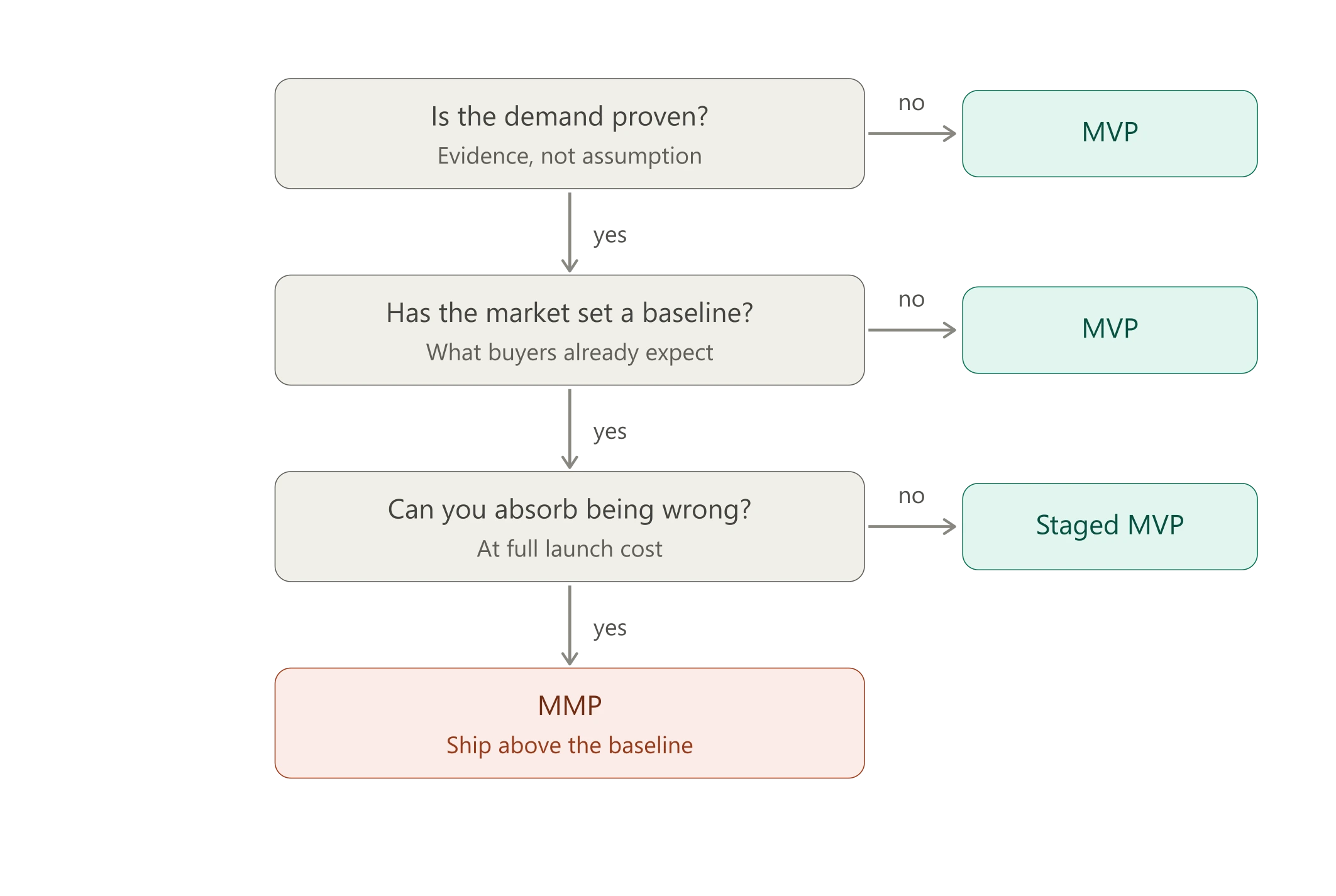
Do you know the demand is there? If the answer rests on assumption rather than evidence, you are describing an MVP. The whole point of the minimum viable product is to buy that evidence at the lowest price you can. If the demand is already proven, by an existing customer base or by competitors selling into the same market, you have already bought it. Spending again is just paying twice.
What does the market already expect? In an established category, customers turn up with a baseline in their heads. Ship below it and the feedback you collect measures your gaps rather than your idea, which is an expensive way to learn nothing. That is the case for an MMP. In a new or underserved category, nobody has set the baseline yet, and an MVP gets to draw it.
What does being wrong cost? This is the question most comparisons skip, and it is the one that decides the budget. An MVP is cheap to be wrong with and expensive to be right with, because success means building the product properly a second time. An MMP is the reverse: expensive to be wrong with, since the money is committed before the market has confirmed anything, and cheap to be right with, since the product is already sellable. So which failure is worse? Neither, in the abstract. The only question that matters is which one your business can absorb.
Requirements work carries the same tension. Deciding what waits is the real work in both strategies. It always is.
Discover the Top 10 Software Development Companies to work with.
MVP and MMP are two popular development strategies businesses use to bring their products to market. MVP suits companies that want to validate their product idea quickly and at a low cost. MMP suits businesses that want to bring a marketable product to market.
Choose on what you know, not on what you can afford. If the demand is still a hypothesis, buy the evidence before you buy the product. If it is proven and the market already has a baseline, ship above it. The coin has two faces and you will probably see both, because most products pass through both: an MVP proves the idea, and an MMP sells it.
A minimum viable product is a version of a product built with the bare minimum features necessary to satisfy early adopters. Its purpose is to test a product idea in the market and collect customer feedback as quickly as possible, before significant resources go into development.
Not usually, and trying is how products get a reputation before they have a product. An MVP is priced, scoped and marketed to people who volunteered to tolerate gaps. The moment you charge the general market, the gaps stop being a research method and start being a complaint. The honest version is to sell the MVP to a small, informed group — design partners, pilot customers — who know what they are buying and are paying for influence over v2.
Fast time-to-market, low development costs, and early customer feedback — and the third is the one that pays for the other two.
An MVP has the bare minimum functionality and a basic design, launches with minimal marketing, and exists to validate an idea with early adopters. An MMP has complete functionality and an attractive design, launches with substantial marketing, and exists to sell to the full target market. An MVP is faster and cheaper. An MMP is ready for revenue.
No. A prototype demonstrates how something would work; an MVP gets used by real customers, and the feedback from that use is the output.
An MMF, or minimum marketable feature, is a single feature small enough to ship on its own while still being worth something to a user. An MMP, or minimum marketable product, is the whole product at its smallest sellable form. The MMF is a unit inside the release. The MMP is the release.
When the MVP has answered the question it was built to answer. Once early adopter feedback confirms the demand is real, the limits of the MVP become the constraint: an incomplete user experience, limited scalability, and no immediate revenue. That is the point at which the additional development and investment an MMP requires starts to pay for itself. On Invisible Homes, that moment arrived as a bug count and an adoption curve that had stopped climbing — the product had proven the market and then hit the ceiling of how it was built.
No. They are answers to different questions. An MVP asks whether anyone wants this; an MMP assumes someone does and asks whether you can win them. Adding features to an MVP without that shift in question gets you a bloated experiment, not a product.
If you are weighing an MVP against an MMP for your next product, contact us, we are happy to talk it through.
Alexandra Mendes is a Senior Growth Specialist at Imaginary Cloud with 3+ years of experience writing about software development, AI, and digital transformation. After completing a frontend development course, Alexandra picked up some hands-on coding skills and now works closely with technical teams. Passionate about how new technologies shape business and society, Alexandra enjoys turning complex topics into clear, helpful content for decision-makers.
Inês Silva is a Project Manager with over four years of experience writing about software delivery, agile methodologies, and tech leadership. Because she started her career as a developer, Inês brings a real, deeply technical understanding to the management side of things. She loves bridging the gap between big-picture business strategy and day-to-day engineering execution, and she's passionate about sharing practical tips that help teams collaborate better and ship great products.
People who read this post, also found these interesting: