Written by:

Last Published:
17 November 2026
•
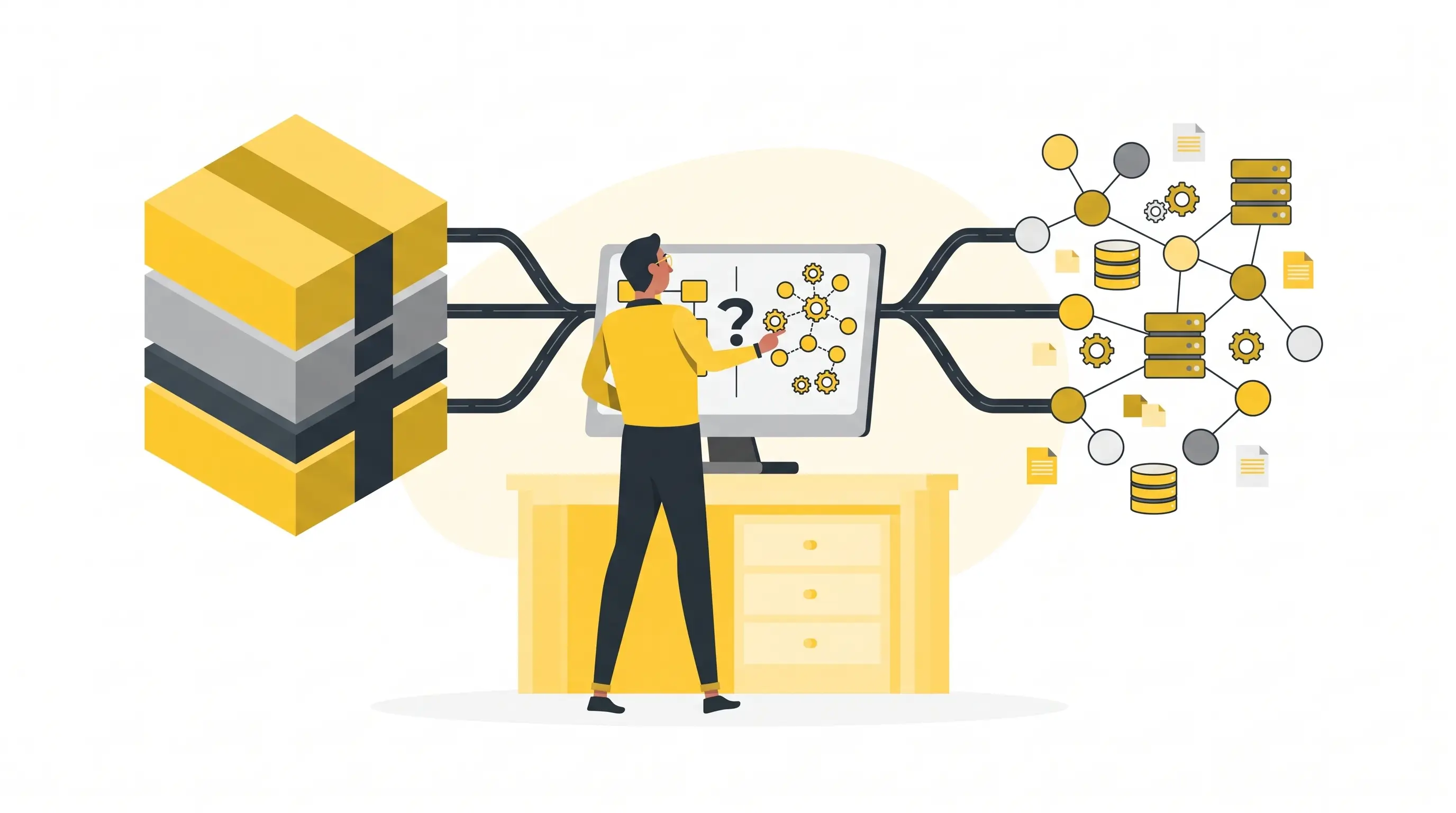
An AI factory is a repeatable system for turning data into AI that works in production. The term has two meanings: a purpose-built data center that produces AI output at scale, and an operating model that moves AI from pilot to production the same way every time.
The first meaning is about buildings: racks of graphics processors (GPUs), liquid cooling and tokens produced per second. (A token is a small chunk of text that a model reads or writes.) The second is about habits: a repeatable way to take AI from a promising pilot to something customers rely on.
Picture the first as a power station and the second as the kitchen that cooks with the power. You need electricity either way. But the electricity does not plan the menu.
So is an AI factory just a data center with better marketing? Partly, depending on who is talking. This guide separates the two meanings, and spends most of its time on the one that decides whether your AI investment pays off: the software and delivery layer.
An AI factory is a standing process for turning data into AI that runs reliably in production. The term has two meanings. In infrastructure, it is a purpose-built data center producing AI output at scale. In software, it is an operating model: data, evaluation, deployment and governance run as one pipeline, so each new use case ships faster.
Here is how the two views compare.
| Infrastructure view | Software and delivery view | |
|---|---|---|
| Who uses the term | NVIDIA, HPE, Cisco, Dell | Business schools, product and engineering teams |
| What it is | Purpose-built compute: GPUs, networking, storage, cooling | A pipeline: data, evaluation, agents, governance, release |
| What it produces | Intelligence, measured in tokens | Working AI features, shipped repeatedly |
| Key metric | Token throughput and energy efficiency | Time from pilot to production, cost per use case |
| Typical buyer | Infrastructure teams, cloud and sovereign providers | CTOs, product and business leaders |
The software meaning is the older one. Harvard Business School professors Marco Iansiti and Karim Lakhani described the AI factory in their 2020 book Competing in the Age of AI as the engine inside AI-driven firms, and HBS Online still teaches it as a system that turns data into insight through repeatable processes.
The infrastructure meaning arrived later, when NVIDIA began promoting it in 2024. The HBS building blocks are a data pipeline, algorithm development, software infrastructure and an experimentation platform. Not one of them is a GPU.
An NVIDIA AI factory is specialised computing infrastructure that manages the whole AI life cycle, from data ingestion to training, fine-tuning and high-volume inference (the stage where a trained model answers real requests). Its output is intelligence, measured in tokens. Put simply, it is a data center built to manufacture AI output, not to host websites.
NVIDIA's own glossary describes an NVIDIA AI factory as a stack of data pipelines, inference infrastructure, digital twins (virtual replicas used to design and test a site before it is built), and full-stack hardware from GPUs to cooling. It says the primary product is "intelligence, measured by token throughput." The term gained traction in 2024, when NVIDIA's CEO announced that several companies would build AI factories using its technology.
HPE and Cisco use the same frame with a twist.
HPE describes an AI factory as infrastructure, data pipelines, models, lifecycle management and governance combined into one system. Cisco calls it an environment built to industrialise how models are produced, trained and deployed.
Partners sell the NVIDIA version as products, such as the Dell AI Factory with NVIDIA and the Cisco Secure AI Factory with NVIDIA.
Notice that even the hardware vendors list governance and lifecycle management. Their answer is a reference architecture you buy. The question underneath it, how you run all of that day to day, belongs to your organisation.
No: a data center is a building that hosts computing. An AI factory, in the infrastructure sense, is a data center designed around AI workloads, with a focus on inference speed and energy efficiency. In the software sense it is no building at all, but the process that decides what runs inside one, or on rented cloud capacity.
That is the core of the AI factory vs data center question. The table puts the three side by side.
| Traditional data center | AI factory (infrastructure) | AI factory (software) | |
|---|---|---|---|
| Purpose | General-purpose computing | AI training and inference at scale | Getting AI into production repeatedly |
| Optimised for | Storage, retrieval, web services | Tokens per second, energy per token | Reuse, quality, speed to release |
| Output | Services and data | Tokens | Shipped, monitored AI features |
| Owned by | IT or a cloud provider | Infrastructure or platform teams | Product and engineering, with a business owner |
| Needs your own GPUs? | Not necessarily | Yes, or rented | No, capacity can be rented |
NVIDIA says standard data centers handle general-purpose computing while an AI factory is built for AI workloads. Cisco puts it more simply: traditional data centers store and retrieve information, and AI factories generate intelligence. Both statements are about hardware. Neither tells you whether your chatbot, your document pipeline or your forecasting model will survive contact with real users.
This part is our view, not a vendor definition. In AI factory vs data center terms, the leadership question is not which one to buy. It is which problem you are solving.
In software terms, an AI factory is the pipeline that moves AI from pilot to production the same way every time. It connects ready data, evaluation, agents or models, release engineering and governance, with an owner at each step. The goal is not a clever model. It is shipping the tenth use case far faster than the first.
Why bother? Because the failure rate is high and the causes are boring. Gartner expects more than 40% of agentic AI projects (projects built around AI agents that take actions) to be cancelled by the end of 2027, citing escalating costs, unclear business value and inadequate risk controls. It also predicts that, through 2026, organisations will abandon 60% of AI projects unsupported by AI-ready data.
Cost, value, risk, data. A software AI factory exists to put a check in front of each one.
It has five layers.
Start with the data your use case actually needs, who owns it and how clean it is. Write down a baseline before you build anything, such as hours spent or errors per week today. Without a baseline, "it works" is an opinion.
This is the layer most pilots skip. Build a test set of real, messy cases, including the awkward ones, and run it every time the prompt, model or data changes. At Imaginary Cloud we use it as a gate: an AI system must pass a test set of real cases, edge cases included, before it goes live. Then keep testing after launch, because production data drifts.
Choose the simplest design that works. An AI agent is software that uses a language model to decide on and carry out steps, such as looking up an order or drafting a reply. Begin with a fixed workflow and add agent steps only where judgement is needed, and keep the model swappable so a better one does not mean a rewrite. If you are unsure whether you need an agent at all, use the five-question test for deciding between an AI agent and traditional automation.
Governance is not a binary lock or free-for-all. Gartner warns that applying uniform rules to every agent regardless of autonomy fails, and predicts that 40% of enterprises will demote or decommission autonomous agents by 2027 because gaps surface only after incidents. Scale the controls to the autonomy.
The NIST AI Risk Management Framework (govern, map, measure, manage) is voluntary and a sensible checklist, and ISO/IEC 42001 covers the management-system side. For agents, OWASP's excessive agency risk is the practical one: limit permissions and require human approval for irreversible actions.
Models do not run themselves. You need CI/CD (automated testing and release pipelines), infrastructure as code, logging, monitoring and a named owner for the live system. That ownership is often called MLOps: the practices that keep machine learning models running reliably in production.
The Imaginary Cloud AI Deployment Framework covers it in five stages: production readiness assessment, architectural hardening, compliance review, MLOps ownership and staged rollout. It exists because a prototype that works in a demo is a different object from a system that works on a Monday morning.
Have AI pilots that have stalled? Our AI development services team can look at where they sit against these five layers and tell you what stands between each pilot and production.
Three groups build AI factories. Infrastructure vendors such as NVIDIA, Dell, HPE, Cisco and Supermicro sell validated designs. Cloud providers and governments build large and sovereign sites. Companies and their software teams build the delivery pipeline that ships AI features, which is the version most organisations need.
On the infrastructure side, packaged offerings now exist from Dell, HPE, Cisco with Supermicro, and Nutanix, most of them built around NVIDIA technology. On the software side, almost any company shipping AI features is building a factory, whether it uses the word or not. The difference is whether it does so on purpose.
A sovereign AI factory keeps data, infrastructure and operations under an organisation's own control, which matters to governments and regulated industries. HPE positions its sovereign AI factory as a way to build, deploy and govern AI while keeping strong control over data, infrastructure, operations and compliance.
For most companies, that level of control is not the starting point. A cloud region you already trust is usually enough, provided you keep the model swappable and address GDPR whenever the AI touches personal data.
Two public projects show what the delivery layer looks like. Neither is a large language model story, and we would rather say that than stretch the facts.
Sedna. Sedna runs two communication platforms for shipping and supply chain teams. The brief was to cut the cost of its Tray.io integration workflows and reduce technical debt. Imaginary Cloud optimised the legacy workflows, then moved them to custom AWS Lambda functions, with CI/CD for data synchronisation plugins and Terraform for infrastructure. One backend and one full-stack developer worked inside Sedna's team.
The published result is an 80% reduction in Tray.io costs.
There is no machine learning in that case study. (This is our reading, not Sedna's statement.) It is the first gate of a software AI factory at work: ask whether the problem needs AI at all. The rules were known, so deterministic code and solid delivery engineering won. The same habits, CI/CD, infrastructure as code and a team that owns the live system, are what keep an AI feature alive after launch.
Environmental Intellect. Ei serves the refinery and process industry. Imaginary Cloud built a machine learning module that automatically detects and tags objects in a 3D point cloud, and later added 3D text detection. Ei states that its clients can save up to $200k in contractor, scaffold planning and verification costs. The page does not attribute that figure to the ML module specifically, so we do not either.
Start small and build the pipeline around one real use case. Pick the use case and its owner, get the data ready, write the evaluation before the feature, choose the simplest architecture, add governance in proportion to autonomy, then ship in phases and monitor. Repeat with the next use case, reusing what you built.
At Imaginary Cloud, every step ends in a gate: a check that must pass before the work moves on. We call this the six-gate method. The gates are the part most how-to guides leave out.
The payoff comes on use case number two. It should reuse the data checks, the evaluation harness, the governance rules and the release pipeline from number one. If it does not, you have a project, not a factory.
Track three numbers for every use case: build cost, time to production and monthly run rate. In a working factory, use cases two and three beat use case one on all three. We do not quote a typical saving for the second use case, because it depends on how much you reuse, so measure it.
To test whether a single use case pays back, use a simple formula from our AI agent guide. Monthly net value is hours saved multiplied by loaded hourly cost, plus errors avoided multiplied by cost per error, minus inference, infrastructure, oversight and maintenance costs. Payback in months is build cost divided by monthly net value.
There is no honest single timeline, because an AI factory is something you accumulate, not something you finish. Set a proof point for each use case within about 90 days, as Gartner recommends for AI investments, and let the reusable parts grow with each one. A first use case needs a small core team, not a department.
Gartner recommends requiring 90-day proof points for AI investments as one way to contain cost. For a first use case, our view is that you need four roles: a business owner, someone accountable for the data, engineers who run the system live, and a security or risk reviewer. One person can hold more than one role in a small company.
As a data point on delivery, Imaginary Cloud's Sedna work used two embedded developers, one backend and one full-stack. That was an automation project, not an AI agent, so read it as an example of a lean delivery team, not a rule.
An AI factory is too early when you have one use case, no named owner and no data baseline. In that case, build one good project with the six gates and stop there. The factory starts to pay when a second use case reuses the data checks, evaluation and release pipeline from the first.
Three signs say you are not ready for a factory, and all three are our view:
Small teams can run a software AI factory without extra infrastructure. The six gates cost discipline, not hardware.
Buy when the use case is common and a vendor already solves it. Build in-house when AI is core to your product and you can staff engineers who run it in production. Bring in a partner when the workflow is specific to your business and spans several systems. Whichever you pick, name an owner and keep the knowledge in-house.
| Route | Best when | Watch out for |
|---|---|---|
| Buy | The problem is common and speed matters | Vendor limits and recurring fees |
| Build in-house | AI is core and you have the engineers | Slow start and the cost of scarce skills |
| Bring in a team | The workflow is specific and crosses several systems | Dependency on the partner |
That last risk is real, and we are a partner, so we will say it plainly. Gartner predicts that by 2028, 70% of enterprises will abandon agentic AI built by vendor forward-deployed engineering, trapped by costs and unable to evolve it themselves. The fix is contractual and practical: insist on code ownership, documentation and your own engineers working alongside ours from week one.
On the infrastructure side, our view is that owning GPUs only makes sense for sovereignty, regulation or very high and steady inference volume. For most teams, renting capacity is simpler.
There is no honest single number. Infrastructure costs follow GPUs, power, cooling and software licences, so ask vendors for a total cost of ownership. For the software factory, published agency ranges put a scoped first use case at roughly $50,000 to $250,000, and a custom multi-system platform at $500,000 to $1 million or more.
Those figures come from Nomtek, and Kanerika gives a similar picture: a workable proof of concept from around $25,000, and an enterprise platform that can pass $1 million once governance, integrations and rollout are in scope. Kanerika adds, citing TechAhead, that integration and quality testing commonly take 40 to 60 percent of build cost on enterprise projects. Treat all of this as orientation, not a quote. These are agencies, some of them competitors of ours.
What matters more than the range is the shape of the bill. DS Stream argues that compute is the most visible line and the easiest to swap out, while the lasting costs sit in data work, integrations, governance and maintenance. Three things move your number most: how many systems the AI touches, the state of your data, and your regulatory scope.
Split the budget in two. Build cost is the one-time work to get a use case live. The run rate starts at first release and covers monitoring, retraining, model updates, compliance reviews and incident response.
Add a 20% to 30% contingency to custom estimates, as Microsoft's guidance suggests (via the same DS Stream analysis). Treating an AI programme as a project hides the run rate, and the run rate is where budgets go to die.
An AI factory is two things with one name. The infrastructure version is a purpose-built data center you can buy. The software version is an operating model you have to build, because Gartner expects over 40% of agentic AI projects to be cancelled by the end of 2027 for reasons of cost, value and risk.
It has five layers: ready data, evaluation before features, the simplest workable agents or models, governance in proportion to autonomy, and delivery with a named owner. Start with one use case, pass the six gates, and judge the factory by whether the second use case is cheaper and faster than the first.
Infrastructure vendors such as NVIDIA, Dell, HPE, Cisco, Supermicro and Nutanix sell AI factory designs and packaged systems, while cloud providers and governments build large sovereign sites. Inside companies, software and product teams build the other kind: the pipeline that takes AI from pilot to production. Most organisations need that second version rather than their own data center.
A cloud provider rents you computing capacity and services. An AI factory is how you use that capacity to ship AI repeatedly. In the software sense, you can run your AI factory on a cloud provider and rent GPUs when you need them. In the infrastructure sense, some providers operate AI factories themselves and sell access to them.
There is no single honest timeline, because the factory grows with each use case rather than finishing on a date. A sensible target is a proof point within about 90 days for each use case, following Gartner's advice on AI investments. The first use case builds the data checks, evaluation and release pipeline that later ones reuse.
A first use case needs a small core team covering four roles: a business owner, someone accountable for the data, engineers who run the system live, and a security or risk reviewer. In a small company one person can hold several roles. Scale the team as you add use cases, not before you have a second one.
It is too early when you have one use case, no named owner and no data baseline. In that situation, run one well-governed project through the six gates instead. An AI factory begins to pay back when a second use case reuses the data checks, evaluation and release pipeline from the first, so wait until you can see one.
Yes, in the software sense, and you can start with a single use case. Pick a problem, an owner and a success measure, then build the data checks, evaluation and release pipeline around it. Building the infrastructure kind, with your own GPUs, makes sense for sovereignty or very high steady volume. Otherwise, rent the capacity.
Decide whether the problem needs AI at all. Imaginary Cloud's five-question test looks at five areas: steps, inputs, exceptions, judgement and systems. If four or five answers point to known rules, traditional automation is cheaper, faster and easier to audit. If they point to messy, variable work, an AI system deserves a serious look, and the six gates come next.
Close relatives, not twins. MLOps (the practices that keep machine learning models running in production) and AI platforms are tooling. A software AI factory adds the decisions around the tooling: which use cases to pursue, how they are evaluated, who governs them and who owns them once live. A company can have the tools and still lack the factory.
If you have a pilot that works and no clear route to production, that gap is exactly what we work on. Talk to us about taking your pilot to production, or browse related case studies to see how we deliver.
Alexandra Mendes is a Senior Growth Specialist at Imaginary Cloud with 3+ years of experience writing about software development, AI, and digital transformation. After completing a frontend development course, Alexandra picked up some hands-on coding skills and now works closely with technical teams. Passionate about how new technologies shape business and society, Alexandra enjoys turning complex topics into clear, helpful content for decision-makers.
People who read this post, also found these interesting: