Written by:


Last Published:
01 August 2026
•
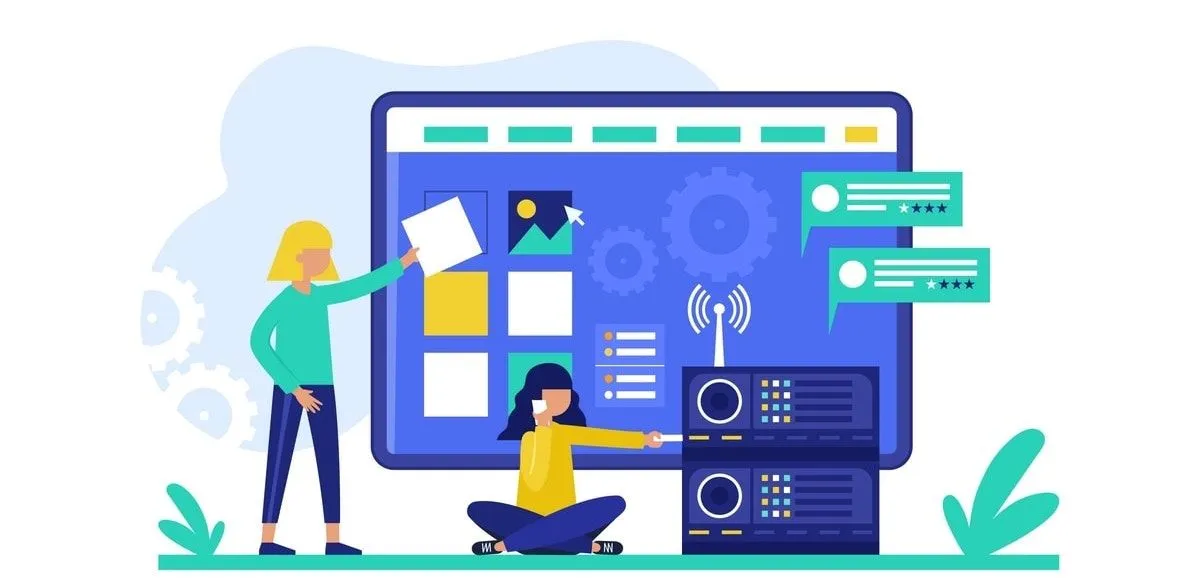
Coding is turning a decision somebody already made into syntax a machine will run. Programming is making those decisions in the first place, then building, testing and keeping alive the system around them. The test that separates the two is simple: can success be checked against something that already exists? It matters commercially, because only one of them can be estimated with any confidence.
The two words get used interchangeably everywhere: in briefs, in job adverts, and in estimates, which is where it starts to cost money.
Think of a musician reading from a score. Playing the notes is demanding, and you can tell at once whether it was done right, because the page is there to check against. Writing the score is a different job: nobody can mark it against anything, because the score is what everything else gets marked against afterwards. That is coding vs programming, and everything below follows from it.
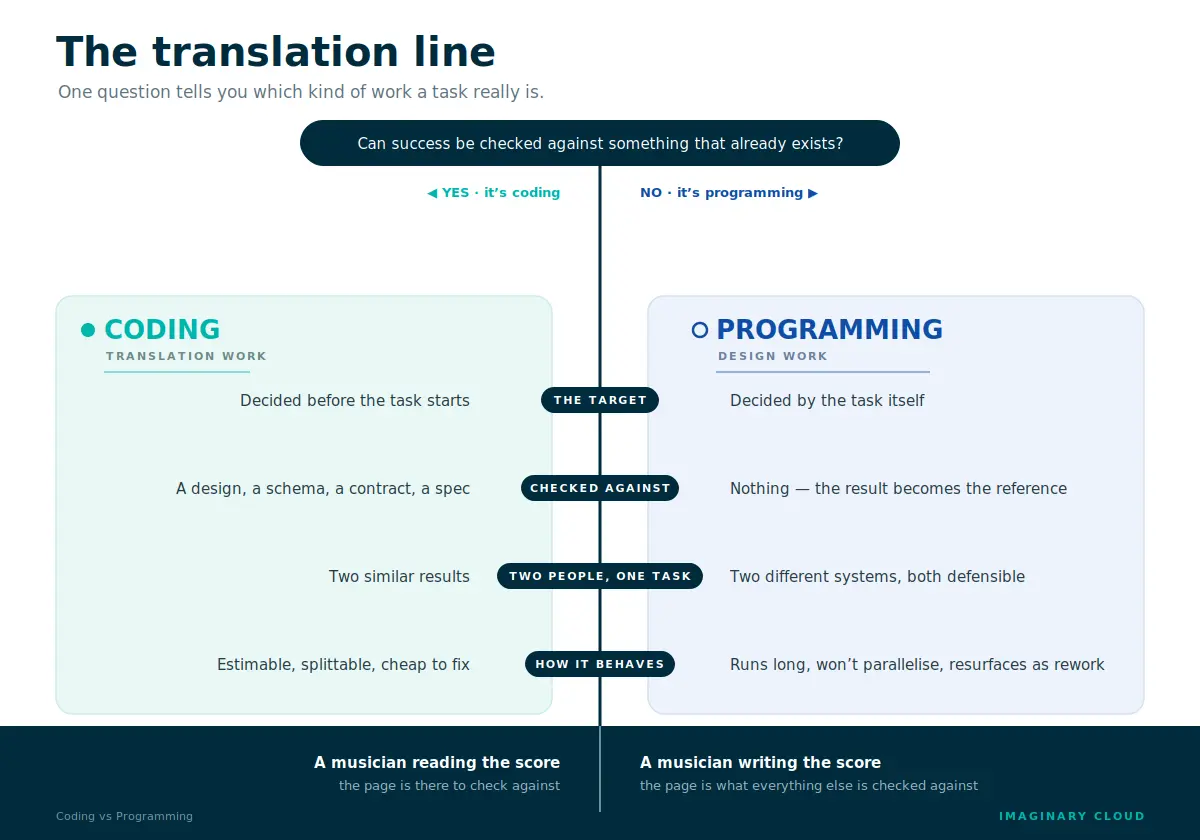
Coding is a subset of programming: the part where a decision that has already been taken becomes something a machine will run. Someone has settled what the screen shows, what the record contains, what the calculation returns. Coding writes that down in a form the machine will accept.
In practice, that looks like marking up a page from a finished design, writing a query against a schema somebody else defined, or converting a supplier's data feed into the format your system expects. Intricate work, often. But the destination is fixed before anyone starts walking.
Which is exactly what makes coding checkable. There's a page to read from, so two competent people given the same task will hand you two similar results, and each one is either right or it isn't.
Languages whose job is to translate, map or represent something directly, without programming logic, are considered coding languages. The most common:
Notice what these have in common: none of them decides anything. They describe a target that was already fixed. That's the tell for translation work.
Short answer: no. Coding is easier because the hard question has already been answered for you. You're working towards a known target, and the feedback arrives within seconds. It compiles or it doesn't. It matches the design or it doesn't.
Programming is harder because its questions are open and its mistakes are slow. A badly chosen data model never fails a test. It just quietly adds a tax to every feature anyone builds on top of it, for as long as the product lives.
We can put a number on that tax. When GoodBarber came to us to prepare their no-code platform for its next major version, the design decisions inside the existing templates had never been written down; they were only in the code. Before anyone could safely build the new version, we had to reconstruct them: templates documented in pseudocode across iOS, Android and web, spanning Objective-C, Swift, Java, Kotlin and JavaScript/TypeScript. That's the bill for design work that was done implicitly years earlier. None of those templates was broken. Each one worked. They just couldn't be built on until someone made the buried decisions legible again.
Programming is deciding what the system should do, then building something that does it: planning the structure, choosing the tools, writing the code, testing it, shipping it, and keeping it standing afterwards.
Much of that work leaves nothing on screen. What the app does when a payment fails halfway through. Whether a half-finished sign-up is stored or thrown away. How the system behaves when a third-party service goes dark. Where one service ends and the next begins. None of it is visible to a user, and all of it decides what next year's changes will cost you.
Where coding reads from the score, programming writes it.
Here is one of those invisible decisions, made explicit. When a card is declined on step three of a checkout, the fastest code throws an error and lets the request unwind, which quietly bins a half-finished order. We treat a declined payment as a state to keep, not an exception to discard:
async function completeCheckout(cart: Cart, payment: PaymentDetails): Promise<CheckoutResult> {
  const order = await orders.create(cart, { status: 'awaiting_payment' });

  try {
    const charge = await gateway.charge(payment, order.total);
    return orders.markPaid(order.id, charge.reference);
  } catch (err) {
    // An infrastructure outage is not a declined card. Let it surface loudly
    // instead of telling the customer their payment was refused.
    if (!isPaymentDeclined(err)) throw err;

    // The decision: keep the order rather than discard it.
    //   persist it as recoverable, so the customer resumes instead of re-entering
    //   emit an event, so support sees the failure before the phone rings
    await orders.markPaymentFailed(order.id, {
      reason: err.declineCode,
      resumeToken: order.resumeToken,
    });
    events.emit('checkout.payment_failed', { orderId: order.id, reason: err.declineCode });

    return { status: 'recoverable', orderId: order.id, resumeToken: order.resumeToken };
  }
}
None of that branch appears in a design file. The mockups show the path where the card clears; everything above is a decision somebody had to make about the path where it doesn't. That is programming, and it is the part no one can estimate until it has been decided.
At Imaginary Cloud we find it more useful to ask one question about a task than to argue about job titles. We call it the translation line.
On one side sits translation work. The target is already decided. Success is verifiable against something that exists: a design file, a specification, an API contract, an existing screen. Give the task to two competent people separately and you get two similar results. That's coding.
On the other side sits design work. The target is the thing that has to be decided. There's nothing to check the result against, because the result becomes the reference. Give that task to two competent people separately and you get two different systems, both defensible. That's programming.
The line earns its keep because it predicts how work behaves. Translation work is estimable, splittable across people, and cheap to put right. Design work is none of those things. It runs long, it doesn't parallelise (adding people to an undecided problem mostly adds opinions), and its errors surface later as rework rather than as bugs.
The same person crosses that line several times before lunch. So "is this person a coder or a programmer?" is the wrong question. "Which side of the line is this task on?" is the one worth asking.
Most comparisons hand you three differences: tools, skills, output. Truth be told, that's one difference seen three times. Everything downstream follows from whether the target was decided before the work began.
| Coding (translation work) | Programming (design work) | |
|---|---|---|
| The target | Decided before the task starts | Decided by the task itself |
| Checked against | A design, a schema, a contract, a spec | Nothing; the result becomes the reference |
| Typical tools | A text editor or IDE: VS Code, Sublime Text, Vim | Those plus compilers, linkers, debuggers, analysis tools and modelling frameworks |
| Knowledge needed | A language and its syntax | Algorithms, data modelling, testing, failure handling, project management |
| What you get | A working piece that does the specified thing | A running system, with its tests, documentation and deployment path |
| Estimating it | Reasonably predictable | Predictable only once the decisions are made |
Read that table downwards, not across. The programmer's toolkit is wider because the questions are wider. The knowledge runs deeper because the consequences last longer. The output is a system rather than a component, because the work included deciding what the system was.
The honest answer is: it depends which index you read, because each one measures a different thing. That distinction matters more than any single ranking.
So "most popular" splits three ways: Python wins on search interest, JavaScript on self-reported usage, TypeScript on GitHub contributors. Pick the index that matches the decision you're actually making.
What each language tends to be reached for:
Both TIOBE and the Stack Overflow survey are updated regularly and are worth checking directly rather than treating any single year as settled. These figures are current as of TIOBE July 2026 and the Stack Overflow 2025 survey.
They aren't two stages in a queue. They interleave, and the useful moment to separate them is the day a brief lands on your desk.
Take a request we see in some form most months: "here are the designs, build the app." The designs are finished, so on the face of it this is translation work, priced by the screen. Split it against the line and a different picture shows up.
Already decided, so coding. The screens, the components, the layout at each breakpoint, the copy, the calls to an API that's already specified. Real work, and estimable to within a day or two either way.
Not yet decided, so programming. What the app does when the card fails on step three of twelve. Whether a half-completed sign-up is stored or discarded. What the support team sees when the customer rings about it. How the app behaves offline, and what happens to the queued actions when it comes back. Who owns the data model when two features want the same record.
None of that appears in a design file, because a design file shows the path where everything works. These aren't extras, and they aren't scope creep. They are the system. Somebody decides them either way: deliberately at the start, or by accident in week six.
This is not hypothetical. The GoodBarber work we mentioned earlier started life looking like translation: document what the templates already do. But "what they already do" was a set of design decisions nobody had recorded: the same decisions that, made by accident in week six, become the codebase that fights back. Making them explicit again, one template at a time, was the design work catching up with the product. If those decisions had been written down when they were first made, the template reconstruction would never have needed to happen. That is the cost of deciding by accident, arriving years later with interest.
So the productive conversation isn't "do we need coders or programmers?". It's walking the brief line by line, marking each item decided or undecided, and planning the two differently.
For a technology leader, coding vs programming isn't a vocabulary question. It's the difference between a brief that lands and a brief that overruns.
Scoping. A request written as coding work ("build the screens in this design") carries an implied promise that every decision has already been made. Usually it hasn't. Those unresolved decisions don't vanish because the brief left them out. They resurface mid-build, where settling them costs more and where changing course means binning work you've already paid for.
Estimates. Translation work can be estimated with reasonable confidence, because there's a known target to measure against. Design work can't, and an estimate that rolls the two into one number is an estimate for the easy half. In our experience of reviewing overrunning projects, the extra weeks went on decisions nobody had made, not on the typing.
Hiring and team composition. A team of capable coders with nobody doing design work will ship quickly and quietly accumulate decisions no one made on purpose. You know the result: the codebase that fights back against every small change. By the time it's obvious, the cause is a year or more behind you. The opposite failure (senior engineers spending their week on translation work) is expensive, but at least it shows up on the invoice.
Vendor selection. A supplier priced on volume delivered is priced for translation work. If your product still has open questions about what it should do, you're buying the wrong thing, however good the day rate.
The test is the one from the top of this article. For each item on the brief, ask whether success can be checked against something that already exists. Everything that can't is design work, and it belongs in the plan as design work.
No, though the same person is often both. Coder describes someone doing translation work, turning a decided outcome into working syntax. Programmer describes someone deciding what the system should do and building it end to end. Most developers move between the two roles inside a single working day.
Yes. Coding is a subset of programming, so every programmer codes. It doesn't run the other way: someone can write competent HTML, CSS or SQL for years without ever designing a system.
Coding first. Learning syntax gives you something that runs, and running code is the fastest feedback loop a beginner can get. Programming skills (structuring an application, handling failure, designing data models) build on top of that and are hard to learn in the abstract.
It depends how many decisions are already made. If you have finished designs, a defined API and a clear specification, most of what's left is coding. If you have a goal and a budget, you need programmers first, and the coding volume only becomes knowable once they've done their part.
Coding is easier to learn and easier to verify, because the target is known and the result either works or it doesn't. Programming is harder because its decisions are open-ended and its mistakes take longer to show themselves.
It shifts the balance rather than removing it. Code generation is strongest precisely where the target is already decided: the translation side of the line. It's weakest where the work is deciding what the system should do, which was always the harder and more expensive side.
If you're looking at a brief and can't tell how much of it is coding and how much is programming, that's worth resolving before anyone starts building. Not after.
We do this with clients regularly in a scoping session: reading the brief, separating the decided from the undecided, and saying plainly which parts can be estimated and which need working out first. If that would be useful for what's in front of you, get in touch and we'll talk it through.
Versatile and data-driven Growth Marketer with in-depth business knowledge, updated with latest developments in the Digital Marketing landscape.
A developer who is fascinated by the cultures of the world, technological advancements, and the potential of humans.
People who read this post, also found these interesting: