Written by:

Last Published:
24 November 2026
•
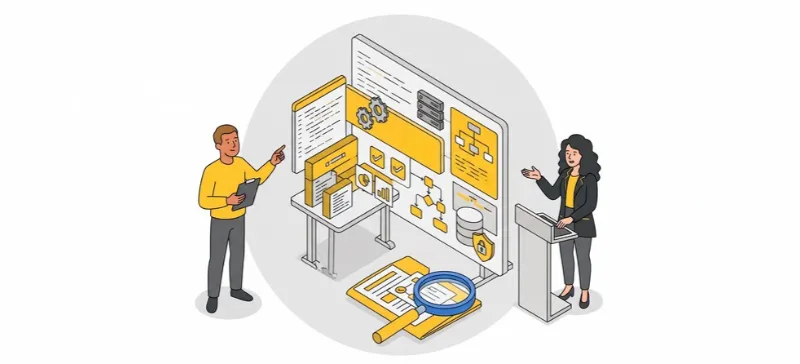
In short: Technical due diligence (TDD) is a structured review of a company's technology before an investment, acquisition or listing. Investors use it to price risk across nine areas, from architecture and security to dependencies and IP. It is a risk assessment, not an exam, so prepare by finding the problems first, sizing them honestly and bringing a plan.
Technical due diligence is the part of a funding round that founders fear and rarely rehearse. Investors have seen the pitch deck and the numbers. Now someone wants to look under the bonnet.
Is it an exam you can fail? Not quite. Its output is a price: an adjusted valuation, a condition in the term sheet or, occasionally, a quiet exit. (More often than founders expect, it is just a shorter list of fixes than they feared.)
Think of the survey a buyer commissions before purchasing a house. The surveyor is not judging your taste. They are hunting for damp, faulty wiring and whatever the previous owner painted over. A good survey rarely kills a sale. A surprise does.
At Imaginary Cloud we audit real codebases, and the findings read the same whether the person holding the report is a CTO, an investor or an acquirer. This guide covers what gets checked, how the process runs, what a report looks like, what it means for valuation and how to prepare. One honest note on scope: our examples come from code audits we ran for product teams, not from investors' own deal processes. Same method, different client.
Technical due diligence (TDD) is a structured review of a company's technology, carried out before an investment, acquisition or listing. It examines architecture, code quality, security, dependencies, infrastructure and the engineering team, then reports the risks and the likely cost of fixing them. Investors, buyers or independent specialists can run it.
The word "technical" matters. This is not a legal review and it is not a financial audit. It answers a narrower question: is the technology real, safe and able to carry the plan the investor is paying for?
It is also not a UX audit. We run those too (for Swiss Side, a UX audit and competitive benchmarking fed a full redesign), but they test how users experience a product, not how safe the code underneath it is.
In mergers and acquisitions, TDD is the same review with higher stakes, because the buyer inherits the entire stack. It looks hard at integration fit, licence obligations and hidden liabilities. In a funding round, an investor buys a minority stake and cares about one thing above the rest: can this technology scale with the money they are about to put in?
You need it whenever someone is about to put money, or their name, behind your technology. The four common triggers are early-stage investment, mergers and acquisitions, compliance demands and an IPO. The depth changes with each: a seed investor tends to look lightly, an acquirer digs, and a public listing leaves very little unexamined.
Reviews at this stage are usually lighter and quicker, and the questions look forward. Can the product scale? Does one founder hold all the knowledge? Are the security basics in place? Is the code actually yours? In our experience, investors expect imperfection here. What worries them is not knowing where it sits.
What does technical due diligence for Series A look like? Expect the same nine areas as any review, at lighter depth, with the weight on four things: whether the architecture can carry the plan the round pays for, whether the security basics hold, who owns the code and how much depends on one or two engineers. A Series A reviewer often does not need to read every line. They need evidence that you know where the risks are and have a plan to deal with them.
Here the review goes deep, because the buyer takes on everything. Expect close scrutiny of code, infrastructure, licences, data handling and how well your stack would fit the buyer's own systems. The findings feed straight into the price and the terms, which we come back to below.
Sometimes the trigger is not money but a customer or a regulator. Enterprise buyers ask for evidence of security practice, and frameworks give that evidence a shape. ISO/IEC 27001:2022 sets out requirements for an information security management system, and certification is optional (ISO does not carry it out). A SOC 2 report can cover five areas, according to the AICPA: security, availability, processing integrity, confidentiality and privacy. If you handle personal data about people in the EU, the GDPR applies as well.
A listing brings the most rigorous scrutiny of the four. Security, controls and the resilience of your core systems get examined closely, and the weak spots matter more because the audience is wider.
A typical review covers nine areas: architecture, code quality and testing, technical debt, dependencies and licences, security, compliance and data, infrastructure and cost, team and key-person risk, and IP ownership. Each area gets findings, a severity and a recommended fix. Scope shrinks or grows with the stage of the company.
| Area | What gets checked | What raises a red flag |
|---|---|---|
| Architecture and scalability | Structure, diagrams, how the system copes with growth | Single points of failure, a monolith nobody fully understands |
| Code quality and testing | Maintainability, complexity, test coverage and quality | No tests around critical flows, code only one person can read |
| Technical debt | Known shortcuts and the cost of repaying them | Debt that nobody has logged or sized |
| Dependencies and licences | Inventory of libraries, versions, maintenance status, licence terms | Abandoned libraries, unknown or restrictive licences in core components |
| Security | Vulnerability management, access, secrets, incident history | Credentials in repositories, unreviewed production access |
| Compliance and data | GDPR practice, ISO 27001 or SOC 2 status | Claims of compliance with no evidence behind them |
| Infrastructure and cost | Hosting setup, backups, recovery, cloud spend against growth | Backups that have never been restored |
| Team and key-person risk | Who knows what, roles, contractors | One engineer who owns every critical system |
| IP ownership | Who wrote the code, assignment agreements, third-party code | Contractors who never assigned their rights |
Three of those areas deserve a closer look, because they are where reviews tend to slow down.
Technical debt is the accumulated cost of shortcuts: code that works today and will be expensive tomorrow. Investors do not expect zero. They check whether you know how much you carry, where it sits and what it would cost to repay. Debt that is logged, sized and prioritised reads as good management. Debt nobody has mentioned reads as risk.
Modern products are mostly other people's code. So reviewers ask for an inventory of every library and service you rely on, which versions you run, whether they are still maintained and which licences apply. The standard format is a software bill of materials. CISA describes an SBOM as a nested inventory of the components that make up a piece of software, and as a foundational element for managing software supply chain risk. SPDX is an open standard for describing that information, licences included, and it is also an ISO standard (ISO/IEC 5962:2021).
Plus, the licence side deserves as much attention as the vulnerability side, and arguably more. A vulnerable library can usually be patched or swapped. A restrictive licence in a core component is harder to undo, because it can force a rewrite or a renegotiation, and it tends to surface late, when someone reads the full dependency list. That is why we treat licences as a finding in their own right, not a footnote to the security section.
Reviewers look at how you prevent, detect and respond. Typical questions: how do you manage vulnerabilities and patching, who has access to production and is that access reviewed, where do secrets live and what happened in past incidents.
Two references make a useful self-check. The OWASP Top 10 is a widely recognised awareness document on the most critical web application security risks, and the current edition is 2025. NIST's Secure Software Development Framework (SP 800-218, version 1.1) sets out core secure development practices as a risk-based starting point rather than a rigid checklist. Neither is a pass mark. Both give you a fair picture of what a reviewer's checklist contains.
A technical due diligence typically runs in six steps: agree the scope, hand over access and documents, review code, tests and infrastructure, hold technical interviews, rank the findings by risk and effort, and deliver a report with a remediation plan. Details vary, but this sequence holds across most reviews.
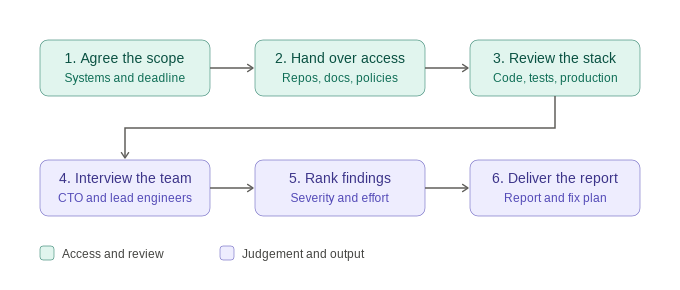
What does that look like in practice? TeachTutti, an online tutoring platform, asked us to audit its video conferencing module, built with Twilio for video, chat and whiteboard. The goal was to assess reliability, security and performance. We ran it in five stages: scope meeting, code review, test review, quality review and assessment.
The brief named one module. The audit did not stop there. It also covered the wider architecture, including a production server assessment and a data management evaluation. That is how a sceptical reviewer behaves too: the component in the brief is rarely the only place risk lives.
The outcome was 49 prioritised findings, categorised by impact and effort and delivered as a roadmap for the development team. You can read the full TeachTutti case study. That impact-versus-effort grid is the same one an investor reads. What is dangerous? What does fixing it cost? Our code audit service follows those same five stages.
A technical due diligence report is a written assessment with an executive summary, the scope and method, findings grouped by area, a risk rating for each and a remediation roadmap with effort estimates. Good ones let a non-technical reader see the biggest risks on page one and an engineer find the evidence behind each.
Here is an illustrative finding (not from a client report) to show how one reads:
Documentation counts as evidence, too. Ahead of its V7 Composer module, GoodBarber needed to understand and standardise the logic behind its V6 templates. We analysed the template code across iOS (Objective-C and Swift), Android (Java and Kotlin) and Web (JavaScript), and documented 195 templates in pseudocode covering data flow, logic paths and return values.
The exercise also surfaced shared patterns and platform-specific differences across the three codebases. For a reviewer, that is the information needed to judge how much of the logic can be reused and how much is tied to one platform, and it answers a question that comes up every time: could a new engineer understand this? See the GoodBarber case study. We will go deeper on this engagement in an upcoming piece on code audits.
A seller-side audit finds and sizes your technical risks before an investor does, so you decide how they are presented. Findings come with a fix list and effort estimates instead of a surprise, and you can negotiate from a documented position. An independent reviewer adds credibility that internal notes cannot.
The same finding tells two different stories. Found and sized by you, a missing test suite is a known gap with a fix, an owner and a date. Found by the reviewer, it reads as a gap in oversight. Same code, different conversation.
It also gives you something to negotiate with. A documented list of risks, each with an effort estimate, turns an open-ended worry into a bounded cost. (That is a better place to stand than "trust us, it is fine".) And investors weigh findings differently when they know you did not write them yourself, which is why the independent part matters.
Technical findings reach the cap table through four routes: a price adjustment, a condition to close, a remediation budget or a walk-away. What moves the number is often less the size of the technical debt than how well the team can size it, how long fixing it would take and whether the plan fits the funding.
For a CEO or CFO, the useful translation is simple. Every finding has a cost and a time attached, and both land in the plan the investor is funding. Months spent repaying critical debt are months not spent shipping the roadmap the round was meant to pay for.
For an acquirer, the same logic applies to the price. Remediation cost and integration time become inputs to the offer, which is why the effort estimates in a report matter as much as the severity ratings.
What reduces the discount? In our experience, three things: findings you have already sized, a plan that fits inside the funding and a team that can explain its trade-offs without flinching. None of them requires a perfect codebase. All of them require looking early.
Start early and be honest. Inventory your dependencies, fix critical security gaps, document the architecture, size your technical debt, confirm who owns the code, reduce key-person risk and organise a data room. A sized, prioritised problem list beats a clean slate nobody believes.
The most useful checklist is the reviewer's own list of questions. Here is each one, with what to have ready:
On timing, start months ahead for anything slow (an independent audit, IP paperwork, security fixes) and weeks ahead for the paperwork. When the data room opens, sequence the documents: architecture, dependencies, security, incidents, tests and team structure with contracts.
How do you prioritise with a small team and a short runway? Fix what is dangerous and cheap first: secrets, access, IP paperwork. Document and size what is expensive. Do not try to repay all your debt before the round. Truth be told, no reviewer expects that, and a sized list shows you understand the problem.
Reviewers tend to pause on the same handful of issues. None of them is fatal on its own. Together, they tell an investor the team has not been looking.
It is the written result of the review. It summarises the risks found in architecture, code, security, dependencies, infrastructure and team, rates each by severity, and recommends fixes with effort estimates. Investors use it to adjust valuation or terms. Founders use it as a roadmap.
It typically covers architecture and scalability, code quality and testing, technical debt, dependencies and licences, security, compliance and data, infrastructure and cost, team and key-person risk, and IP ownership. Depth depends on the deal: a seed round is lighter, an acquisition or listing goes much further.
Start months ahead. Run your own audit, generate an SBOM, close critical security gaps, document the architecture, size your technical debt, confirm IP ownership and spread knowledge across the team. Then organise a data room and brief your CTO. Honest, prioritised findings land better than a polished story.
In mergers and acquisitions, TDD means technical due diligence: a review of the target company's technology before a deal closes. Because the buyer inherits the whole stack, it examines code, infrastructure, security, licences and integration fit, and it prices the risks and remediation costs into the negotiation.
Often an independent technical specialist or advisory firm hired by the investor or buyer, and sometimes the investor's own technical team. Sellers can commission one on themselves. Whoever runs it reads code, checks infrastructure, interviews engineers and reports to the party that commissioned it.
A Series A report usually covers the nine areas at lighter depth, with the emphasis on scalability, security basics, IP ownership, key-person risk and dependencies. Expect an executive summary, findings rated by severity and effort, and a short list of fixes the round should fund. It rarely reads every line of code.
A checklist follows the nine areas: architecture, code quality and testing, technical debt, dependencies and licences, security, compliance and data, infrastructure and cost, team and key-person risk, and IP ownership. The most practical version pairs each reviewer question with the evidence you can show, as in the checklist above.
It depends on the scope, the size of the codebase and the stage of the deal, so a single number would be a guess. For reference, our Engineering and UX Health Check runs for three weeks: one to discover, one to assess and one to plan. A narrow seed-stage review can be lighter, and an acquisition review goes deeper.
Cost depends on the scope, the size and complexity of the codebase, the stage of the deal and who runs the review, so treat any published figure with care. Our Health Check is fixed-price and agreed upfront, and the fee is credited if you continue with us. Ask any provider for a fixed scope and price before you start.
Yes. A seller-side audit lets you find and fix problems before an investor does, and gives you a documented view of your own risks. An independent reviewer adds credibility, because investors trust findings they know you did not write yourself.
The cheapest time to find a problem is before anyone is paying to find it. If you are weighing up technical due diligence services before a round, our Engineering and UX Health Check covers the same ground from your side of the table. It is a three-week, fixed-price assessment that reviews code quality, security, performance, dependencies and cloud cost. You get a risk register ranked by business impact, effort and cost estimates for each phase, a target architecture, an executive summary and quick wins your team can act on straight away.
If you need a narrower, code-level review, our code audit service follows the five-stage process described above.
Book a technical audit before your next round, talk to our team, or browse the related case studies.
Alexandra Mendes is a Senior Growth Specialist at Imaginary Cloud with 3+ years of experience writing about software development, AI, and digital transformation. After completing a frontend development course, Alexandra picked up some hands-on coding skills and now works closely with technical teams. Passionate about how new technologies shape business and society, Alexandra enjoys turning complex topics into clear, helpful content for decision-makers.
People who read this post, also found these interesting: