Written by:



Last Published:
27 July 2026
•

Most people meet object-oriented programming as four words to memorise for an exam. Encapsulation, abstraction, inheritance, polymorphism. Tidy, quotable, and almost useless if that is where the story stops, because the part that touches your business is the part the textbook leaves out.
So let's start plainly. Object-oriented programming (OOP) is a way of structuring software around objects, self-contained units that bundle data together with the functions that work on it. It is the paradigm behind most of the languages running modern companies, including Python, Java, C#, Swift and TypeScript. Learn it once, and the thinking travels almost everywhere.
For a technical leader, though, there is a better definition than the tidy one. OOP is an architectural decision. It quietly sets how fast your product can grow, how quickly a new hire stops being a passenger, and how much it will cost you to change your mind later. This guide covers what OOP is and its four pillars, then goes where most articles will not: the trade-offs, the judgement calls, and the do's and don'ts that decide whether your object model becomes an asset or a millstone.
Here is the number that reframes everything. The build is the tip of the iceberg; the mass sitting under the waterline is maintenance, and that is where the money goes. The IEEE Computer Society and Gartner both put maintenance at roughly 60 to 80 percent of a system's total lifecycle cost, and Gartner has estimated that organisations spend 55 to 80 percent of their IT budgets just keeping the lights on. So any decision that makes code cheaper to maintain is not a tidiness decision. It moves a big number.
OOP, done well, is one of those decisions. Code organised around well-named objects is easier to maintain, which shaves the cost off every future feature. It scales with your team, because clean boundaries let several developers work in parallel without treading on each other. It kills rework, because a reusable object is written once and borrowed everywhere after that.
And it shortens onboarding, which matters more than it sounds. Truth be told, a new engineer can read ten small, purposeful files far faster than they can unpick one thousand-line monster. That time adds up: Stripe's Developer Coefficient study found engineers already lose around 42 percent of their working week, roughly 17 hours, to maintenance and bad code. Structure is what stops that number climbing.
Is any of this the developer's problem to fret over? Partly. But mostly it is yours, because it shows up as technical debt, and technical debt is paid in delivery speed. Handled well, OOP is a lever on maintainability, delivery speed and total cost of ownership. Handled badly, it is a slow leak. Everything below is about which one you get.
Object-oriented programming is a paradigm that structures a program around objects, each holding both its data and the functions that act on that data. Two building blocks do the work. A class is the blueprint that defines a type, and an object is a specific thing built from that blueprint. One blueprint, many houses, each with its own furniture inside.
In an object-oriented language, you write code to define classes and their objects by following four principles: encapsulation, abstraction, inheritance and polymorphism. Because those principles are shared across languages, the skill you build in one carries into the next. That portability is a big part of why OOP has stayed dominant since the 1990s.
The four pillars of object-oriented programming are encapsulation, abstraction, inheritance and polymorphism. The definitions are standard, so we will pair each with the reason it earns its keep, because for a decision-maker the "why it pays" beats the "what it is" every time.
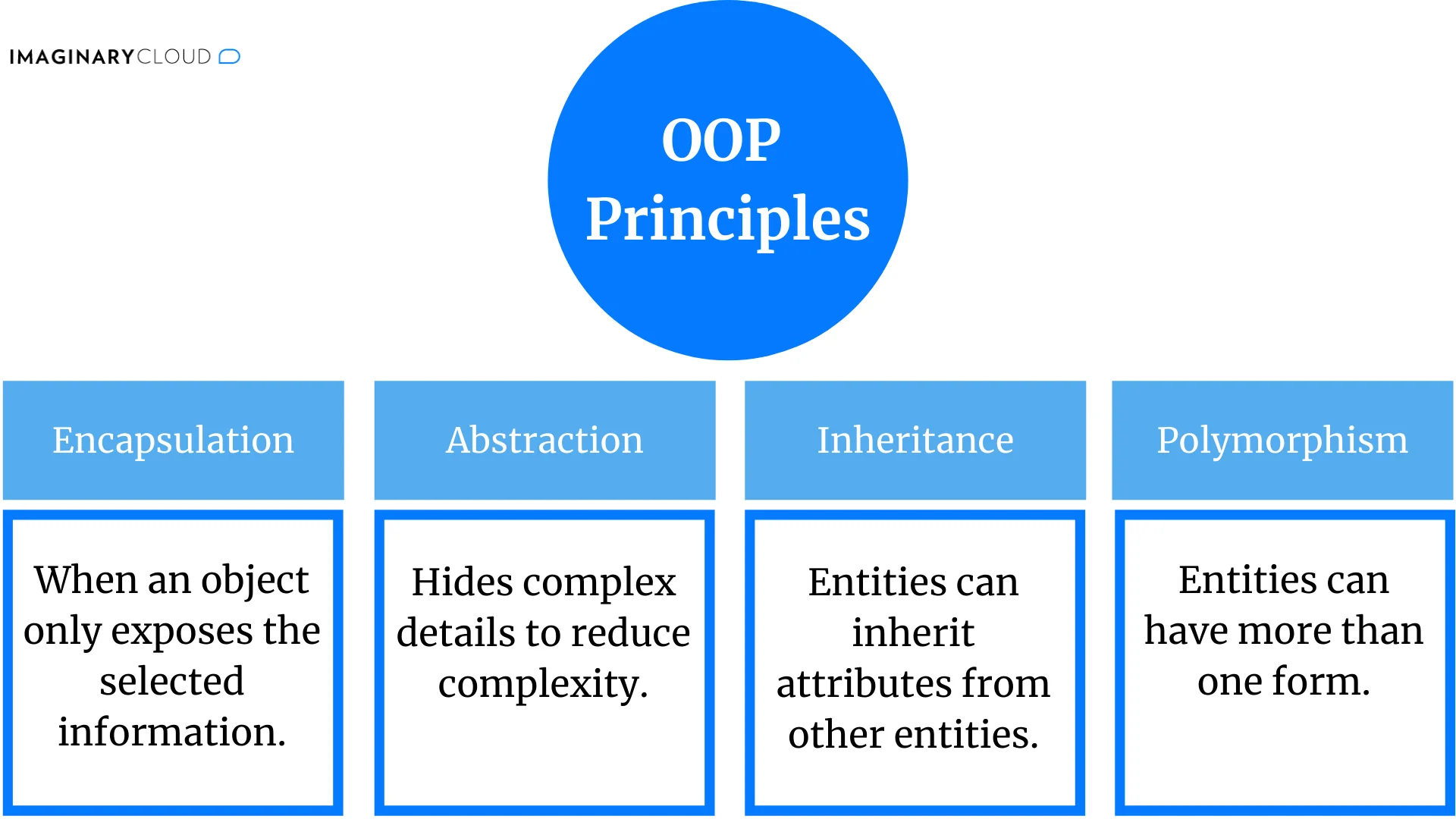
Think of a well-encapsulated object as a vending machine. You press a button, a can drops, and the wiring behind the panel is none of your concern. Encapsulation means an object keeps its internal state private and exposes only what it chooses to, which needs the ability to mark fields as private or public. Commercially, that hidden wiring is the point: you can rebuild the machine's insides without changing a single button, so a change stays local instead of rippling across the whole system.
Abstraction is the steering wheel, not the engine. You turn the wheel and the car goes where you point it, and you never once think about pistons. In code, abstraction hides complex detail so you interact with an object through a few named methods rather than its guts. Smaller surface, lighter load, faster for a new engineer to pick up.
Inheritance lets a child class inherit attributes and behaviours from a parent, the way a family passes down traits. It supports reuse and spares you from duplicating logic across near-identical types. The upside is speed. The risk, which we will get to, is what happens when the family tree grows too tall.
Polymorphism lets objects share one interface while each behaves in its own way, so the same method call does the right thing for whichever object runs it (through overriding or overloading, if you want the jargon). Picture one light switch wired to different rooms, each lighting up as it should. It is what lets you add a new variant without rewriting the code that already uses the old ones.
You will find these definitions written up carefully in the reference material for most languages, including the Python class documentation, the Oracle Java tutorial on object-oriented concepts and Microsoft's C# object-oriented guide.
Is knowing the four pillars enough? Not really, because the pillars tell you what OOP is, not how to keep it healthy once it grows. Two bodies of practitioner wisdom close that gap.
The SOLID principles, set out by Robert C. Martin, are the standard next step: single responsibility, open/closed, Liskov substitution, interface segregation and dependency inversion. In plain terms, SOLID is a set of guardrails that keep objects small, focused and loosely tied to one another, so a change here does not force ten changes there. If the four pillars are the grammar of OOP, SOLID is the house style.
Composition over inheritance, popularised by the "Gang of Four" in Design Patterns, is the counterweight the family-tree metaphor was warning about. Inheritance carved from one block of marble looks elegant early and cracks under pressure later, because a change to the base class travels down to every child. Composition builds behaviour from small, snap-together bricks instead, so you can rearrange without shattering anything. The rule of thumb: reach for inheritance when types genuinely share an "is-a" bond, and for composition when they just need to share behaviour. Hold that thought, because it directly qualifies the subclassing advice further down.
Is OOP the right tool for every job? No, of course not, and reaching for it by reflex is its own kind of mistake. Picking a paradigm is a design decision that should follow the shape of the problem, and it sits alongside the wider tech stack decisions every project has to make. Let's line the three up.
Reach for OOP when your system models real-world things with clear state and behaviour, when many components share structure that inheritance and polymorphism can capture, and when a large team needs stable module boundaries to work in parallel. Business applications, long-lived platforms and domain-rich products are its home turf. That is why it rules enterprise software.
Reach for procedural programming for linear, script-like jobs: a sequence of steps with barely any shared state, like a small automation utility or a quick data transformation. Wrap that in a class hierarchy and you have added ceremony, not value.
Reach for functional programming where predictability and concurrency matter most. By favouring immutable data and pure functions, functions that do not reach out and change anything around them, it removes a whole family of bugs caused by shared mutable state. That is gold in data pipelines and heavily concurrent systems. More often than not, modern codebases are happy hybrids: objects to model the domain, functional touches for the data crunching.
In big systems, the good and the bad of OOP both get louder. Enterprise software is maintained for years by rotating teams, wired into a dozen external services, and changed constantly under commercial pressure. Object-oriented structure gives it the seams it needs: bounded parts you can understand, test and swap out one at a time.
It is also where sloppy OOP does its worst damage. Tall inheritance chains go stiff. Objects that leak their internals quietly weld unrelated modules together. Both harden into technical debt that drags on delivery and taxes every single release.
That last word is the strategic point for a C-level reader. Get the object model wrong and the cost is not a one-off write-down. It is a standing tax on every future change, and it grows with the codebase. The checks in the next section are how your team keeps that tax low.
The four guidelines below are the questions our engineers put to an object model on real client work, from long-lived platforms to iOS applications. One at a time they look like common sense. Used together as a lens, they are what keeps a model maintainable while it grows.
Open a large project for the first time, see the wall of files, and the gut reaction is that the thing is unknowable. Usually it is the reverse. Ten small files whose names tell you what they do beat one block of code that does everything, hands down. So when you catch yourself asking whether something deserves its own object, the answer is nearly always yes.
The real work is not the count. It is the organisation. Group files into a clear folder structure, guided by a recognised pattern such as MVC (Model-View-Controller, which keeps data, display and control logic apart), so whoever inherits the code can find their way around. This is single responsibility from SOLID, applied to the whole codebase.
Watch for the class that has swollen into a Swiss Army knife: one type carrying a long list of properties and enum flags that flip its behaviour. When one class tries to be many things, every change is a gamble on what else moves. Better to separate those behaviours and keep the base generic enough to keep extending.
Two tools do that job. Subclassing, where a real "is-a" bond exists. Composition, where objects just need to share behaviour. And remember the marble versus the bricks: reaching for a subclass on instinct is exactly how rigid hierarchies form, so the check is "separate these behaviours the right way", not "always subclass".
One of OOP's quiet strengths is that a well-designed class can be reused across projects, which is real engineering time saved. Designing for reuse means keeping the core generic and pushing the project-specific bits out to the edges. Keep a generic class for a cross-cutting concern such as API handling or payments, then subclass or compose it for the exact data each project needs. Written once. Tested once. Borrowed for years.
.webp)
Here is a tempting shortcut. A method needs a dozen properties, so rather than passing each one you tip them into a dictionary or array and hand that over. It feels neat. It rarely is. Weeks later a colleague has to repack that bag in precisely the right order, then loses an afternoon working out why one value comes through empty.
Pass the whole object that owns the properties instead, even when it carries more than the method needs today. It holds up better, and it scales better, because the full context tends to be wanted later anyway. That is encapsulation working for you rather than against you.
You can see the lens at work in two engagements we ran for GoodBarber, a global no-code platform whose users build native mobile apps and progressive web apps without writing a line of code. The product is template-based, and those templates have to behave consistently across three environments — iOS, Android and Web — spread across Objective-C, Swift, Java, Kotlin and JavaScript. That is exactly the setting where a healthy object model earns its keep, and a messy one quietly taxes every release.
The first engagement was Check 1 and Check 3 discipline before a line of new code was written. Rather than diving straight into a rewrite, we documented the existing template logic (all 195 templates, each expressed in pseudocode that captured its data-to-render logic) and separated what was genuinely shared across platforms from what diverged per platform. That distinction is Check 3 in the wild: the shared patterns are the generic core, the platform-specific bits are the edges. The deliverable was not a feature. It was architectural clarity, and the foundation for a new abstraction layer between the legacy templates and whatever came next.
The second engagement built on exactly that. Nobody started from a blank page. Working from the documented boundaries, we re-implemented the V7 Composer: a new widget framework on Django, roughly 150 widgets rewritten, all 195 templates delivered under the new architecture. Because the shared-versus-specific split had already been drawn, the rebuild followed a tested map rather than a guess. GoodBarber reports the outcome as a Composer that is more scalable, more maintainable and more performant, with reduced technical debt across the platform.
That is the whole argument in miniature. Yesterday's mapping became today's foundation: the generic core absorbed what was common, the edges absorbed what was not, and the second team moved faster because the first had drawn the seams. It is also why reusable structure of this kind is what eats into the 42 percent maintenance tax Stripe put a figure on, and why the disciplined engineering behind it is what McKinsey's Developer Velocity research ties to top-quartile firms growing revenue four to five times faster than their peers, with 60 percent higher shareholder returns.
Object-oriented programming structures software around objects and the way they talk to each other. Technically, it stands on four pillars, encapsulation, abstraction, inheritance and polymorphism, extended in practice by SOLID and kept honest by composition over inheritance. Practically, it comes down to four checks: split by responsibility, separate behaviours the right way, keep a generic core, and pass whole objects.
Commercially, the whole thing collapses into one line. OOP is an architectural decision with a long tail, because maintenance dominates lifecycle cost, and a clean object model is what keeps that cost, your onboarding time, and the price of changing your mind, all under control as the product and the team grow. That is not a matter of taste. For a CEO, CTO or COO it reads as maintainable systems, teams that scale, faster time-to-value, and less risk waiting down the line.
OOP stands for object-oriented programming, a way of structuring software around objects that bundle data together with the functions that work on it. It is built on classes, which are blueprints, and objects, which are specific instances of those blueprints. The aim is code that is easier to maintain, extend and reuse.
The four pillars of object-oriented programming are encapsulation, abstraction, inheritance and polymorphism. Encapsulation keeps an object's state private, abstraction hides complexity behind simple interfaces, inheritance lets classes share attributes and behaviours, and polymorphism lets one method behave differently depending on the object. Together they make object-oriented code modular and reusable.
Yes. Python is an object-oriented language in which almost everything is an object, and it supports classes, inheritance and polymorphism directly, as set out in the official Python class documentation. It is also multi-paradigm, so it happily supports procedural and functional styles alongside OOP.
A class is a blueprint that defines the attributes and behaviours a type will have, while an object is a concrete instance built from that class. One class can produce many objects, each with its own state. Put simply, the class is the template and the object is the thing made from it.
SOLID is a set of five design principles, single responsibility, open/closed, Liskov substitution, interface segregation and dependency inversion, that extend the four pillars into maintainable design. Where the pillars define what OOP is, SOLID guides how to keep objects small, focused and loosely coupled. It is the standard practitioner reference for object-oriented code that stays flexible as it grows.
OOP adds little for small, linear, script-like tasks with barely any shared state, where a procedural approach is clearer and quicker. It can also be the wrong fit for work that prizes immutability and concurrency, such as data pipelines, where functional programming often cuts down on bugs. Force a class hierarchy onto those problems and you buy complexity with nothing to show for it.
Most mainstream languages support OOP, including Java, C#, Python, TypeScript, Ruby and Swift. Many are multi-paradigm, meaning they support object-oriented, procedural and functional styles in one codebase. Language documentation such as the Oracle Java tutorial and Microsoft's C# guide spells out how each one implements the four pillars.
Object-oriented design creates stable component boundaries that let several developers work in parallel, which supports bigger teams and faster delivery, while reusable objects cut duplicated effort across projects. Because maintenance runs to 60 to 80 percent of lifecycle cost, a clean object model has an outsized effect on total cost of ownership. Those are the commercial reasons OOP still rules long-lived enterprise software.
Decisions like these compound over the life of a product, and the cost of getting them wrong grows with the codebase. If your team is weighing how to structure a new build, untangle an ageing system, or scale a platform without watching maintenance costs balloon, our engineers can help you make the call with the commercial outcome in view. Have a look at our technical and UX audit and AI-enabled custom development services, or get in touch with the Imaginary Cloud team and tell us where you are stuck.
A senior iOS developer who is part of an agile iOS team and empowers individuals in achieving their dreams and goals.
Marketing Intern with a particular interest in technology and research. In my free time, I play volleyball and spoil my dog as much as possible.
Alexandra Mendes is a Senior Growth Specialist at Imaginary Cloud with 3+ years of experience writing about software development, AI, and digital transformation. After completing a frontend development course, Alexandra picked up some hands-on coding skills and now works closely with technical teams. Passionate about how new technologies shape business and society, Alexandra enjoys turning complex topics into clear, helpful content for decision-makers.
People who read this post, also found these interesting: