Written by:


Last Published:
10 August 2026
•

The ten best web app development companies in the US and UK for 2026 are Imaginary Cloud, TekRevol, Saritasa, One Beyond, Sidebench, Orases, GoodCore Software, Digiryte, 10Pearls and Apadmi. Every one clears the same five gates: a top ranking on Clutch for web app development in the US or UK, at least 20 client reviews, an overall rating of 4.8 or higher, five or more years in the market, and a demonstrable track record of building scalable digital products.
It is written for whoever signs off the budget: a founder, CTO or product lead buying web app development from an outside team rather than hiring in-house. You will find each company's services, tech stack, clients, rate band and best fit, a comparison of all ten, the factors that separate them, and what a web app costs to own.
Disclosure. This ranking is written and published by Imaginary Cloud, which appears in it at number one. The five gates below are applied identically to every company; the data is drawn from public Clutch profiles and company websites; and no place on this list was paid for, sponsored or exchanged for anything. You should weigh that self-interest when you read it, which is why the method is spelled out in full, so you can apply it yourself and check our working.
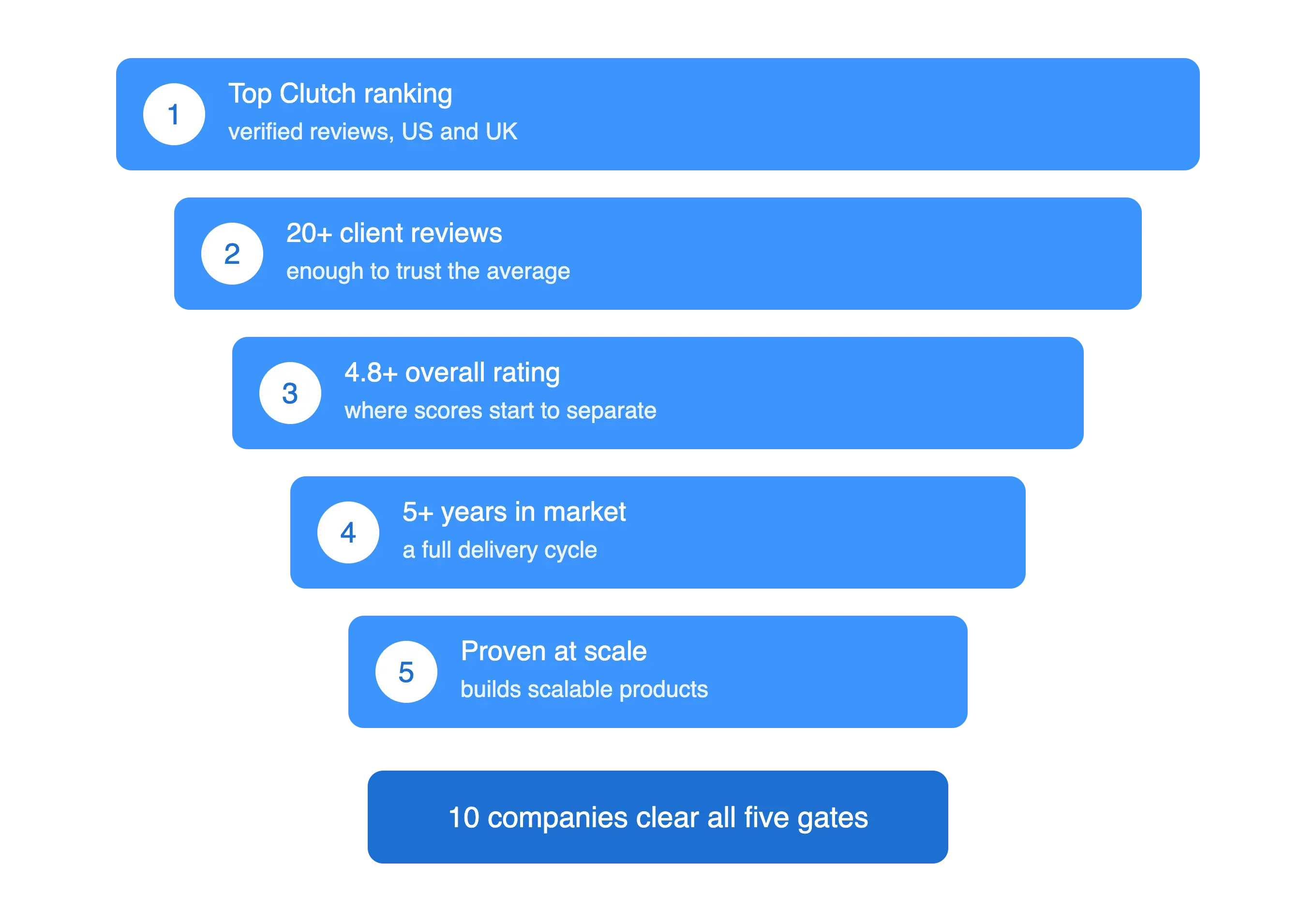
A ranking is only as good as the sieve behind it. Here is ours, applied identically to every company, with the reasoning for each gate written out so you can disagree with it where your situation differs:
Clutch helps businesses find service providers through verified client reviews, ratings and sector analysis across web app development, marketing and design. The ratings and review counts below were taken from public Clutch profiles in August 2026. Check the current figures before you shortlist, because they move.
| # | Company | Location | Team size | Clutch (Aug 2026) | Rate band | Best suited to |
|---|---|---|---|---|---|---|
| 1 | Imaginary Cloud | London, UK | 50-249 | 5.0 (34) | $50-$99/hr | Scale-ups and enterprises needing product and engineering together |
| 2 | TekRevol | Houston, USA (dev in Pakistan) | 250-999 | 4.9 (66) | $50-$99/hr | Startups wanting apps, games and e-commerce under one roof |
| 3 | Saritasa | Newport Beach, USA (dev in Russia) | 50-249 | 4.8 (88) | $100-$149/hr | SMBs and industrial firms needing AR/VR, IoT or systems work |
| 4 | One Beyond | London, UK | 250-999 | 4.8 (55) | $50-$99/hr | Bespoke CRM, ERP and legacy modernisation programmes |
| 5 | Sidebench | Santa Monica, USA | 50-249 | 4.9 (46) | $100-$149/hr | Enterprises and funded ventures starting from product strategy |
| 6 | Orases | Frederick, USA | 50-249 | 5.0 (60) | $150-$199/hr | Large US organisations buying custom web applications and portals |
| 7 | GoodCore Software | Croydon, UK (dev in Pakistan) | 50-249 | 5.0 (26) | $25-$49/hr | Startups and SMEs on tight budgets, MVP first |
| 8 | Digiryte | Manchester, UK (dev in India) | 50-249 | 4.8 (41) | $50-$99/hr | Product teams needing MVP, prototyping and UX work |
| 9 | 10Pearls | Washington DC, USA (dev in Pakistan) | 1,000-9,999 | 4.9 (31) | $25-$49/hr | Large-scale programmes needing deep bench capacity |
| 10 | Apadmi | Salford, UK | 50-249 | 4.8 (28) | $300+/hr | Enterprises with mobile-led digital products |
A quick word on the acronyms, because nobody should have to guess. An MVP (minimum viable product) is the smallest version of an app you can put in front of real users. A CRM (customer relationship management) system tracks customers and sales; an ERP (enterprise resource planning) system runs finance, stock and operations. AR/VR is augmented and virtual reality. IoT (internet of things) covers connected physical devices. DevOps is running build-and-release infrastructure alongside development; SecOps does the same for security. An NFT (non-fungible token) is a blockchain ownership record. L.A.M.P. is a long-established server stack: Linux, Apache, MySQL and PHP.
Best suited to: scale-ups and enterprises.
Why it clears the screen: 5.0 on Clutch across 34 reviews, more than 15 years in the market (founded 2010), and a portfolio of enterprise work at Nokia and Ernst and Young scale.
Imaginary Cloud designs scalable technology, with development processes built around reliable, user-centred solutions for enterprise and scale-up companies. Over the past decade it has been named in Clutch's Top 100 Fastest-Growing Companies and Top 1000 Global Companies (2020 and 2021), a UK Top B2B Company (2021 and 2022), and a Europe Best Workplace (2022).

Why it clears the screen: 4.9 on Clutch across 66 reviews, the second-largest review base on this list, and eight years in the market.
A Silicon Valley startup with its development group in Pakistan, established in 2018, TekRevol builds applications, websites, games and e-commerce platforms for startups and growing businesses. It works to short iteration cycles and reports client satisfaction as its main internal measure.
Why it clears the screen: the deepest review base here, 88 reviews at 4.8, and more than two decades (founded 2005) of work across web, AR/VR and connected hardware.
Saritasa designs, develops and integrates mobile, web, AR/VR, software, systems-architecture and IoT projects. It serves small and mid-sized businesses, corporations, life sciences, and commercial, industrial and high-tech organisations, and assigns business analysts to new projects so requirements are examined before build.

Why it clears the screen: 4.8 across 55 reviews and the longest track record on this list, building bespoke systems since 1994.
One Beyond is a bespoke software development firm that, since 1994, has built cost-effective online, desktop and mobile apps for businesses, non-profits, government agencies and funded startups. Its services run through UK-based and nearshore delivery centres under a single methodology and a partnership approach.
Why it clears the screen: 4.9 across 46 reviews, and a client list spanning enterprise technology and venture-backed products.
Sidebench is a strategy, design and development firm working with enterprise companies and new ventures that need product strategy. It combines management consulting and founder experience with systems architecture and a UX-first approach to product design.
Why it clears the screen: a straight 5.0 across 60 reviews and 26 years (founded 2000) building custom applications for large US organisations.
Orases builds custom software intended to improve process and support staff. Its specialists discuss corporate goals first, then build a scalable solution to fit them. It works with technology-first entrepreneurs, CTOs, CMOs and product owners who need to build or scale development groups.
Why it clears the screen: 5.0 across 26 reviews at the lowest rate band on this list, with more than two decades (founded 2005) behind it.
GoodCore develops software for startups and established businesses, including custom operational software and feature-rich apps. It offers a fixed-cost, time-bound discovery phase to refine design and technical requirements before build.
Why it clears the screen: 4.8 across 41 reviews and more than ten years (founded 2015) of product work for clients including the NHS and Channel 4.
Digiryte builds apps and digital products against business goals, working with founders bringing new ideas to established industries. Its speciality is creating mobile and web app user experiences.

Why it clears the screen: 4.9 across 31 reviews and the only company here with a bench of over a thousand people.
10Pearls is a technology partner set up to build mobile applications and custom software at scale. Its work spans emerging technology and digital transformation, and it has been recognised by research firms including Gartner and Forrester.
Why it clears the screen: 4.8 across 28 reviews and 17 years (founded 2009) of mobile-led work for national brands and public bodies.
Apadmi builds digital products for large enterprises and their customers, across mobile, online and digital platforms.
All ten companies clear the same bar, so the choice between them is a question of fit, not quality. This checklist covers what actually separates them: cost, speed, years in the market, tech stack, team size, security, commercial judgement and time to impact.
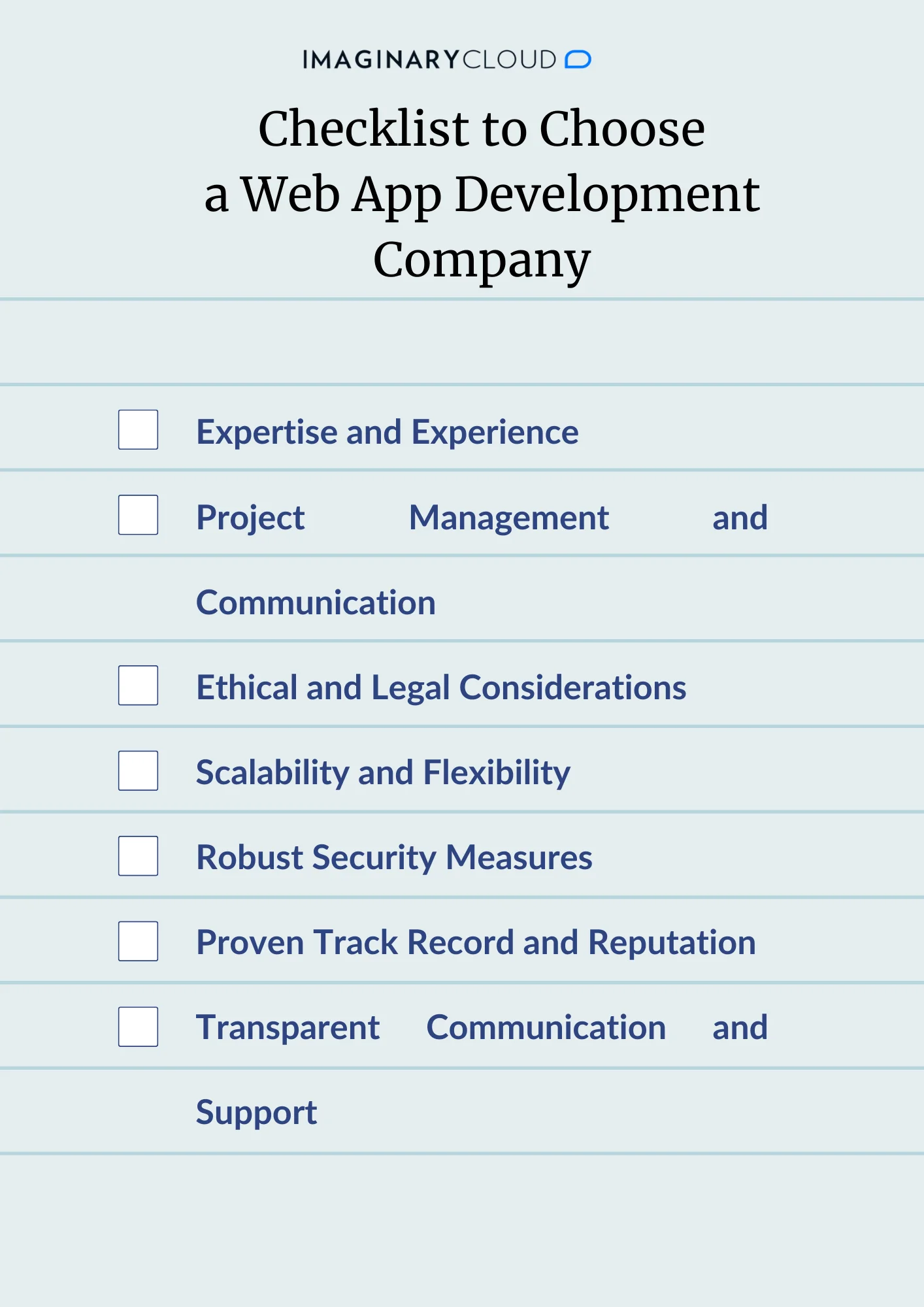
What you are buying when you buy web app development services is an app that is functional and attractive, works on any device, and is easy to navigate. These are the factors that decide whether you get it.
Cost depends on development time, team size and technology stack, which we cover below, plus one hidden factor: technical debt. Tech debt is what you owe the codebase after taking shortcuts during development, and like any debt it charges interest, so updates and maintenance get slower and more expensive the longer it sits there. Clean code keeps the balance low, so ask how a company manages technical debt before you sign.
Know the turnaround time before you hire. Make sure a company can deliver within the timeframe specified, because late delivery costs you money in overruns and delays. Build time varies widely with project complexity and budget.
Two things matter: a company's age and its expertise. Established firms have proven they can deliver, but they have also had time to build processes that can slow them down. Newer firms bring fresh perspectives and faster cycles, so check their level of expertise before signing.
The technology stack affects pricing, because someone experienced in popular frameworks costs more than an inexperienced developer working with less popular ones. Look at the spectrum of technologies rather than any single one, because being an expert at everything means being an expert at nothing, and note that good vendors will tell you when a product will not fit their areas of expertise rather than talk you into it. Our guide to choosing the best tech stack for web development sets out how to compare them.
Team size affects cost in the obvious way: five developers cost more than three. But headcount is not throughput. Ask how many people would be assigned to your project specifically, how many are shared with other clients, and how many sign-offs stand between a decision and a deployment. The companies here run from 50 staff to nearly 10,000; the size of the bench tells you about capacity in year two rather than pace in month one. Picking a company roughly your own size buys you attention: too big and you may not get enough; too small and they may not have worked at your scale.
A secure development company builds your app with security in mind from the start, not just so it works correctly, but so it leaves no vulnerabilities for attackers to exploit. This matters because web application threats keep rising. Edgescan's 2026 Vulnerability Statistics Report found that more than a fifth of internet-facing vulnerabilities are rated critical or high severity, and Verizon's 2025 Data Breach Investigations Report found that around 60 per cent of breaches exploited a known vulnerability for which a patch already existed. Your developer should provide ongoing updates, patches and support to fix problems quickly.
An agency that is commercially savvy as well as technically proficient will push back on the wrong feature rather than build it, and tell you which half of your scope can wait. That is worth more than raw delivery speed. You can see that judgement in the early involvement of business analysts, or in tech advisers supporting delivery teams: Saritasa puts a business analyst on new projects before build, and GoodCore and Sidebench both start from a paid discovery or product-validation phase. A successful partnership is built on knowledge transfer between vendor and client, one reason project management matters as much as engineering.
"Time to impact" is how quickly an agency can affect your product. What sets the date of the first useful commit is contracting time, access to your systems, and how much context a new team must absorb before it can touch the code. So ask for the date, ask what would move it, and ask who specifically would be working that week. A firm that can answer all three has thought about it; a large headcount on its own tells you nothing. Including tech leaders and advisers on a team shortens the time to that first contribution.
Hourly rates are the easiest number to compare and the least useful on their own. Two companies here quote $25 to $49 per hour and one quotes $300 or more, a twelve-fold spread that tells you almost nothing about what you will have spent by year three.
The case for buying rather than hiring is specific, and the ten profiles above show what each benefit looks like in practice.
Take three companies whose best-fit profile matches your stage and budget, then ask each the same four questions:
If you want a wider view before you commit, our ranking of the top web development companies covers the adjacent market. Throughout the assessment, keep in mind how your team and theirs would work together, and whether the two cultures fit.
All ten clear the same bar, so this is a fit decision rather than a quality one. Match the rate band to your budget, the best-fit profile to your stage, and the tech stack to what you will have to maintain. Then test the relationship with a paid discovery before you commit to a full build. The variables to weigh are the ones we have gone through: years of experience, team size, tech stack, development speed, security and support, plus a company's commercial judgement, and what the app costs to own once it is live.
Weigh five things: experience and expertise (look at the portfolio and the types of project handled); client reviews and testimonials; technical skills in the frameworks you need; communication and post-launch support; and cost and timeline against your budget.
Cost is the hour estimate multiplied by the rate, and the rate bands on this list run from $25 to $300 or more per hour. A small app of around 600 hours lands between roughly $30,000 and $90,000; a larger platform of 3,000 hours between roughly $150,000 and $450,000. Add continuing maintenance, hosting and support after launch.
That depends entirely on your contract, so settle it before work starts. Ask for written assignment of the source code, design files, cloud accounts and domains, and ask how a handover would run if you moved the work elsewhere.
Access to experienced developers and designers; high-quality, scalable and secure applications; professional project management and streamlined processes; ongoing support and maintenance; and solutions built to your business needs rather than a template.
Yes. Most top web application development companies offer full-stack services, covering both front-end (UI/UX design, client-side scripting) and back-end (server-side scripting, database management).
Industry-specific experience helps: it means the company understands your field's challenges and requirements, which tends to lead to more relevant solutions, quicker development and fewer misunderstandings.
Yes. Most agencies publish case studies or portfolios on their websites. Reviewing them gives you a sense of their capabilities, design style and experience with similar projects.
If you want a scoped estimate before committing to a build, book a scoping session with Imaginary Cloud. You will leave with a defined scope, an hour estimate and a delivery plan, whether or not you go on to work with us.

Alexandra Mendes is a Senior Growth Specialist at Imaginary Cloud with 3+ years of experience writing about software development, AI, and digital transformation. After completing a frontend development course, Alexandra picked up some hands-on coding skills and now works closely with technical teams. Passionate about how new technologies shape business and society, Alexandra enjoys turning complex topics into clear, helpful content for decision-makers.
Inês Silva is a Project Manager with over four years of experience writing about software delivery, agile methodologies, and tech leadership. Because she started her career as a developer, Inês brings a real, deeply technical understanding to the management side of things. She loves bridging the gap between big-picture business strategy and day-to-day engineering execution, and she's passionate about sharing practical tips that help teams collaborate better and ship great products.
People who read this post, also found these interesting: